
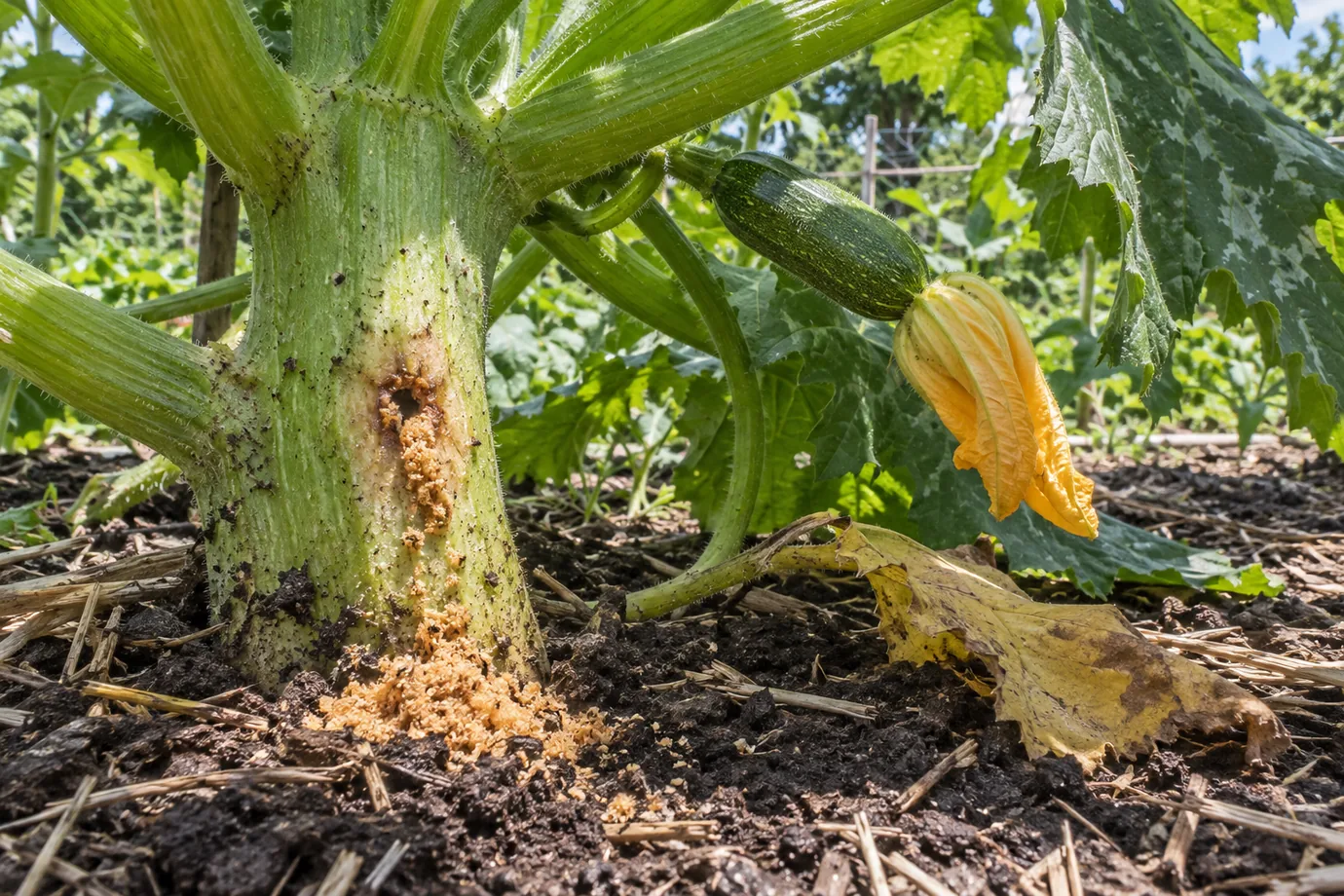
A zucchini plant can look perfect in the morning and lie flat by afternoon. The leaves droop, and watering does not bring them back. If you look closely at the base of the stem, you may find a small hole and a pile of wet, yellowish sawdust. That is the work of the Squash Vine Borer, one of the most destructive pests of squash and pumpkins east of the Rocky Mountains.
The insect is hard to fight once it is inside the stem. Still, gardeners who understand its timing can keep it out, and they can often save a plant that is already under attack. In this guide, you will learn how to recognise the moth and its damage, when to protect your plants and what to do when a vine starts to wilt. The advice comes from University of Maryland Extension and Illinois Extension, with tips from Clemson’s Home and Garden Information Center.
What Is the Squash Vine Borer?
The squash vine borer is the larva of a moth. Unlike most moths, the adult flies during the day, and it looks more like a wasp than a moth. Illinois Extension describes it as about 5/8 inch long, with orange and black legs and hind legs heavily fringed with orange and black hairs. Maryland describes a fat, black, clear-winged moth with an orange and black abdomen.
The moth itself does no harm. Instead, the trouble starts with its eggs. Females lay tiny, flat, brown eggs, one at a time, mostly on the lower stem. Maryland notes that egg laying begins about three days after the moths emerge. Clemson HGIC adds that the eggs can hatch in about a week.
The larva is a white to cream caterpillar with a dark head. Soon after hatching, it bores straight into the stem and feeds inside it. According to Maryland, it grows to about 1 inch long and feeds for four to six weeks. Illinois adds that most of the feeding happens within the first four feet of the vine, near the base.
The Squash Vine Borer Life Cycle
Timing is everything with this pest, so it helps to know its calendar.
The squash vine borer spends the winter underground, as a pupa inside a cocoon about 2 inches below the soil surface. In early summer, the moths emerge. In Maryland, they fly from mid-May to mid-June; in Illinois, the adults appear in late June and early July. So the dates depend on your region, and the further south you are, the earlier they come.
After feeding, the full-grown larvae leave the stem and dig into the soil to pupate. In the north, there is one generation a year. Farther south, there can be a second, which means a second wave of attacks in late summer. Maryland reports one to two generations a year.
This cycle explains why the pest keeps coming back to the same garden. The cocoons sit in the soil where last year’s squash grew, and the moths emerge right next to this year’s crop.
Which Crops Does It Attack?
The squash vine borer feeds on cucurbits with thick, hollow stems. Maryland lists summer squash, winter squash and pumpkin as highly susceptible. Zucchini is a favourite, which is why so many gardeners meet this pest for the first time in their zucchini row. If you grow them, Growing Zucchini: Spacing, Pollination, and Picking Before They Turn Into Clubs covers the rest of the crop’s care.
On the other hand, some crops are much less appealing to the insect. Maryland names butternut, tromboncino and cushaw as resistant, because their stems are solid and fibrous rather than hollow. Yellow crookneck is less susceptible. Cucumbers, melons and gourds are rarely affected.
So if the borer wipes out your squash every year, switching to butternut is the simplest fix. It stores well, too; Storing Winter Squash: Wonders of Curing and Long-Term Preservation explains how to cure it.
Signs of Squash Vine Borer Damage
The first symptom is wilting. A single runner, or the whole plant, suddenly droops, often in the heat of the day. At first, it may recover overnight. Later, however, it stops recovering.
Next, check the base of the stem. You are looking for these signs:
- An entry hole. A small hole in the stem, usually near the soil line.
- Frass. Maryland describes greenish-white, sawdust-like material pushed out of the hole. Clemson calls it yellowish. It is a mix of chewed stem and droppings.
- A soft stem. The stem feels mushy around the hole.
- Rot beyond the hole. Illinois notes that the plant rots and dies beyond the point of attack.
Don’t confuse this with drought stress or bacterial wilt. A thirsty plant perks up after watering, and bacterial wilt leaves no hole and no frass. In other words, the frass is the real giveaway.
How to Prevent Squash Vine Borer Attacks
Prevention is far easier than cure. Once a larva is inside the stem, sprays cannot reach it. So the goal is to stop the moth from laying eggs, or to catch the eggs before they hatch.
Cover the Plants
First of all, a floating row cover is a physical barrier the moth cannot get through. Maryland recommends keeping it on until the plants flower. At that point, you must remove it, or the bees cannot reach the flowers. For fabric weights and anchoring, see Floating Row Covers: Protecting Brassicas from Pests and Frost.
If you want to keep the cover on longer, you can pollinate the flowers yourself. Hand Pollinating Squash: Saving Your Harvest When Bees Are Scarce shows how to do it with a small brush or a male flower.
Rotate the Bed
Because the cocoons stay in the soil, growing squash in the same place every year puts the crop right on top of the next generation. Therefore, Illinois recommends moving squash to another spot in the garden. Tilling the old bed in fall or spring also helps, because it exposes the overwintering insects. Vegetable Crop Rotation: An Essential Guide for Soil Health Families explains how to plan the move.
Shift the Planting Date
Another option is to miss the egg-laying window. Maryland suggests planting seed in mid-June, after the main flight. Transplants are another choice. Either way, by the time the plants are big, the moths have mostly finished laying. A second sowing in summer also gives you a backup if the first planting fails; Succession Planting: A Guide to Continuous Harvests covers the method.
Clemson offers a different angle: plant early, and plant more than you need. If you lose a few plants, you still get a harvest.
Guard the Stem
Maryland lists some simple stem defences. Wrap aluminum foil around the lower stem, so the moth cannot lay eggs there. Alternatively, dust the lower stem with diatomaceous earth.
Look for Eggs
From the start of the flight season, check the lower stems every few days. Clemson recommends scouting regularly and destroying any eggs as soon as you spot them. They are tiny and brown, so a quick look with good light pays off. Illinois advises weekly checks in early summer.
Sprays and Biological Controls
If you choose to spray, timing is critical. Illinois stresses that the insecticide must go on before the larvae enter the stem. Maryland suggests spraying pyrethrins on the lower stems in mid to late May, and repeating after 14 days. Adjust these dates to your area, and always follow the label.
For a gentler approach, Maryland also mentions Bt (Bacillus thuringiensis), a bacterium that kills caterpillars, and beneficial nematodes. Both can be injected into the stem through the entry hole. The nematodes hunt the larva inside the tunnel. For more on these tiny hunters, read Beneficial Nematodes: Natural Pest Control for Soil Grubs.
Beyond that, wider habits matter too. A garden built around prevention, with healthy soil and natural predators, has fewer outbreaks overall. Organic Pest Management: Eco-Friendly Solutions for the Vegetable Garden sets out that approach.
How to Save a Plant with a Squash Vine Borer
When you find a hole and frass, act fast. You can often save the plant with a little surgery.
- Find the tunnel. Look for the entry hole and the soft section of stem above it.
- Slit the stem. With a clean, sharp knife, make a vertical cut along the length of the stem, upward from the hole. Clemson and Maryland both describe this lengthwise slice, which does less harm than a cut across the stem.
- Remove the larva. Pull out the caterpillar and kill it. There may be more than one, so check the whole tunnel.
- Bury the wound. Mound moist soil over the cut section of the stem.
- Water well. Keep the plant thoroughly watered while it heals.
The buried stem often grows new roots, which help the plant recover. For this reason, many gardeners also bury a few leaf nodes further along the vine as insurance. If a larva gets into the main stem, these extra roots keep the plant alive.
Squash Vine Borer Cleanup
At the end of the season, don’t leave infested vines on the bed. Maryland recommends sealing them in plastic bags before the larvae leave to pupate, and Illinois advises removing and destroying them to break the life cycle. Do not add them to the compost pile, where the larvae can finish their development and emerge the next summer.
After that, till or loosen the soil where the squash grew, to expose any cocoons. Next spring, plant the squash somewhere else.
Keep Growing Squash
The squash vine borer is a serious pest, but it is not unbeatable. Know when the moths fly in your region, cover the young plants, and watch the stems. Plant a resistant butternut beside your zucchini, and keep a knife ready for surgery. With those habits, the pumpkin patch can survive the summer; How to Start a Pumpkin Patch: The Ultimate Guide to Growing Pumpkins takes you from seed to harvest.
Check out the author’s book here: The Year-Round Vegetable Garden for Beginners.


Leave a Reply