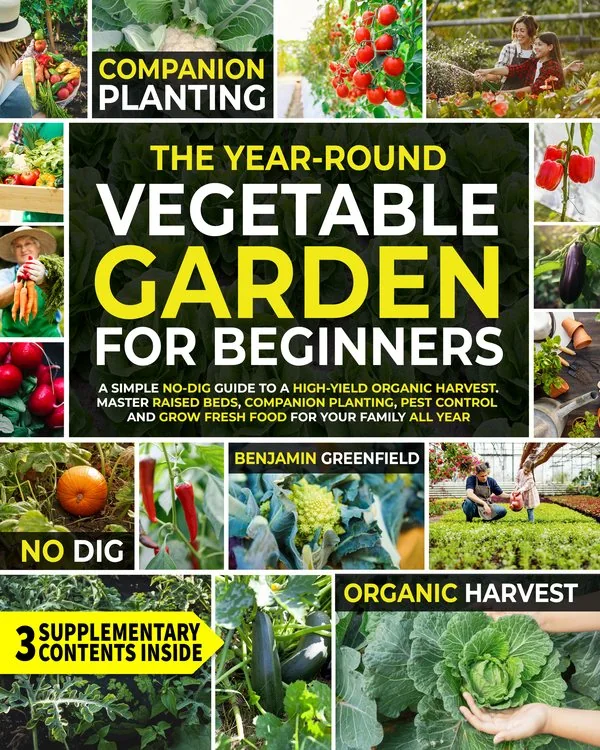

You want to grow your own food. You just don’t know where to start.
The Year-Round Vegetable Garden for Beginners takes you from an empty patch of ground to a harvest in every season.
The Year-Round Vegetable Garden for Beginners is the plain, step-by-step guide for people who have never grown a vegetable. It follows the order in which a first garden actually happens. First you find the right spot and build the soil the no-dig way. Then you sow, plant, water and feed. Finally you harvest, preserve, and keep hardy greens going under cover when the cold comes.
Maybe you have already tried. You bought seedlings in May and they sulked. The lettuce bolted, the tomatoes cracked, something ate the cabbages overnight, and the advice online contradicted itself at every step. Or you never started, because you have a balcony and not a farm. Besides, it all looked like too much to learn. Every season you wait means more pale supermarket tomatoes, and a season you can get back only by starting.
Benjamin Greenfield grew up on his family’s small farm in Oregon. Later he worked alongside farmers in Asia, South America and Europe. Today he opens that same farm to neighbors who want to learn. In fact, the questions they ask him over the fence are the questions this book answers.
What the Year-Round Vegetable Garden for Beginners will help you do
- Start in the right place. Map your sun and find your hardiness zone and frost dates. Then choose between in-ground rows, raised beds, containers and vertical supports for the space you really have.
- Build soil that feeds itself. Test your soil with a jar and make compost without fuss. After that, build a lasagna bed straight on top of the grass: no digging, no tilling.
- Plant at the right time, wherever you live. Every date is counted from your own frost dates, not from the calendar. As a result, every instruction in this book fits your garden, in Texas or in Minnesota.
- Get more from a small space. Companion planting, succession sowing, intercropping and square-foot beds keep the same ground producing from spring to fall.
- Keep pests away without chemicals. Know your friends from your foes and bring in pollinators and ladybugs. Then use organic treatments only when you need them, and with care.
- Eat from the garden longer. Harvest at the right moment, then store and preserve the surplus. Finally, stretch the season with row covers, cold frames and low tunnels.
Inside the book
- Five parts, fifteen chapters. From laying the groundwork to seed to harvest, the vegetables, managing the garden, and your next steps.
- Your first year on one page. A season-by-season map of what to do and which chapter explains how.
- Sixteen vegetable cards. Basil, beans, carrots, cucumbers, garlic, kale, lettuce, onions, peas, peppers, potatoes, radishes, spinach, Swiss chard, tomatoes and zucchini. Each card tells you when to sow, how far apart, when to pick, and what to watch for.
- Tables you will actually use. A planting calendar counted from your frost dates, seed types at a glance, watering tools compared, and organic fertilizers. There are also tables for pests and diseases and for preservation methods. Finally, a troubleshooting table covers the problems beginners meet most often.
- Four kinds of boxes. Benjamin’s Tips from his own beds, Safety First notes and Key Takeaways. Also, a Try This Weekend task closes each chapter, small enough to finish in a few hours.
- The reference pages. A month-by-month calendar, seasonal checklists, a glossary, an index and a grid for sketching your own garden plan. Finally, three bonus extras you unlock with a QR code.
It is illustrated throughout, because some steps are easier to see than to read. For example, new drawings show the jar test, a three-bay compost bin and a lasagna bed in cross-section. Similarly, they show hardening off, transplanting, a square-foot bed, a rain barrel and a cold frame.
How it works
Read it through the winter before you start. Then keep it by the back door and open it at the chapter you need. The most important step comes first: write down your frost dates once. After that, “sow six weeks before your last spring frost” means the right week for your garden. That may be late January or late April.
However, you do not need to do everything in the first year. Start with one bed or three pots. The book is also honest about what a garden can and cannot do. In winter it is light, not cold, that stops most crops. Therefore the year-round part means hardy greens like spinach, kale and mâche picked from under cover, not tomatoes at Christmas.
Is the Year-Round Vegetable Garden for Beginners right for you?
- You have never grown a vegetable. It starts from zero and explains every term, with a glossary at the back.
- You only have a balcony or a patio. Containers, minimum pot sizes and vertical growing are all covered. In fact, a sunny balcony can hold herbs, lettuce, peppers and a compact tomato.
- You are on a budget. A beginner’s kit of eight tools, a list of tools that can wait, and everyday items to repurpose. In addition, homemade fertilizers and DIY raised beds, trellises and cold frames.
- You want to garden organically. Compost, mulch and natural pest control. Moreover, Safety First notes flag anything that could hurt you, your children or your pets.
What readers say
On Amazon the book has 4.4 stars from more than 160 ratings. Three verified purchasers in the United States, all five stars:
Very very very awesome beginners gardening book! If your just starting out this is the book for you! […] The way they break down everything is so easy to follow. Helped me alot. Great read!
shericka burroughs, Amazon
Very well written, easy to read and follow. Definitely a great book for if you are not familiar with gardening.
Julie Wade, Amazon
For begginners but great information for all gardeners.
GarageTinker, Amazon
In short, 130 pages take you from an empty patch of ground to your first harvests. Then they carry you through fall and winter. A no-dig method, sixteen crop cards, and timing that fits your own garden.
Keep reading
The book gives you the method. Meanwhile, the blog follows it on the farm, one vegetable and one season at a time. Good places to begin: No-Dig Gardening Method, Vegetable Garden Layout Ideas for Beginners, Common Gardening Mistakes, and Cold Frame Gardening.