
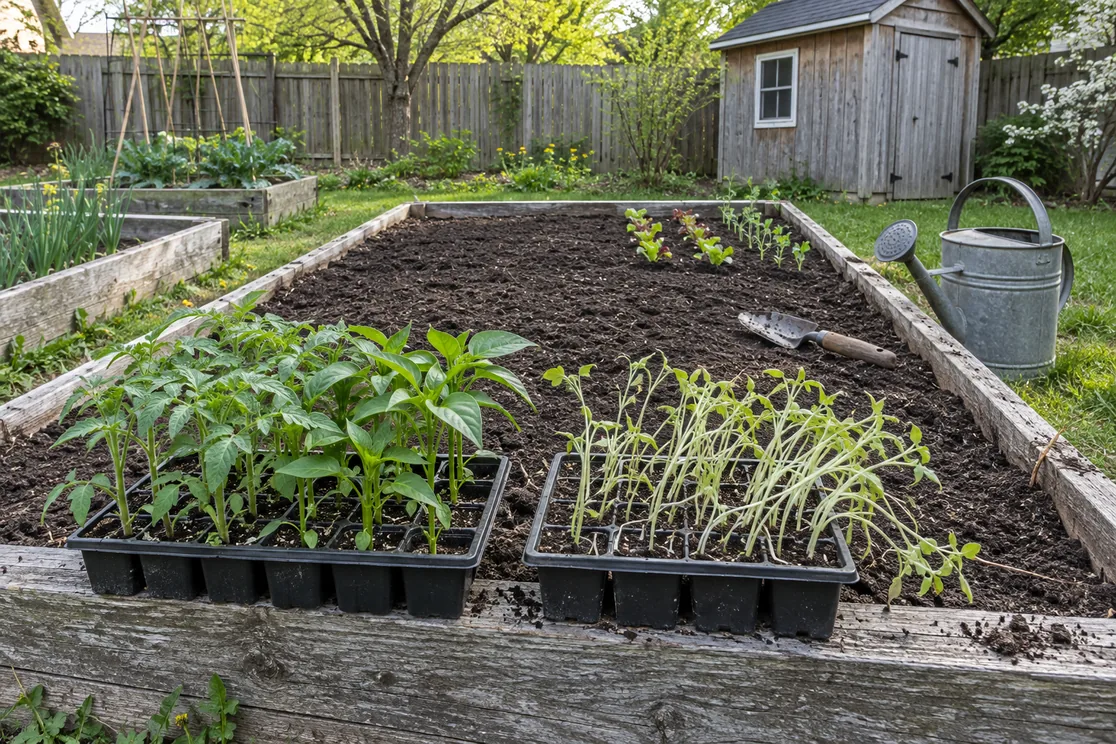
Every new gardener learns the big lessons quickly: find a sunny spot, feed the soil and pull the weeds before they seed. Yet many first gardens still struggle for reasons that are much harder to spot. The seedlings flop, the beans never come up, and half the lettuce bolts in the same week. These are the quieter common gardening mistakes, the ones that happen at the edges of the season and often go unnoticed until the harvest is smaller than it should be. This guide covers ten of them, with advice from university extension services on how to avoid each one.
Why These Common Gardening Mistakes Are Easy to Miss
Most beginner guides focus on the obvious problems, such as shade, poor soil and weeds. We cover the site itself in Starting a Vegetable Garden: A Checklist for Newbies, and it is a good place to start. The mistakes in this article are different, because they are mostly about timing and habits rather than the site itself.
That is also why they are easy to repeat. A seedling that was started too early still looks alive, so you may not connect its poor harvest to a date on the calendar in March. Similarly, a bed that was dug while wet may take years to show the damage clearly. Once you know what to look for, however, each of these errors is simple to prevent.
Common Gardening Mistakes With Seeds and Seedlings
The first group of errors happens before a single plant goes into the garden. Seedlings are small and fragile, so a few days in the wrong conditions can set them back for weeks.
Mistake 1: Starting Seeds Indoors Too Early
Enthusiasm is the enemy here. On the first warm day of late winter, it is tempting to fill every tray with tomato seeds. However, the University of Maryland Extension names sowing too early as a common mistake, because it produces tall, root-bound plants that do not perform well in the garden.
UMD gives clear timings for how long crops should grow indoors before they go out. Tomatoes need about 5 to 6 weeks, while peppers, eggplant and onions need 8 to 10 weeks. Cabbage and broccoli need 4 to 6 weeks, and cucumbers, squash and melons only 3 to 5 weeks. So count back from your planting date, not forward from the first sunny afternoon. Our seed starting calendar makes that easier, and our guide to leggy seedlings explains how to rescue plants that have already stretched.
Mistake 2: Skipping the Hardening-Off Step
Seedlings raised indoors have never felt wind, strong sun or a cold night. If you move them straight into the garden, the leaves can scorch and the plants may stall for weeks. Instead, UMD advises that you begin hardening transplants one to two weeks before you set them out.
Start with an hour or two in a sheltered, shady spot, and then add a little more sun and time each day. UMD also warns against putting tender seedlings outdoors on windy days or when temperatures fall below 45°F. Once the nights stay above 50°F, many plants can remain outside overnight. The effort pays off, because properly hardened tomatoes can usually tolerate a light, unexpected frost. Our guide to hardening off plants gives a day-by-day schedule.
Mistake 3: Sowing Seeds Too Deep
A seed carries only a small store of energy. If it is buried too deep, it may run out of fuel before the shoot reaches the light. According to UMD, a suitable planting depth is usually about twice the seed’s diameter, so a seed an eighth of an inch wide goes about a quarter inch deep.
Tiny seeds such as lettuce, carrots and many herbs need barely any cover at all. Large seeds such as beans, peas and squash can go deeper. When in doubt, check the packet, since our guide to reading seed packets shows where to find the depth and spacing for each crop.
Common Gardening Mistakes at Planting Time
The next group of errors happens when the plants and seeds finally go outside. At this stage, the calendar and the weather matter more than effort.
Mistake 4: Planting Into Cold Soil
A warm spring afternoon does not mean the soil is warm too. Seeds respond to soil temperature, not air temperature, and cold soil slows or stops germination. Oregon State University Extension lists minimum soil temperatures of 60°F for beans, squash and cucumbers, and 50°F for corn and tomatoes. Peas and carrots can start at 40°F, while lettuce germinates from about 35°F.
Even hardy crops sprout slowly in cold ground. In the OSU data, carrots take about 17 days to emerge at 50°F, but only about 6 days at the ideal range of 77 to 80°F. Meanwhile, seeds that sit in cold, wet soil are more likely to rot. A simple soil thermometer solves the problem, as our guide to soil temperature for planting explains.
Mistake 5: Planting Everything on the Same Day
Planting the whole garden in one busy weekend is one of the most common gardening mistakes. The result is a flood of lettuce and radishes that all mature together, followed by weeks with nothing to pick. In addition, a single late frost or a heat wave can hit every plant at the same stage.
Instead, sow short rows of quick crops every two or three weeks. That way, a new batch is always coming along as the last one finishes. Our guide to succession planting shows how to plan these sowings, and our planting schedule helps you fit them into your season.
Mistake 6: Choosing the Wrong Varieties
A variety that thrives in a long southern summer may never ripen in a short northern one. Before you buy seeds, check the days to maturity and compare them with the frost-free days in your area. Utah State University Extension advises comparing maturity times, cold and heat tolerance and pest resistance when you choose.
USU also recommends trying a new variety on a small scale for a year or two before you rely on it. For a home garden, that simply means planting a few new varieties next to your proven favorites each year. Our guide to heirloom vs hybrid seeds explains what each type offers.
Care and Planning Mistakes
The last group of errors builds up slowly over the season and from one year to the next. None of them causes a disaster overnight, yet together they weaken the whole garden.
Mistake 7: Watering the Leaves in the Evening
When you water matters as much as how much. Illinois Extension explains that foliar fungal diseases need leaves to stay wet for several hours to infect the plant. If you water overhead in the evening, the leaves stay damp all night, which is exactly what the fungi need.
So water early in the day, and aim at the soil rather than the leaves whenever you can. Illinois Extension suggests about 1 to 1.5 inches of water every 7 to 10 days, including rain. Soaker hoses and drip lines put the water where the roots are, as our guide to efficient watering techniques describes.
Mistake 8: Working Soil While It Is Wet
After a wet spring, it is hard to wait. Nevertheless, digging or tilling soggy ground is one of the most damaging common gardening mistakes. Purdue University warns that working wet soil packs the particles tightly, leaving less room for air and water. The clumps then dry into hard lumps that are difficult to break up.
Worse still, Purdue notes that compacted soil can take many years to rebuild, with yearly additions of organic matter. Before you dig, squeeze a handful of soil. If it crumbles through your fingers, it is ready; if it forms a muddy ball, wait a few more days. Beds that you never walk on, such as those in our guide to the no-dig gardening method, avoid much of this problem.
Mistake 9: Growing the Same Crop in the Same Spot
Tomatoes go where the tomatoes grew last year, simply because that is where the stakes are. Unfortunately, pests and diseases remember too. Penn State Extension explains that many pests and diseases target a specific plant family, such as squash bugs on cucumbers, melons and squash. Once they find their favorite food in one spot, they tend to stay.
Moving each family to a new bed gives the soil a year or two of relief. It also balances nutrients, since each crop takes up its own mix from the soil. Our guide to vegetable crop rotation groups the main families and shows a simple four-bed plan.
Mistake 10: Forgetting to Keep Records
By next spring, few gardeners remember which tomato tasted best or where the beans grew. Without notes, you cannot rotate crops properly, and you may repeat the same errors year after year. Penn State recommends keeping a garden journal with bed diagrams, soil test results and the date and location of each planting.
A journal does not need to be elaborate. A notebook, a phone note or a simple spreadsheet works, as long as you write in it regularly. Record sowing dates, first harvests, pests and the varieties you liked. Our garden journal template gives you a ready-made page to start with.
How to Avoid Common Gardening Mistakes Next Season
Most common gardening mistakes share one cause: acting on impulse rather than a plan. Therefore, a little preparation in late winter prevents almost all of them. First, find your last frost date and count back to set your seed starting dates. Next, buy a soil thermometer and check it before each outdoor sowing. Then sketch a planting plan that includes succession sowings and rotates each crop family to a new bed.
Keep your journal close at hand throughout the season. At the end of the year, read it through and note what worked. Finally, choose one or two changes to try next season rather than trying to fix everything at once.
Frequently Asked Questions
What are the most common gardening mistakes for beginners?
Beyond poor sites and weeds, beginners often start seeds too early, skip hardening off, plant into cold soil and sow everything at once. Most of these are timing problems, so a simple calendar prevents them.
Can you fix common gardening mistakes in the middle of the season?
Many of them, yes. You can still start succession sowings, switch to morning watering and begin a journal. Rotation and variety choices, by contrast, wait until next year.
How do I know if my soil is too wet to work?
Squeeze a handful of soil from a few inches down. If it crumbles apart, it is ready, but if it holds together as a sticky ball, wait a few more dry days.
Learning From Common Gardening Mistakes
Every gardener makes mistakes, and the best ones learn from them quickly. Start seeds on time, harden them off gently and wait for warm soil before planting tender crops. Sow a little at a time, choose varieties that suit your season, and water the soil in the morning. Keep off wet ground, move each crop family every year and write everything down. With these habits in place, common gardening mistakes become rare, and each season builds on the last. If you want to plan your first beds with the same care, see our guide to vegetable garden layout ideas.
Check out the author’s book here: The Year-Round Vegetable Garden for Beginners.

Leave a Reply