
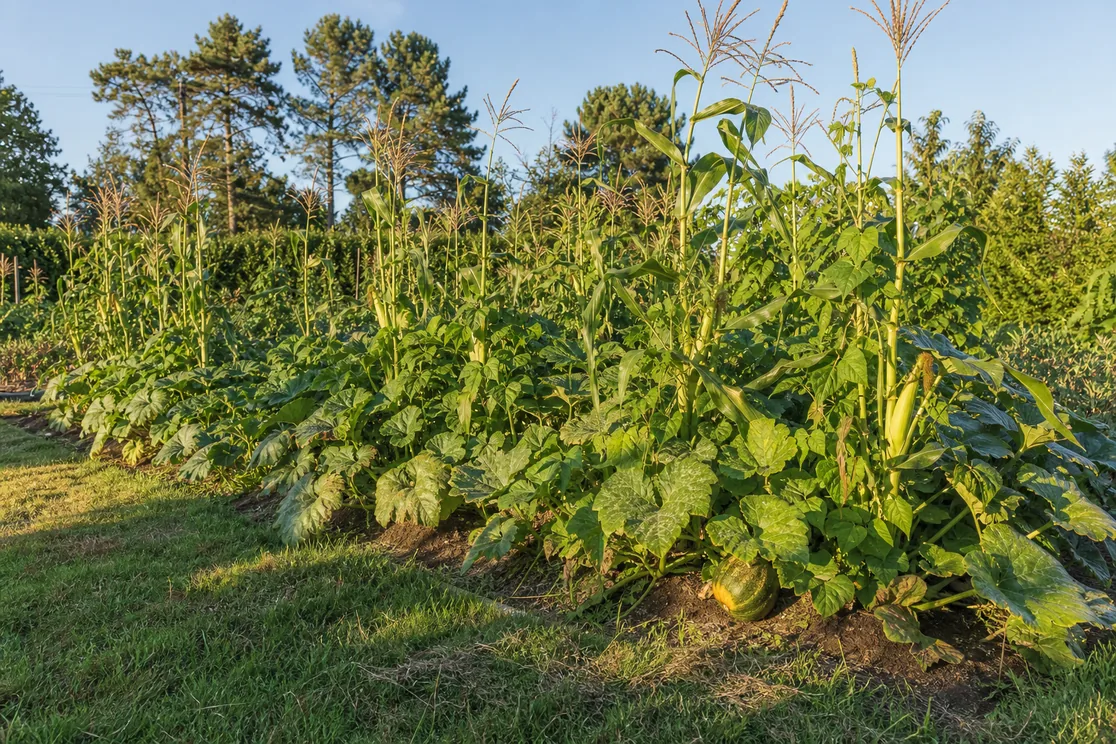
A Three Sisters Garden puts corn, beans and squash on the same low mound, where each plant does a job for the other two. The corn is the pole, the beans climb it, and the squash covers the ground below. It is one of the oldest planting systems on this continent, and it still works in a backyard today.
October is the right moment to plan a Three Sisters Garden for next year. The mounds are easiest to build in fall, when the beds are clearing and there is spare compost and leaves around. By spring the soil has settled, and the only thing left is timing the three sowings.
Three Sisters Garden at a Glance
| The crops | Corn, pole beans, winter squash or pumpkin |
| Season | Late spring to first frost, 90 to 120 days |
| Zones | USDA 3 to 10, with timing adjusted to your frost dates |
| Mound size | About 12 inches high, 3 to 4 feet wide, flat on top |
| Mound spacing | Roughly 4 feet apart, in a block, never a single line |
| Sowing order | Corn first, beans when it is 4 to 6 inches tall, squash a week later |
| Soil temperature | At least 60 °F for corn, warmer for beans and squash |
| Best for | Dry beans, flint or flour corn, storage squash |
Where the Three Sisters Come From
The system belongs to many Indigenous nations of North America, and the name is best known from the Haudenosaunee, the Iroquois Confederacy. The National Agricultural Library describes how women farmers placed several corn kernels in a hole. They mounded soil around the seedlings until each hill stood about a foot high and two feet wide.
Two or three weeks later they returned to plant beans in the same hills. Squash or pumpkins went into the spaces between the hills, where their vines could run. The three crops were grown, stored and eaten together, and they held a central place in ceremony as well as diet.
That history is worth knowing before you copy the method. It was designed for dry corn and dry beans that fed a family through winter. It was never meant for a tidy row of sweet corn, and most of the disappointments people report come from ignoring that difference.
What Each Sister Actually Does
Corn (Zea mays) is the frame. It grows fast and straight and gives the beans something to climb without a single stake. It is also a hungry crop that needs rich soil and steady water.
Beans (Phaseolus vulgaris) are the climbers. Like every legume, they host bacteria on their roots that fix nitrogen from the air. Be realistic about that gift, though, because it rarely reaches the corn in time. Most of the nitrogen stays in the bean plant and the seeds, so the corn beside it gets little in the same season. The real payoff arrives the following year, when the bean roots and stems break down in the mound. The post on green manure cover crops explains how much a legume actually leaves behind.
Squash (Cucurbita species) is the living mulch. Its broad leaves shade the soil, hold moisture and smother weeds between the mounds. The prickly stems also discourage raccoons, which dislike walking through them to reach ripe corn.
The arrangement is a textbook case of vegetable intercropping: three plants with different heights, root depths and timing sharing one patch of ground.
Choosing Varieties for a Three Sisters Garden
Variety choice decides whether a Three Sisters Garden works or collapses by August. The traditional pairing is flint or flour corn with a dry pole bean, both left on the plant to mature fully. Those corn types have thick stalks that stand up to a vine pulling on them for three months.
Sweet corn can work too, as long as you choose it with care. Pick a tall, sturdy variety of at least 6 feet, and choose a moderate pole bean rather than the most vigorous one on the rack. A heavy bean can drag a thin sweet corn stalk to the ground by August. Remember too that sweet corn is picked in midsummer, while dry beans want to hang until fall. The guide to growing sweet corn covers the varieties and the harvest window.
For the beans, choose a pole type, since bush beans have nothing to gain from the corn. For the squash, a vining winter squash or pumpkin suits best. Butternut and other Cucurbita moschata squash have solid stems that resist the squash vine borer, which matters in any garden east of the Rockies.
Pro Tip: If you want to save seed from this garden, grow one variety of corn only. Corn is wind pollinated and crosses with any other corn within a few hundred feet. The post on vegetable cross pollination explains the isolation distances for corn and the other crops you might save.
Planning the Plot in Fall
A Three Sisters Garden needs space. The corn is wind pollinated, and a single line of stalks drops most of its pollen on empty ground. Plan a block of at least four mounds by four, which fills roughly a 16 by 16 foot area. Smaller than three by three and you will harvest cobs with missing kernels.
Pick your sunniest ground, with at least 6 hours of direct sun and ideally 8. The corn will shade the north side of the patch by midsummer, so put the block where that shadow falls on a path rather than another bed.
Fall is the best time to build the mounds, while leaves and finished compost are easy to find. Mark the centers about 4 feet apart and pile each one with compost, shredded leaves and topsoil. Aim for about 12 inches high and 3 to 4 feet across, with a flat top about 10 inches wide, following the Old Farmer’s Almanac method. Cover the whole area with organic garden mulch for the winter so rain does not flatten the mounds.
Planting Order: Corn, Then Beans, Then Squash
Timing is the whole trick in a Three Sisters Garden. The three crops go in on different days, and the order never changes.
- Corn first, after your last frost date, once the soil reaches 60 °F at planting depth. Sow four to six kernels in a circle on the flat top of each mound, about 6 inches apart and 1 inch deep. The post on soil temperature for planting shows how to check.
- Beans second, when the corn stands 4 to 6 inches tall, usually two to three weeks later. Sow four beans per mound, each 3 to 4 inches out from a corn plant.
- Squash last, about a week after the beans. Plant two or three seeds on the outer edge of the mound or on a small mound of its own between the corn hills, then thin to the strongest plant.
Planting the beans early is the most common mistake. A bean that starts beside a corn seedling will overtake it and pull it over. The corn needs a head start of at least two weeks to stay ahead.
A Three Sisters Garden in a Small Space
You can try the method in a raised bed, but scale it with care. A 4 by 8 foot bed holds two mounds at most, and that is too few corn plants for good pollination.
The fix is to plant the corn in a tight grid of 12 inches each way instead of on mounds. Sow the beans at the base of every second stalk. Train one squash vine off the end of the bed and onto the path. You may need to hand pollinate the corn by shaking the tassels over the silks in the morning.
A small bed also runs dry faster. Check the soil a few inches down every other day in July.
Feeding and Watering Through Summer
Corn is the greedy sister, and it shows in pale leaves by midsummer. Give the mounds a side dressing of compost or a balanced organic fertilizer when the corn is knee high. Give them another when the tassels appear, following the rate on the product label.
Water deeply at the base of the mounds, about 1 inch a week from rain and hose combined. The critical stretch is tasseling and silking. Drought then leaves gaps in the cobs that no later watering repairs.
Once the squash leaves close over the ground, weeding stops almost completely. Until then, pull weeds by hand, because a hoe near the corn roots does more harm than good.
Pests and Problems in the Mix
Mixed planting confuses some insects, but it does not stop them all. Look for these:
- Squash vine borer and squash bugs on the squash, which a moschata variety and row covers until flowering help control.
- Corn earworm in the tips of the cobs, which you can cut away at harvest.
- Mexican bean beetle on the bean leaves, which you hand pick into soapy water.
- Raccoons a few nights before the corn ripens, which the squash deters but never fully stops.
If your squash sets flowers but no fruit, pollinators may be scarce in the dense canopy. The guide to hand pollinating squash solves that in five minutes a morning.
Warning: Dry beans must be cooked thoroughly before eating. Raw or undercooked dry beans contain lectins that cause stomach upset, in people and in dogs, so keep the harvested pods away from pets.
Harvesting a Three Sisters Garden
The harvest comes in the order the crops mature, and a traditional garden comes in almost all at once in fall.
Dry beans are ready when the pods rattle and the seeds inside are too hard to dent with a fingernail. Flint and flour corn are ready when the husks are brown and the kernels have dented or hardened. Pull the ears and hang them somewhere airy to finish drying.
Winter squash and pumpkins are ready when the rind resists a thumbnail and the stem turns corky. Cut them with a few inches of stem, cure them in a warm spot and store them cool. The post on storing winter squash covers curing times.
What Goes Wrong in a Three Sisters Garden
| Problem | Cause | Fix next year |
|---|---|---|
| Corn pulled over by beans | Beans sown too early, or a vigorous bean on thin corn | Wait until corn is 4 to 6 inches tall, choose sturdier corn |
| Cobs with missing kernels | Too few mounds, or a single row | Plant a block of at least 3 by 3 mounds |
| Squash smothering young corn | Squash sown with the corn | Sow squash a week after the beans, at the mound edge |
| Weak, pale corn | Poor soil, or relying on beans for nitrogen | Build mounds with compost, side dress twice |
| Beans still green at frost | Late sowing or a long-season variety | Pick a bean that matures in 90 days or less |
| Squash vines collapsing | Squash vine borer | Grow moschata squash, cover until flowering |
Three Sisters Garden Questions Answered
Can you plant a Three Sisters Garden with sweet corn?
Yes, but choose a tall, sturdy variety and a moderate pole bean. Harvest the cobs carefully in summer without breaking the stalks, since the beans still need them.
How far apart should Three Sisters mounds be?
About 4 feet from center to center, in a block rather than a row. The squash will fill the gaps between them by midsummer.
Do the beans really feed the corn?
Only a little in the same season. The nitrogen mostly benefits next year’s soil, once the bean plants break down. Feed the corn with compost as if the beans were not there.
Can you grow the Three Sisters in containers?
Not really. Corn needs a block of plants for pollination, and squash vines need yards of room. A large raised bed is the practical minimum for a Three Sisters Garden.
Plan It Now, Sow It in May
A Three Sisters Garden asks for more space and more patience than a row of anything. In return it gives you a patch that mulches itself, climbs without stakes and fills the pantry in one fall weekend. Build the mounds this month, let the winter settle them, and sow the corn when the soil hits 60 °F.
Check out the author’s book here: The Year-Round Vegetable Garden for Beginners.


Leave a Reply