
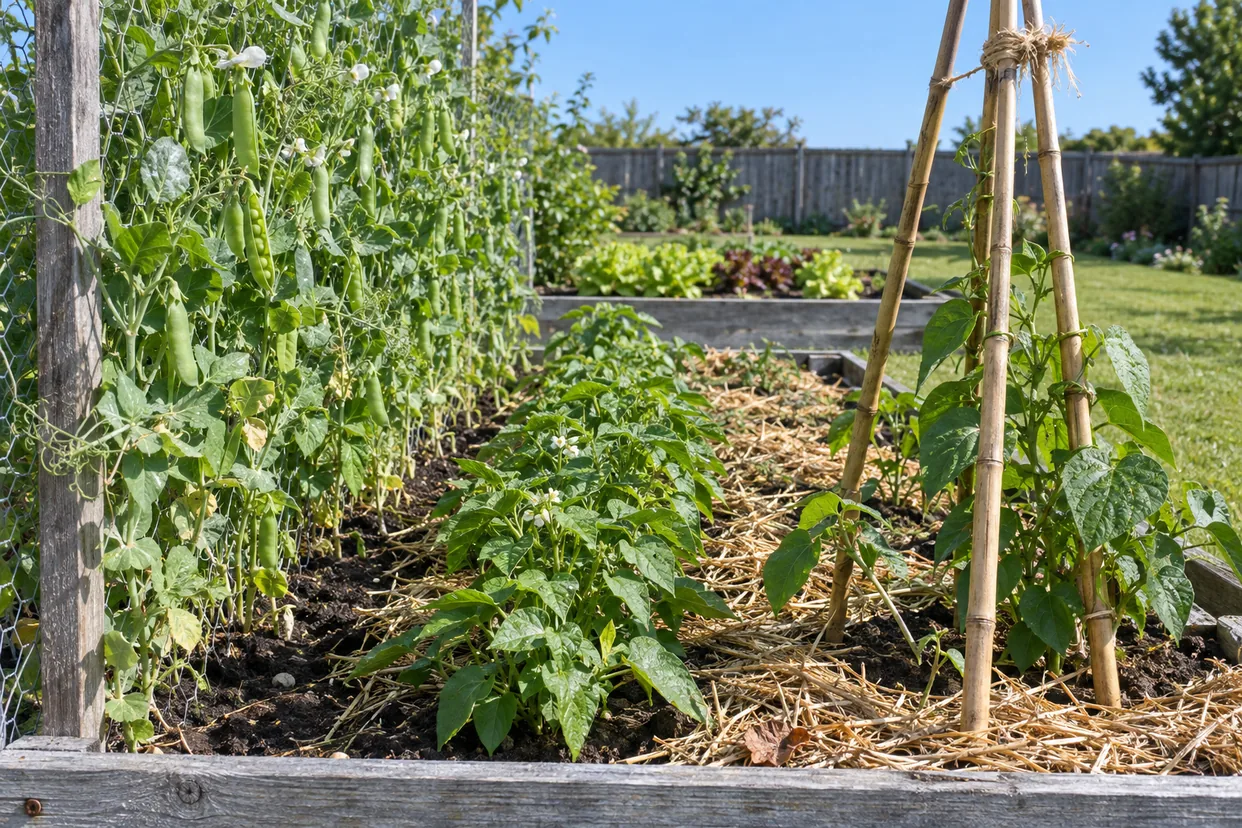
The first year I planted peas, I sowed them on the same day as the beans, in mid-May. The beans came up in a week and never looked back. Meanwhile the peas sulked, flowered in the heat, and gave me two handfuls of pods before they turned yellow. That lesson took one season to learn and has held for twenty. Growing beans and peas is easy, but they are not the same crop, and the calendar is where most people go wrong.
Both are legumes, both make their own nitrogen, and both are hugely productive in a small bed. However, peas want cold soil and a short spring, and beans want warm soil and a long summer. Treat them as two separate sowings, three months apart, and the same bed will feed you from June to October.
Growing Beans and Peas at a Glance
| Peas | Beans | |
|---|---|---|
| When to sow | 4 to 6 weeks before the last frost, soil above 40°F | 1 to 2 weeks after the last frost, soil above 60°F |
| Spacing | 1 to 2 inches apart, rows 18 inches | 2 to 4 inches apart, rows 18 to 30 inches |
| Depth | 1 inch | 1 inch, 1½ inches in light soil |
| Days to harvest | 55 to 70 | 50 to 60 (bush), 60 to 75 (pole) |
| Support | Almost always | Pole types only |
| Ends when | Days pass 80°F | First frost |
Why Growing Beans and Peas Rewards Beginners
Legumes carry their own fertilizer. Bacteria called rhizobia live in small nodules on the roots and turn nitrogen from the air into plant food. Because of that partnership, beans and peas grow well in soil that would leave a tomato or a cabbage hungry. Better still, they leave some of that nitrogen behind for the next crop. This is why they sit at the heart of any vegetable crop rotation: what follows them gets a free feed.
There is a second reason they suit beginners, and it is the seed itself. A pea or bean seed is large, easy to handle, and comes up in a week or two with no fuss. You sow it where it will grow, so there are no seed trays, no transplant shock, and no hardening off. In fact, the University of Minnesota’s bean guide is blunt about it. Beans should always be sown directly, because their roots resent being moved.
The third reason for growing beans and peas is the yield: a single 10-foot row of bush beans gives a family several pounds over three weeks. A row of pole beans gives more than that over two months. Few crops return as much food per square foot for as little work.
Peas First: The Cold-Soil Sowing
Peas are a spring crop, and the whole game is getting them in early. In most of the United States that means sowing four to six weeks before the last frost. As soon as the soil can be worked and is no longer sticky, the peas go in. The seed will germinate at 40°F, slowly, and much faster at 50 to 60°F. Peas sown in cold soil take up to three weeks to appear, so patience is part of the method.
The reason for the rush is heat, not frost, because pea plants shrug off a light freeze. Once daytime temperatures pass 80°F, though, they stop setting pods and the vines yellow. Consequently, every week you gain in March or April is a week of harvest in June. If you want to pin the date down, your first frost date marks the fall side of the calendar. The last frost marks the spring side, and growing beans and peas needs both.
Three kinds of pea share the same growing rules:
- Shelling peas (English or garden peas) are grown for the seeds inside; the pod is tough and discarded.
- Snap peas have a thick, sweet, edible pod and are picked when the peas inside are plump.
- Snow peas have a flat, edible pod and are picked before the peas inside swell.
Sow the seed an inch deep and one to two inches apart in a double row, with a trellis between the rows. Even dwarf varieties climb, and a plant lying on the soil gets more mildew and fewer pods. A length of chicken wire or netting on two stakes is all the support they need. Water at sowing, then leave them alone until they are up. A cold, wet seedbed rots more pea seed than any pest.
Beans Second: The Warm-Soil Sowing
Beans are the opposite in almost every respect, and this is where growing beans and peas splits into two jobs. They want the soil above 60°F, and they want it to stay there. So the right date is one to two weeks after the last frost, when the ground has warmed through. Sow too early and the seed rots in place. If you have a thermometer, soil temperature for planting is a better guide than any calendar date. Here, 60°F is the floor, and 70°F is where beans race.
Bush beans grow about two feet tall, need no support, and give one heavy flush of pods over two to three weeks. They are the choice for a quick crop and for succession sowing. Pole beans climb eight feet or more, need a trellis or teepee, and produce steadily for two months from a single sowing. They also take twice the space in the air and half the space on the ground.
Sow beans an inch deep, an inch and a half in sandy soil, and two to four inches apart. Space bush rows 18 inches apart and pole rows 30 inches. Do not soak bean seed before sowing: a bean that swells too fast cracks its seed coat and rots. Water the row once after sowing and then wait for the seedlings, which appear in seven to ten days.
Plant pole bean supports on the day you sow, not after. A bean seedling starts looking for something to climb within a week, and pushing stakes in later damages the roots. The simplest structure that works is a teepee of three or four eight-foot poles tied at the top. Sow five seeds at the base of each pole.
Growing Beans and Peas Through the Season
Once the plants are up, growing beans and peas comes down to the same few habits.
- Water at the right moment. Legumes need about an inch a week, and most of all while flowering and filling pods. A dry spell at flowering makes the blossoms drop and the pods stay empty. Water the soil, not the leaves, and water in the morning so the foliage is dry by evening.
- Mulch, then leave the roots alone. A two-inch layer of organic garden mulch keeps the soil moist and the weeds down. Legume roots are shallow, so pull weeds by hand rather than hoeing near the stems.
- Skip the nitrogen. This is the one that surprises people. A legume fed with high-nitrogen fertilizer stops making nodules and grows leaves instead of pods. Compost worked into the bed before sowing is all they need. A pH between 6.0 and 7.0 helps the nodules form, so a soil pH test is worth doing if your beans have never done well.
- Do not touch wet plants. Bean diseases such as rust and bacterial blight spread on wet leaves. Walking through a wet row carries them from plant to plant. Pick and weed in the afternoon.
The University of Minnesota’s pea guide adds one point that saves a lot of seed. Peas grown in the same spot two years running pick up root rot, so move them to fresh ground every season.
The Two Pests and the One Disease Worth Knowing
Aphids find both crops, and they find peas first. A cluster on the growing tips is normal in May; a coating on every shoot is not. A hard spray of water knocks most of them off. Then the ladybugs arrive within a week or two, if you leave them room. The full toolkit is in aphid control methods.
Mexican bean beetles are the bean pest. The adult looks like a coppery ladybug with sixteen spots, and the yellow, spiny larvae skeletonize the leaves from underneath. Check the undersides of the leaves twice a week from June on and crush the yellow egg clusters. Pull any plant that is more than half eaten. A floating row cover over bush beans until they flower keeps the beetles off entirely.
Powdery mildew is the disease. It arrives as a white dust on pea leaves in warm, humid weather and on beans in late summer. Usually it slows the plants more than it kills them. Good spacing, morning watering, and a trellis that keeps the foliage off the ground prevent most of it. When it does appear, powdery mildew treatment explains what works and what is a waste of a spray bottle.
Picking Beans and Peas So the Plants Keep Producing
Harvest is where growing beans and peas is won or lost. Both plants have one aim, which is to ripen seed. Once a few pods mature, the plant considers the job done and stops flowering. Therefore, pick early and pick often.
- Snap beans are ready when the pod is pencil-thick and snaps cleanly in half. Pick before the seeds inside show as bumps. Pick every two or three days, and hold the stem with one hand so you do not tear the plant.
- Shelling peas are ready when the pod is round and full but still bright green. A dull, wrinkled pod is past it and starchy.
- Snap peas are picked plump; snow peas are picked flat, at two to three inches, before the peas inside swell.
Peas are sweetest in the hour after picking. The sugars start turning to starch as soon as the pod leaves the vine. Pick them in the cool of the morning and get them into the kitchen or the refrigerator at once.
A row of bush beans is best sown twice or three times, two weeks apart, rather than all at once. One long row gives you fifteen pounds in a fortnight and then nothing. Three short sowings give you a bowl every week from July to September. That is the whole idea of succession planting, and beans are the easiest crop to practice it on.
When the plants finish, cut them at the soil line and leave the roots in the ground. The nodules break down over the winter and feed whatever you sow there next spring.
A Simple First-Year Plan for Growing Beans and Peas
If you are starting from nothing, this is enough for one four-by-eight bed and a first season of growing beans and peas.
- In early spring, as soon as the soil is workable, sow a double row of snap peas along the north edge. Put a four-foot trellis between the rows.
- Two weeks after the last frost, sow a row of bush beans down the middle of the bed. Put up a teepee of pole beans in the south corner.
- Sow a second row of bush beans three weeks after the first.
- Pull the peas when they yellow in early summer and sow a third row of bush beans in their place.
- Pick everything every two or three days, and stop fertilizing altogether.
That one bed gives peas in June, bush beans from July, and pole beans from late July to the first frost. It also leaves a bed full of nitrogen for next year’s brassicas.
Frequently Asked Questions
Can I grow beans and peas in the same bed?
Yes, as long as you sow them at different times. Peas go in six weeks before beans, and by the time the beans are climbing, the peas are finishing. They do not compete, and both leave nitrogen behind.
Why are my beans flowering but not setting pods?
Heat or drought at flowering. Above 90°F bean blossoms drop, and a dry spell does the same. Water deeply, mulch, and wait for cooler weather; the plants usually resume within two weeks.
Do I need to buy inoculant?
Not usually, because the rhizobia bacteria are present in most garden soil that has grown legumes before. Inoculant is cheap and worth using in a brand-new bed or in fill soil. However, it will not rescue a bed that is too cold, too wet, or too rich in nitrogen.
Can I sow peas in fall for a second crop?
Yes, in most climates. Sow eight to ten weeks before your first frost, using a fast variety, and expect a smaller harvest than spring. Peas hate the heat they germinate into, so a little shade and steady water in the first two weeks make the difference.
Check out the author’s book here: The Year-Round Vegetable Garden for Beginners.


Leave a Reply