
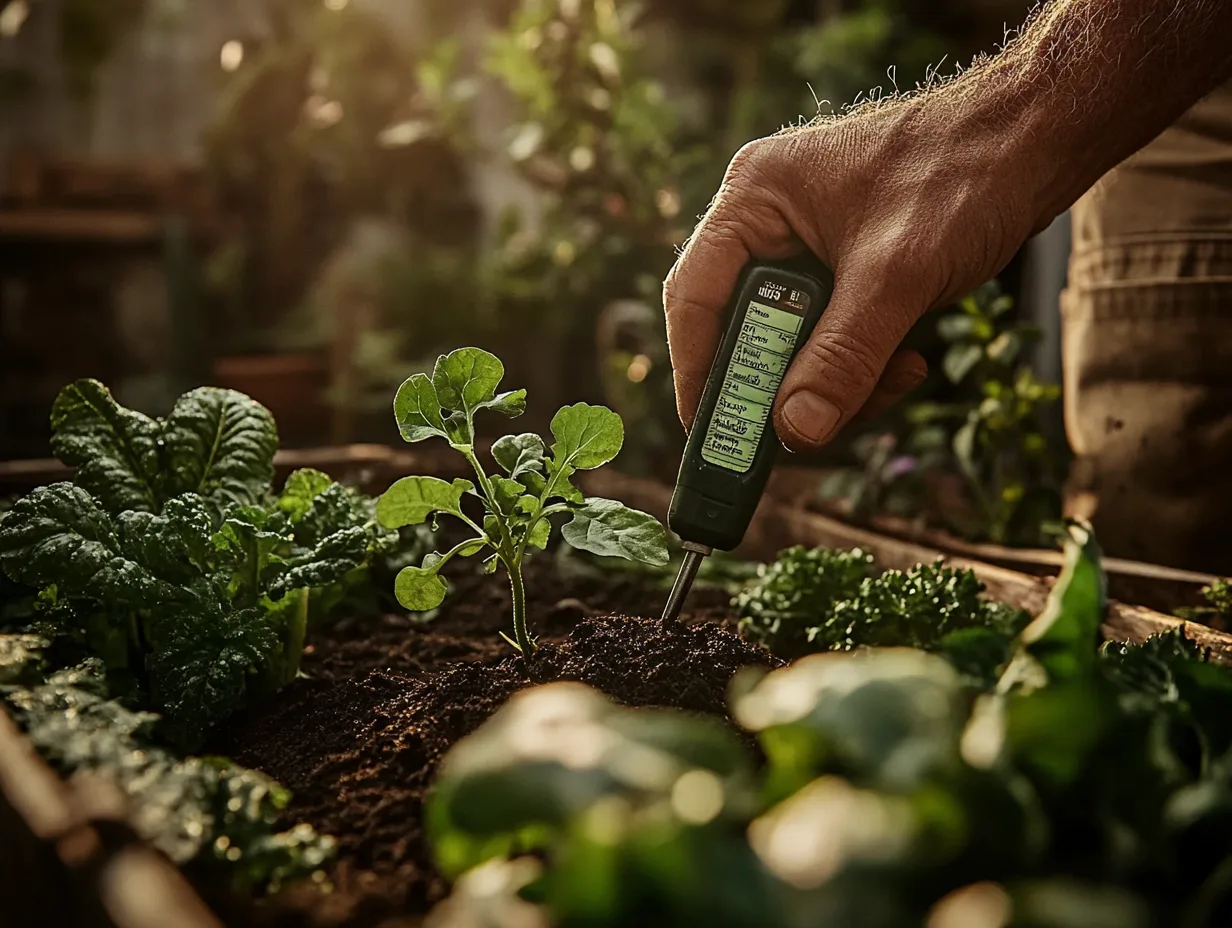
Two gardeners can test the same bed on the same morning and get different answers. That is not a fault in the meters, since Soil pH Testing gives a number that moves. It moves with the season, with the depth of the trowel and with the instrument in your hand. Extension trials have measured each of those shifts, and none of them is huge on its own. Stack three together, however, and a bed reading 6.4 in April can read 5.9 in July. That is the difference between doing nothing and spreading lime. This guide covers how to take the sample and how much confidence the number deserves.
Soil pH Testing at a Glance
| Question | Short answer |
|---|---|
| How many cores per sample? | 10 to 15, mixed into one composite |
| How deep? | The top 4 to 8 inches, below mulch and debris |
| Best time of year? | Fall or early spring, before amendments go down |
| How often? | Every 3 to 5 years, or when plants show trouble |
| Seasonal swing? | Spring readings run 0.3 to 0.5 units higher |
| Which tool? | A calibrated hand-held meter, or a lab |
| Which tool fails? | The push-in soil probe sold for houseplants |
Soil pH Testing Is Only as Good as the Sample
A single trowel of dirt tells you about that trowel of dirt and nothing more. Soil varies across a few feet, because compost went down unevenly or a path was limed. One corner stays wet all spring while another drains, so a single reading describes a hole.
The fix is a composite sample, built from cores taken all over the bed. Iowa State extension tells home gardeners to collect from 10 to 15 locations across the area being tested. Nebraska extension gives the same figure for a garden plot, and the agreement is not a coincidence. So the first rule of Soil pH Testing is arithmetic rather than chemistry. You are averaging a bed rather than sampling a hole in the ground.
Areas managed differently get their own sample, because averaging them hides both problems. The vegetable beds and the lawn are separate tests, and so is a shady end that has always behaved differently.
How Many Cores and How Deep for Soil pH Testing
Depth matters because acidity is not evenly distributed down the profile. Iowa State puts the working layer at the top 4 to 8 inches, and Nebraska samples gardens with eight-inch cores. That band holds most of the feeding roots of vegetables.
Skim off the surface first, because the top layer is not what you are measuring. Mulch, leaf litter, fresh compost and root fragments all belong outside the bag. They read differently from the mineral soil underneath, so scrape them aside before the trowel goes in.
Then mix properly, which takes longer than most gardeners expect. Spread the cores on clean paper, break up the clods and pull out stones and roots. Stir until the colour is uniform right through the pile. A lab measures a single spoonful of what you send, so that spoonful has to look like the whole garden.
When in the Year You Test Changes the Number
Most guides skip this part, and it is the one that catches people out. Oregon State reports that soil pH readings run 0.3 to 0.5 units higher in spring than in summer. Nothing changed in the bed itself between those two readings. Biological activity, moisture and salt concentration all shifted, and the meter simply followed them.
Half a pH unit is not a rounding error in a garden. It is the gap between 6.5 and 6.0, which separates a bed needing lime from one that does not. So compare like with like whenever you look back at old results. A spring test goes against last spring, never against last August.
Iowa State recommends sampling in fall or early spring, which also gives amendments months to react before planting. Avoid soil that is soaking wet or bone dry, and never sample straight after an amendment. Lime, fertilizer, compost and manure all produce readings that describe the amendment rather than the bed.
The Water You Mix With Moves the Reading Too
Laboratories do not all use one method, which matters more than it sounds. Oregon State lists saturated paste, a 1:1 soil to water ratio and a 1:2 ratio. Readings rise slightly with more water, by about 0.1 to 0.2 pH units.
That is small, but it argues for staying with one lab and one method over the years. Switching labs halfway through a project turns a genuine trend into noise. At home the practical version is simpler, since you only need to choose the water. Use distilled water rather than tap water for a slurry test. Tap water in a hard-water area carries its own alkalinity into the jar.
Soil pH Testing Tools: Meters, Kits and a Probe That Fails
Not every tool sold for Soil pH Testing earns its shelf space. Oregon State compared the field methods directly, and the results sort them cleanly.
The hand-held meter came closest to the laboratory standard of the three. It needs calibration with buffer solutions before each use, and that step is what makes it trustworthy. Colour kits and pH strips landed somewhere in the middle of the range. The kit tested read in 1.0 unit steps although many cropping decisions need 0.5 units. A colour compared against a chart is also a judgement rather than a measurement.
The two-pronged push-in probe failed outright in the Oregon State comparison. It could not distinguish between samples more than 2.0 pH units apart in the field. That makes it unusable for estimating soil pH in a bed. It is the cheap meter sold beside the houseplants. The needle moves, so it feels like it works, but it is not measuring what the label claims.
Calibration Is Not Optional
Soil pH Testing rests on an electrode, and every electrode drifts over time. Calibrate against buffer solutions before each session, then store the probe wet as the instructions say. Rinse it with distilled water between one sample and the next. A probe left dry in a shed drawer over winter will read confidently and wrongly.
Replace the electrode when calibration stops holding, because a drifting probe is worse than none. That is the moment a cheap meter stops being cheap. Know it before you build a season of decisions on the output.
What a Lab Gives You That a Meter Cannot
A meter gives you a single number and leaves you to interpret it. A lab report gives that number plus the amendment rate, which is what you act on. Nebraska extension notes that lime rates are set by the buffer pH test rather than by soil pH alone.
The distinction matters, since soil pH tells you how acidic the soil is right now. Buffer pH tells you how hard that soil will resist being changed. A clay soil rich in organic matter needs far more lime than a sandy one at the same reading. Without that figure you are simply guessing at the dose. Working through a full report is a skill in itself, covered in How to Read a Soil Test Report.
A lab test also arrives with phosphorus, potassium and organic matter alongside the pH. Those figures are worth having on their own account. The organic matter percentage in particular explains how soil organic matter is trending in a bed.
Reading the Result Against Your Crops
Most vegetables work inside the 6.0 to 7.0 band without complaint. Potatoes prefer it lower, near 5.5 to 6.0, which suppresses scab. Brassicas sit at the upper end and hold up better in near-neutral soil than most crops do.
A result inside the band needs no action at all from you. A result outside it needs a correction, and corrections are slow. Lime and elemental sulfur both take months rather than weeks to work. The dose and the method belong to a separate job, covered in Soil pH Level. Whatever you spread, spread it evenly and re-test before adding more. Overdosing is a real risk, and the quantities in Soil Amendments: Natural Methods for Rejuvenating Earth apply to lime too.
Crops with strong preferences deserve a corner of their own in the plot. Potatoes are the obvious case, though root vegetables generally respond to bed preparation more than to feeding. That point runs right through the advice on growing carrots.
Soil pH Testing does not explain everything that happens in a bed. A bed can read perfectly and still disappoint because of compaction, shade or poor structure. Those are questions for loam soil preparation and for the organic matter you work in, not for the meter.
When to Test Again After Soil pH Testing
Annual testing is usually wasted money in a settled garden. Nebraska extension says a test every fifth year is adequate unless a major amendment went down. Iowa State gives a window of every 3 to 5 years, or whenever plants show trouble.
There are three cases where you should test sooner than that. You have just limed or sulfured and want to confirm the correction landed. You have built a new bed from imported material, which stays an unknown until measured. Anyone mixing a raised bed soil mix meets the same problem. Or a crop has failed in a way that looks like nutrient lockout rather than neglect.
Keep the results somewhere you will be able to find them again. A line in a notebook holds the date, the depth, the tool and the reading. Four scattered tests then become a trend, and a trend beats any single number.
Frequently Asked Questions About Soil pH Testing
How accurate are cheap home soil pH meters?
A hand-held meter calibrated before use gets close to laboratory results. The two-pronged push-in probe does not, since it cannot separate samples 2.0 pH units apart. Buy the meter with a calibration routine, or send the sample to a lab.
Can I test soil pH with vinegar and baking soda?
The kitchen test only shows whether soil is strongly acid or strongly alkaline. It gives no number, so it cannot tell you a dose. Treat it as a curiosity rather than as Soil pH Testing.
How much soil does a lab need?
Most labs ask for one to two cups of the mixed composite sample. Check the specific laboratory before sending, since requirements differ and a short sample gets rejected.
Should I test before or after adding compost?
Take the sample before the compost goes on rather than afterwards. Iowa State advises against sampling just after compost, manure, lime or fertilizer goes down, because the amendment dominates the reading. Wait through a whole season before you test that bed again. Finished compost sits close to neutral anyway, so it buffers a bed rather than steering it.
Does my tap water affect the soil pH over time?
It can, because hard water carries dissolved carbonates that nudge soil upward year after year. That shows up first in containers and in small raised beds. If a bed keeps drifting alkaline despite no amendments, the irrigation is the suspect.
What the Number Is Worth
Soil pH Testing is worth doing and worth doing properly. Take 10 to 15 cores from the top 4 to 8 inches and mix them into one sample. Test in fall or early spring, and use a calibrated meter or a lab rather than a probe. Then record the date and the method beside the reading.
Do that and the number becomes a measurement you can act on. Skip the sampling and you have a reading from one trowel of soil. It came from an unknown depth in an unpredictable month, on an instrument nobody calibrated. That number is not worth the lime it would make you buy.
Check out the author’s book here: The Year-Round Vegetable Garden for Beginners.


Leave a Reply