
The first soil test I ever paid for came back with a dozen numbers, and I read the wrong ones. I worried about the potassium and the pH and ignored the line that said “organic matter: 2.1%.” That figure was the whole story. It explained why the bed dried out two days after every watering and why the carrots forked. Ten years later the same bed tests at 6%, and it needs half the water and none of the fertilizer.
Soil organic matter is the one number worth tracking in a vegetable garden. It is the decayed remains of roots, leaves, compost, and the creatures that ate them, and it is what turns dirt into soil. Everything a gardener wants from the ground follows from it. That means water that stays, nutrients that release on their own, and a structure roots can push through. This guide explains what the number means, how to get it measured, and how to move it.
Soil Organic Matter at a Glance
| What it means | |
|---|---|
| Below 2% | Tired ground: dries fast, crusts, needs feeding every season |
| 3 to 5% | The target for a vegetable bed in most climates |
| 6 to 8% | Excellent; a mature bed with years of compost behind it |
| Above 10% | Too much of a good thing; check phosphorus and salts |
| How to measure | A lab soil test, once every 2 to 3 years, in the same month |
| How fast it moves | About half a point a year with steady compost and cover |
| What it does | Holds water, releases about 20 lb of nitrogen per acre per 1% each year |
What Soil Organic Matter Actually Is
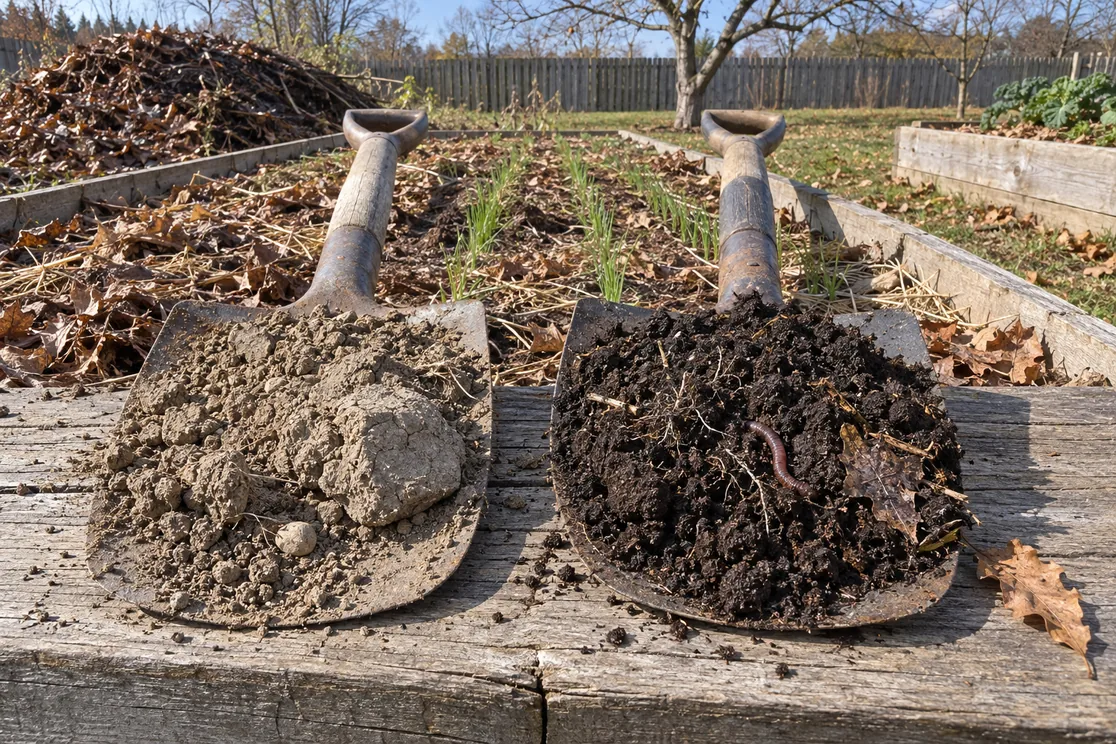
Dig a spade of ground from an old vegetable bed and a spade from the lawn beside it. The bed is darker, crumbles rather than breaks, and smells of a forest floor. That difference is organic matter, which is mostly carbon, and it comes in two forms that behave very differently.
The first form is the fresh stuff: last year’s roots, the straw mulch, the compost you spread in spring. Microbes eat it within a season or two, and as they do, they release the nutrients it held. The second form is humus, the dark, stable residue left after the fresh material has been digested many times over. Humus can persist for decades, and it holds water like a sponge and clings to nutrients so they do not wash away.
A healthy bed has both. The fresh material feeds the soil life and the plants this year, while the humus is the long-term account that makes the bed forgiving. When people say a soil is “rich,” they mean the humus, and humus is what the soil test measures.
Why Soil Organic Matter Matters More Than Fertilizer
There are three reasons the number matters, and water is the first. Each percentage point of organic matter lets the top foot of a bed hold roughly an extra half inch of rain. In July, that is several days between waterings. Consequently, a bed at 2% wilts on the third dry day; the same bed at 5% goes a week.
Nitrogen is the second reason, because organic matter breaks down slowly and steadily. Penn State Extension’s guide to managing soils puts the release at about 20 pounds of nitrogen per acre each year for every 1% of organic matter. In a home garden that is a small figure, but it arrives every week from May to September, in the form roots use best. A bed at 5 or 6% supplies most of what leafy crops need with no fertilizer at all.
Structure is the third, and it is the one you can see. Organic matter glues sand grains and clay particles into crumbs, and the spaces between crumbs are where air, water, and roots go. Structure is why a rich bed never crusts after rain and why carrots grow straight in it. It is also why the spade goes in without a boot on it.
How to Get Soil Organic Matter Measured
The kits sold in garden centers test pH and three nutrients. They do not test organic matter, and no home test does it well. The jar test tells you the sand, silt, and clay proportions, which is useful. However, it says nothing about humus, so the number has to come from a lab.
Fortunately, that is cheap. Most state extension services run a basic garden soil test for $15 to $30, and organic matter is on the standard panel. Take ten small cores from across the bed, six inches deep, mix them in a clean bucket, and send a cupful. Test in the same month each time, because the number drifts through the year. Late fall, after the beds are cleared, is the usual choice.
When the report arrives, look for the line that says “organic matter” or “OM” and a percentage. The rest of the report is worth reading too, and how to read a soil test report walks through it line by line. However, if you only track one figure from one year to the next, track this one.
Test again in two or three years, not next season. Soil organic matter changes slowly, and a single year’s difference is inside the error of the test. Two tests three years apart tell you whether what you are doing is working.
Raising Soil Organic Matter: The Four Sources
Every gardener who has raised the number has done it with the same four sources, in roughly this order of effect.
Compost is the fastest. An inch spread over a bed every year, on the surface or lightly forked in, adds about three cubic yards per thousand square feet. That is enough to lift a bed from 2% toward 5% over five or six years. Make it yourself if you can, because bought compost varies wildly. The full method is in Composting 101, and Oregon State Extension’s guide to improving garden soils with organic matter gives rates for different materials.
Mulch is the slowest and the least work. A layer of straw, shredded leaves, or grass clippings on the bed all summer feeds the worms. In turn, they pull it down into the soil for you. By fall most of it is gone, and that is the point. The guide to organic garden mulch covers which materials suit which crops and how thick to lay them.
Cover crops do what no amount of compost can: they add organic matter below the surface, where roots grow. A stand of winter rye or crimson clover sown in September puts a mass of fine roots through the top foot of soil. Cut it in spring and leave the roots in place. In a vegetable crop rotation, the cover crop takes the bed’s off season instead of leaving it bare.
Roots left in the ground are the free source, and the method is simple. When a crop finishes, cut it at the soil line rather than pulling it. The root mass rots in place, feeds the soil life, and leaves channels for water. This alone, done for every crop, is worth a quarter point a year.
Leaves deserve a mention of their own. Bagged fall leaves, left to rot for a year, become leaf mold, which is nearly pure humus. It adds few nutrients but raises the organic matter figure faster than anything else you can make for nothing.
The Two Habits That Burn Humus
Adding is half the job. The other half is not losing what you have, and two habits lose it fastest.
The first is tilling, and it is the worse of the two. Every pass with a rototiller or a deep dig floods the soil with air. The microbes respond by eating organic matter as fast as they can. A bed tilled twice a year can lose more humus than an inch of compost puts back. This is the case for the no-dig gardening method. The soil is disturbed only where a plant goes in, and organic matter accumulates instead of burning off.
The second is bare soil, and it is the more common. Ground left uncovered through winter loses organic matter to rain, sun, and erosion. A cover crop or a mulch stops that loss. Bare ground in summer is worse still, because the heat speeds decomposition and there are no roots to replace it.
The test that convinced me was two beds side by side. One was tilled each spring and left bare each winter; the other was mulched, never dug, and cover-cropped. Both got the same compost, and after six years the first bed tested at 3.4% and the second at 6.1%.
There is a third, quieter loss: “topsoil” bought by the yard. Most of it is subsoil screened fine, with almost no organic matter. Filling a new bed with it sets the number back to 1%. A raised bed soil mix built from compost and loam starts at 5% or better.
When Soil Organic Matter Is Too High
This surprises people, but yes, a vegetable bed can have too much. Gardeners who spread manure or compost every year for a decade often test at 12% or more, and the problems arrive with the number. Compost is high in phosphorus, and phosphorus does not leach. It builds up until it locks out iron and zinc and the leaves yellow between the veins. Manure-based compost also carries salts, and in a dry climate they accumulate.
University of Minnesota Extension has written on exactly this question. The title is compost and soil organic matter: the more, the merrier?, and the answer is no. Above about 8% in a vegetable bed, stop adding compost and switch to mulch and cover crops. They keep the soil life fed without adding phosphorus. Check the phosphorus line on the soil test too, because if it reads “very high,” the bed needs no compost for several years.
A bed that is too rich also grows too much leaf and too little fruit. Tomatoes and squash in a 12% bed make enormous plants and set late. Lean the bed out with a season of heavy feeders and no amendment at all.
A Five-Year Plan for a Tired Bed
Suppose the test comes back at 2%, and you want 5%. This is what gets it to 5% by the fifth test.
- Year one, fall. Spread two inches of compost and sow winter rye, then cut the rye in April and leave the roots.
- Year one, summer. Mulch every bed with straw or shredded leaves, and cut finished crops at the soil line.
- Year two onward. One inch of compost each fall, a cover crop on every bed that is empty by mid-September, mulch every summer. No tilling.
- Year three. Test again, and expect 3 to 3.5%.
- Year five. Test again, and expect 4.5 to 5.5%. From here, an inch of compost every second year holds the number.
The plan costs three cubic yards of compost per thousand square feet per year, a pound of rye seed, and a few bales of straw. It costs almost no digging. The bed will need less water in year two and no fertilizer by year four.
Frequently Asked Questions
What is a good soil organic matter percentage for a vegetable garden?
Between 3 and 5% in most climates. Above 5% is excellent for vegetables; above 8% is where phosphorus and salt problems start, and it is time to stop adding compost.
How much compost does it take to raise soil organic matter by 1%?
More than you think. The top six inches of a thousand square feet weigh about 45,000 pounds, so 1% is 450 pounds of stable humus. Most compost decomposes rather than becoming humus, so it takes roughly an inch a year for two or three years to gain a single point.
Does peat moss raise soil organic matter?
It does, but slowly and expensively, and it adds nothing to the soil life. Leaf mold does the same job for free, and a bin of worm castings does it better still.
Can I raise soil organic matter in a single season?
The test figure will barely move, but the bed will behave better within one summer. Mulch, a cover crop, and no digging change the water-holding and the crumb within months. The humus follows over the years.
Check out the author’s book here: The Year-Round Vegetable Garden for Beginners.

Leave a Reply