
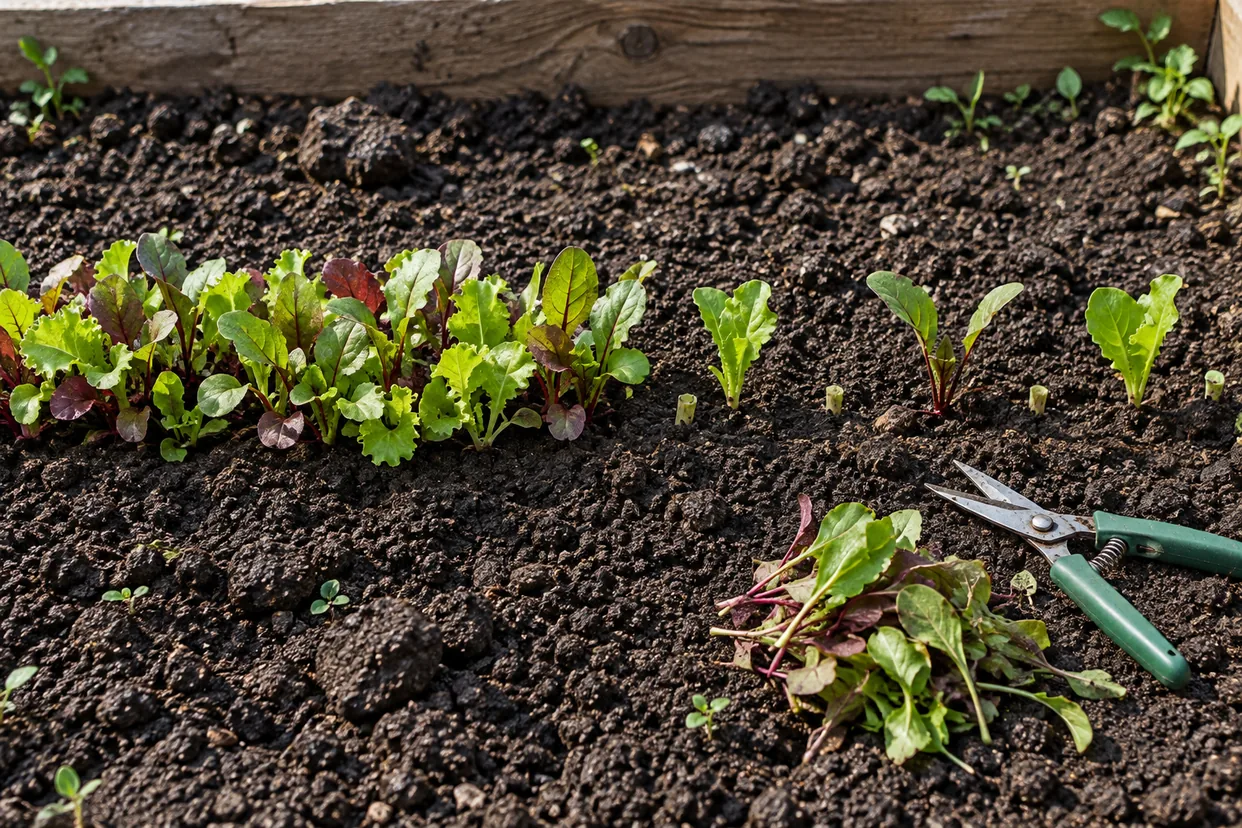
Every packet of carrot or lettuce seed holds far more seeds than a row can support. As a result, most gardeners sow thickly and end up with a green carpet of seedlings a few weeks later. That carpet looks promising, but it hides a problem: crowded plants compete for the same water, light and nutrients, and none of them grows well. Knowing how to thin seedlings turns that crowded row into a smaller number of strong plants. This guide explains when to do it, which method to use, and how far apart each crop should end up.
Why Thinning Matters More Than It Seems
Pulling out healthy seedlings feels wasteful, so many beginners skip the job or do it halfway. However, the University of Maryland Extension is clear on the cost: failure to thin seedlings stunts plant growth and reduces the harvest. Small seeds are difficult to place at the right spacing, so thinning is simply the second half of sowing them.
The reasons are practical: crowded seedlings shade each other, so each one stretches toward the light and forms a weak stem. In addition, their roots compete in the same few inches of soil. Root crops suffer the most from crowding in a row. A carrot or beet with no room to swell stays thin, forks or twists around its neighbours. Leafy greens stay small, and they tend to bolt sooner under stress. The guide on what is bolting explains why that stress matters.
Crowding also affects plant health, because dense foliage holds moisture and blocks air movement, which creates the conditions fungal problems prefer. In seed trays, that damp, still air is one of the main triggers of damping off disease.
Timing: How to Thin Seedlings at the Right Stage
Timing is the first decision, and early is better than late. According to UF/IFAS Extension, the right moment comes when plants are about 1 to 2 inches tall. Alternatively, watch for the moment they have two sets of true leaves. True leaves are the ones that appear after the first pair of seed leaves, and they already look like the adult plant.
Waiting longer makes the job harder, because as seedlings grow their roots spread and tangle, so pulling one disturbs the others. For that reason, Ohio State University advises thinning while seedlings are very small, so the roots of the plant you keep stay undisturbed.
Water First, Then Thin
Moist soil makes a big difference, and Ohio State recommends watering a day before thinning. As a result, the roots slide out more easily and the remaining plants are less likely to be disturbed. In trays, the same guide suggests thinning after bottom watering or misting the surface first. If you already water trays from below, the guide to bottom watering seedlings fits neatly into this routine.
A cool, cloudy day is also kinder than a hot afternoon. Seedlings that lose a neighbour, or get nudged in the process, need a little time to settle. They recover faster when they are not under heat stress at the same time.
How to Thin Seedlings: Snip or Pull
There are two basic methods, and each has its place. UF/IFAS describes both: pull out seedlings with your fingers or forceps, or use small scissors to cut them off at ground level.
How to Thin Seedlings With Scissors
Scissors are the safer choice in most rows, and UF/IFAS explains why. It points out that cutting unwanted seedlings prevents you from dislodging the root system of the plants you leave behind. Ohio State calls this “scissor thinning” and recommends it whenever seedlings grow too close together or their roots have already intertwined.
The technique is simple enough for a beginner: use small, sharp scissors, such as nail scissors or fine garden snips, and cut each unwanted stem flush with the soil. After that, the root left underground simply decays in the soil within a few weeks. Snipping is the best choice for carrots, parsnips, beets and other root crops. In those crops, the root of the plant you keep must not be damaged at all.
Pulling by Hand
Pulling works well when seedlings are still tiny and the soil is moist. Hold the unwanted seedling close to the base and draw it straight up, slowly. At the same time, press the soil gently around the remaining plant with your other fingertip, so its roots stay in place.
Pulling also has one advantage: you can replant the extras. Ohio State notes that thinned seedlings from trays can be moved into new pots if space allows. This works for lettuce, brassicas and onions, but not for carrots, which dislike transplanting.
Thinning Wide Rows With a Rake
For broadcast beds, the University of Maryland describes a faster method. Drag a metal rake about one inch deep through the planting, and it will dislodge the excess plants. It is less precise than scissors, so it suits greens sown thickly in wide rows rather than neat rows of carrots.
Choosing Which Seedlings to Keep
Knowing how to thin seedlings is partly a matter of choosing well. The goal is not simply to remove plants at regular intervals, but to leave the best ones in the right places. A few quick checks help with that choice.
- Stem thickness. A short, thick stem signals a plant that has had enough light, while a thin, pale one has been stretching.
- Leaf colour. Deep green, evenly coloured leaves are a good sign, whereas yellow or spotted leaves suggest stress or disease.
- Position. If two good seedlings stand side by side, keep the one closest to the ideal spacing, even if it is slightly smaller.
- Damage. Remove anything chewed by slugs or bent at the base, because it rarely recovers fully.
For that reason, it pays to look along the whole row before you start cutting. When you are unsure how to thin seedlings in a patch where every plant looks alike, simply follow the spacing and let position decide.
How to Thin Seedlings in Stages
Thinning does not have to happen in one pass, and in fact many gardeners prefer to work in two or three rounds. This approach leaves a margin for losses to slugs, birds or dry spells.
- First pass: at the first true leaves, thin to roughly half the final spacing. Remove the weakest, the smallest and any seedlings with damaged leaves.
- Second pass: a couple of weeks later, thin to the final spacing and keep the strongest plant in each spot.
- Final adjustment: for crops such as beets and lettuce, let the last thinning become an early harvest of baby roots or baby leaves.
This staged approach also suits crops with patchy or uneven germination. If whole sections of a row failed, a quick seed germination test before the next sowing tells you whether old seed was the cause.
How to Thin Seedlings by Crop: Final Spacing
The final distance depends on the crop and the variety, so the seed packet remains the most reliable guide. The article on reading seed packets explains where to find that information. As a general reference, these are the spacings most packets give:
- Carrots: 2 to 3 inches between plants. Wider spacing gives larger roots, while closer spacing suits small varieties. The guide to growing carrots covers the rest of the crop.
- Beets: 3 to 4 inches, since each beet “seed” is in fact a cluster that produces several seedlings, so beets almost always need thinning.
- Radishes: about 1 to 2 inches, and because radishes grow fast, thin them early or they will split and turn woody.
- Lettuce: 4 to 6 inches for leaf lettuce and 10 to 12 inches for head lettuce.
- Spinach and other greens: 3 to 6 inches, depending on whether you want baby leaves or full plants.
- Onions from seed: 2 to 4 inches, with the wider end for large bulbs.
The University of Maryland adds a word of caution for anyone tempted to squeeze plants closer together. Deep, fertile soil and careful watering may allow slightly tighter spacing, but crowding reduces air circulation and increases competition. As a result, both disease and smaller yields become more likely. The guide to raised bed crops shows how spacing affects what fits in a bed.
How to Thin Seedlings in Trays and Cells
Indoor seed starting follows the same logic on a smaller scale. Most gardeners sow two or three seeds per cell to allow for poor germination. Once they sprout, Ohio State recommends keeping the strongest seedling in each cell and removing the rest.
Snipping is almost always the better method here, because roots in a small cell tangle quickly. As a result, pulling out one seedling can easily lift the whole plug of soil. Choose the seedling with the thickest stem and the most compact shape, rather than simply the tallest one. A tall, pale seedling is usually a stretched one, not a strong one.
Thinned trays are also easier to manage later, since every remaining seedling gets full light and airflow. It also moves into the garden with a single, healthy root ball. When that time comes, hardening off plants prepares them for the change.
Common Thinning Mistakes
- Waiting too long. Tangled roots make every pull a risk to the remaining plants. Thin at the first or second set of true leaves.
- Thinning dry soil. Dry soil grips the roots and tears them, so water the bed the day before.
- Pulling root crops. Carrots and parsnips react badly to any root disturbance, so snip them instead.
- Keeping the tallest seedling. Height often means stretching, so keep the sturdiest seedling instead.
- Leaving thinnings on the bed. Pulled carrot seedlings release a scent that can attract carrot flies, so remove them promptly.
Better sowing reduces the work next time: mixing tiny seeds with dry sand spreads them more evenly. In addition, a seed starting calendar helps you sow in smaller batches rather than one crowded row.
Frequently Asked Questions
How to thin seedlings without hurting the ones you keep?
Use scissors and cut the unwanted stems at soil level. That way, the roots of the remaining plants stay untouched. Watering the day before also helps, especially if you prefer to pull.
Can you eat the thinnings?
Yes, in many cases, and the University of Maryland suggests eating excess seedlings as microgreens. Young lettuce, beet, spinach and radish thinnings also make a good addition to salads.
Is it too late to thin once seedlings are several inches tall?
Late thinning is still better than none, but snip rather than pull and expect the remaining plants to take a few days to recover.
Do all vegetables need thinning?
No. Large seeds such as beans, peas, squash and corn can be spaced correctly at sowing, as the University of Maryland notes. Small seeds such as carrots, lettuce and radishes are the ones that almost always need it.
Final Thoughts
Learning how to thin seedlings is less about technique than about accepting a trade: fewer plants, but better ones. Thin early, when seedlings have their first true leaves, and water the day before. Then snip root crops and use the seed packet for final spacing. In return, you get straighter carrots, rounder beets and lettuce with room to form a proper head.
Check out the author’s book here: The Year-Round Vegetable Garden for Beginners.
Leave a Reply