
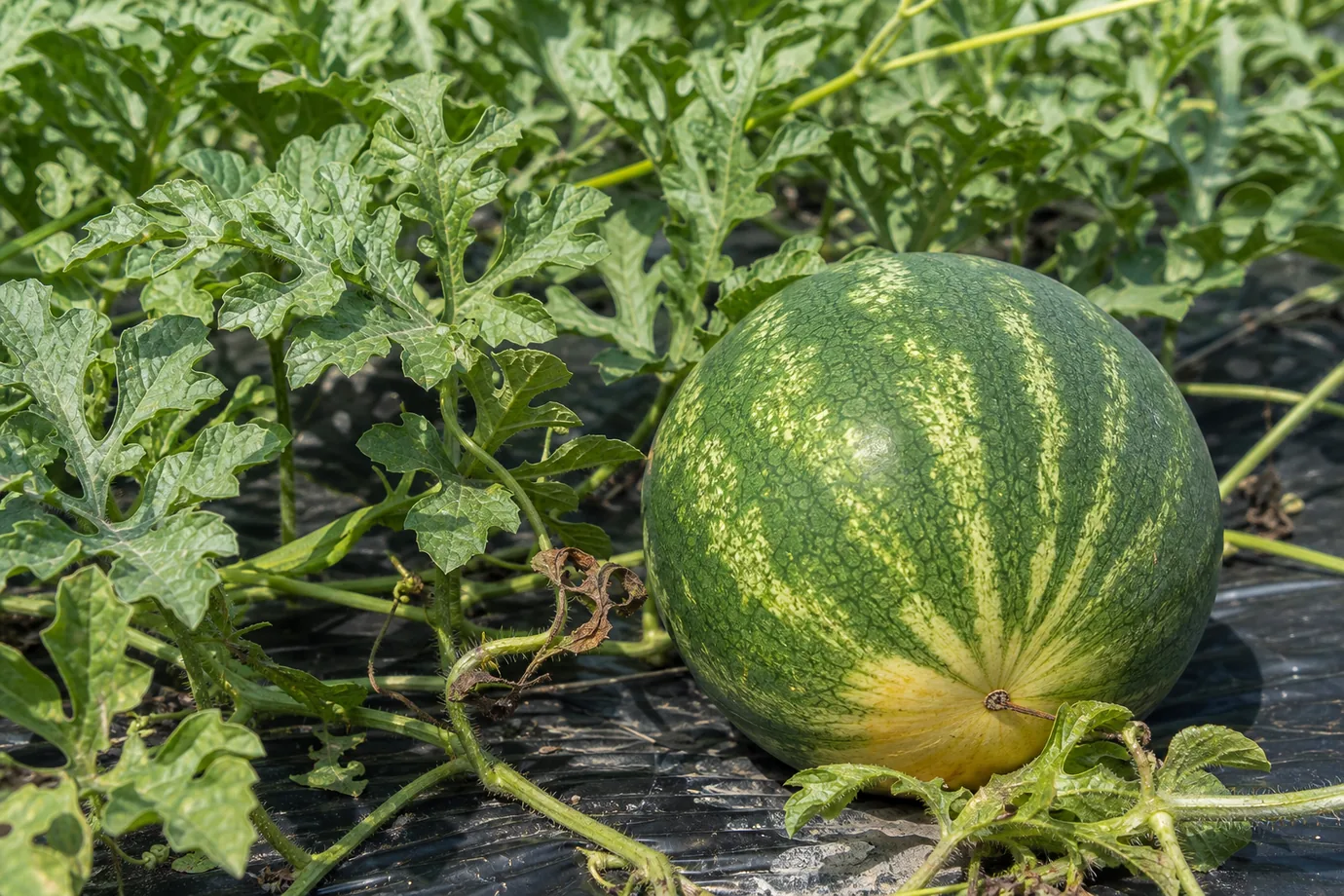
Nothing says summer like a watermelon you grew yourself. However, it is not a crop you can simply drop into a corner of the bed. The vines want heat, a lot of room and busy bees, and the fruit has to be picked at the right moment. Growing Watermelon at home is very possible, even in cooler regions, as long as you respect those four needs.
This guide walks through the whole season, from warming the soil to thumping the ripe fruit. The advice comes from Utah State University Extension, University of Georgia Extension and University of Maryland Extension.
What Growing Watermelon Really Asks For
Watermelon is a warm-season member of the cucumber family. As a result, it shares most needs with squash and cucumbers, only more so. Before you order seed, check that you can offer:
- Full sun. UGA calls for 8 to 10 hours of sunlight a day.
- Warm soil. Both USU and UGA wait for the soil to reach 65°F, and UGA puts the target at 65 to 70°F.
- Space. UMD notes that vines run from 6 feet for bush types to 20 feet for the vigorous ones.
- A long season. UGA gives 70 to 90 days to harvest, depending on the variety, and UMD 80 to 100 days from transplanting.
If your summers are short, do not give up. Instead, choose an early variety, start transplants indoors and warm the soil, as described below.
Choosing Varieties for Growing Watermelon
Variety choice matters more with watermelon than with most crops, because size and days to maturity vary so much.
USU suggests the large red-fleshed ‘Crimson Sweet’ and ‘Mirage’, which reach 15 to 25 pounds. For smaller gardens, it lists the icebox types ‘Mickylee’ and ‘Minilee’ at 10 to 15 pounds, and the yellow-fleshed ‘Golden Crown’ and ‘Yellow Baby’. UGA recommends ‘Sugar Baby’, ‘Bush Sugar Baby’, ‘Golden Crown’ and ‘Yellow Baby’ as early varieties.
A Note on Seedless Watermelon
Seedless varieties such as ‘Cotton Candy’, ‘Honey Heart’ and ‘King of Hearts’, all listed by UGA, are popular. Still, there is a catch. Their pollen is not fertile, so you must plant a standard seeded variety alongside them as a pollinizer. Otherwise the seedless vines flower but set little or no fruit. For the same reason, save seed only from open-pollinated seeded types; Vegetable Cross Pollination: How to Prevent Hybridization in Seed Saving explains why.
When to Plant Watermelon
Cold soil is the most common reason watermelon fails. Seed sown too early sits in the ground, rots or comes up weak. Therefore, wait until all danger of frost has passed and the soil has warmed. A soil thermometer takes the guesswork out; Soil Temperature for Planting: When to Safely Sow Warm-Season Crops shows how to read one.
Starting Transplants Indoors
Transplants give you a head start of several weeks. UMD notes that transplanted melons can mature as much as four weeks earlier than direct-sown ones, while USU puts the gain at about two weeks.
UGA suggests starting seeds indoors 4 to 5 weeks before the last frost, with lights 6 to 12 inches above the plants for about 14 hours a day. Sow 2 or 3 seeds per pot and keep the strongest. Watermelon roots dislike disturbance, so use individual pots rather than trays of loose soil. Before planting out, harden the seedlings off gradually, as described in Hardening Off Plants: How Much Stress Is Enough. USU recommends transplants with 2 or 3 true leaves and a well-developed root system.
Warming the Soil With Black Plastic
In cooler areas, black plastic changes everything. UMD notes that watermelons grown on black plastic mulch or black landscape fabric produce larger and earlier harvests. The plastic warms the soil, keeps down weeds and holds moisture.
Lay the plastic a week before planting, so the soil can warm up underneath. Run a soaker hose or drip line beneath it first, as UMD suggests; Drip Tape Installation: DIY Micro-Irrigation for Efficient Veggie Gardens shows the setup. Then cut an X where each plant goes.
USU adds that row covers let you plant 2 to 3 weeks earlier. Remove them as soon as flowers appear, however, because bees need to reach the blossoms. Floating Row Covers: Protecting Brassicas from Pests and Frost explains how to lay and lift them.
Planting and Spacing Watermelon
Watermelon is traditionally planted in hills, which are groups of seeds rather than raised mounds.
- Prepare the soil. UGA recommends a pH of 6.0 to 7.0 and 3 pounds of 10-10-10 per 100 square feet, worked into the top 6 to 8 inches.
- Sow the seeds. USU sows 4 to 6 seeds 1 to 2 inches deep, and UGA 4 or 5 seeds 1 inch deep.
- Space the hills. USU places them 4 feet apart, while UGA allows 8 feet on all sides.
- Thin the seedlings. Both USU and UGA thin to 2 plants per hill.
For transplants, USU suggests 2 feet in the row with rows 4 to 6 feet apart. UMD gives 3 to 4 feet in the row with 6 to 7 feet between rows.
Saving Space
UMD suggests lifting and moving the vines so they grow in one or two directions only. Small icebox varieties can also climb a sturdy support, provided each fruit is held in a sling. Vegetable Trellis: Five Designs, What They Cost, and Which Crop Goes on Each compares the options.
Watering and Feeding the Vines
Water deeply rather than often. USU recommends 1 to 2 inches a week, and UGA suggests watering to a depth of 6 inches. Drip irrigation is best, since wet leaves invite disease.
Later in the season, the rule changes. UMD advises stopping watering once the fruits begin to ripen, which improves flavour and reduces splitting. USU likewise recommends reducing water as the fruit ripens.
Feeding is simple:
- At planting. Work in a complete fertilizer, as UGA describes above.
- When the vines run. USU recommends side-dressing with 3 to 4 tablespoons of 21-0-0 once runners develop.
- Not too much. UMD warns that excess nitrogen lowers yield and quality.
In very hot spells, a light mulch of straw keeps the roots cooler; Protecting Plants from Extreme Heat: Preparing Your Garden for Summer Waves has more ideas.
Pollination: Why Bees Matter
Each vine carries separate male and female flowers. The female flowers have a tiny melon at their base, and bees must carry pollen to them from the male flowers. UMD notes that poor fruit set is common in rainy weather, when bees are inactive.
To help, avoid spraying pesticides during bloom, as UMD advises. In addition, plant flowers nearby to draw bees in; Pollinator Friendly Garden: Attracting Bees and Butterflies to Your Vegetables lists good choices. When bees are scarce, you can transfer pollen yourself with a small brush, exactly as for squash; Hand Pollinating Squash: Saving Your Harvest When Bees Are Scarce shows how.
Pests and Diseases When Growing Watermelon
USU lists aphids, cucumber beetles, powdery mildew, wilt diseases and viruses. UMD adds anthracnose, bacterial wilt, downy mildew and squash vine borer.
Cucumber beetles are the most serious pest. They chew seedlings and spread bacterial wilt, which makes whole vines collapse. Cover young plants and remove the cover at flowering. For the borer, which tunnels into the base of the vine, see Squash Vine Borer: How to Spot It, Stop It and Save the Plant.
Powdery mildew usually appears late in summer as a white coating on the leaves. Good spacing and drip watering slow it down; Powdery Mildew Treatment: Buying Weeks, Not Winning the War explains the realistic options.
Finally, UMD recommends placing cardboard or straw under the developing fruit to prevent rot where it touches damp soil.
How to Tell When Watermelon Is Ripe
Picking at the right moment is the hardest part of growing watermelon. Unlike cantaloupe, which parts from its stem on its own when ripe (see Growing Cantaloupe: Warm Soil, Steady Water and the Full Slip Test), watermelon does not slip off the vine, and it does not ripen further once picked. USU notes that fruit takes 35 to 45 days to mature after flowering.
Look for several signs together:
- The tendril. The curly tendril opposite the fruit stem turns brown and dry. UGA says it should be completely dry.
- The ground spot. The patch where the melon rests changes from white to a creamy yellow, as both USU and UMD note.
- The skin. USU notes that the rind changes from shiny to dull.
- The sound. UMD suggests thumping the fruit: ripe melons give a dull sound rather than a metallic one.
No single sign is reliable on its own, so check at least two before cutting the stem. USU expects about 40 fruits per 100 feet of row, and UMD 2 to 4 per plant.
Storing Your Harvest
Watermelon keeps better than most people think. UGA says it stays fresh for about 2 weeks below 60°F, or 7 to 10 days at room temperature. USU gives 1 to 2 weeks at 45 to 50°F. Once cut, keep it in the refrigerator.
Nothing needs to go to waste. UMD points out that the rind is edible and can be stir-fried, stewed or, more often, pickled.
Enjoy Growing Watermelon This Summer
Warm soil, full sun, plenty of room, deep watering and busy bees: that is the whole secret. Start with an early icebox variety if your season is short, and read the tendril and the ground spot before you pick. With those basics, growing watermelon becomes one of the most rewarding parts of the summer garden.
Check out the author’s book here: The Year-Round Vegetable Garden for Beginners.


Leave a Reply