
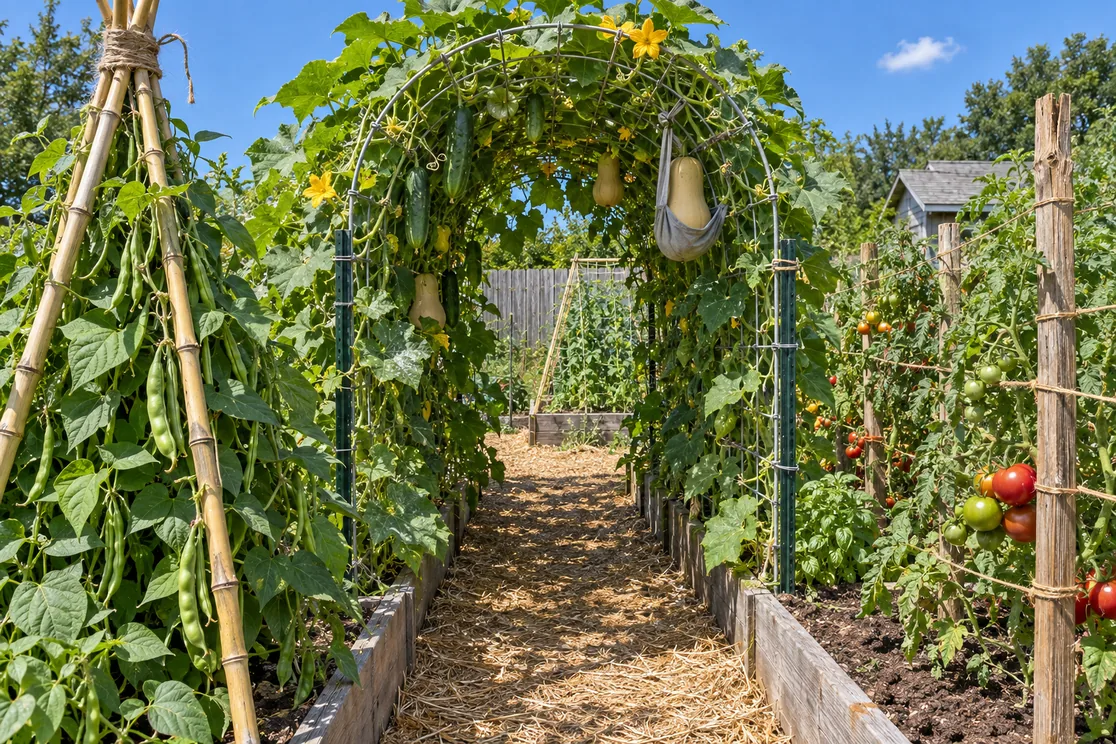
The first vegetable trellis I ever built was a pair of tomato stakes with string between them. It lasted until the second week of July, when the cucumbers weighed more than the stakes could hold. One wet night the whole thing lay down across the lettuce. Since that summer I have built every design I could find, and five of them have earned a permanent place. This guide is about those five: what each one costs, how tall it stands, and which crop belongs on it.
The right vegetable trellis is not a matter of taste. A pea wants something thin enough for a tendril to wrap around. A tomato wants a stake or a string and a hand to tie it. Meanwhile, a squash needs a structure that will hold sixty pounds in a thunderstorm. Match the design to the plant and the support disappears into the foliage by midsummer. Get it wrong and you spend August propping things up.
Vegetable Trellis Designs at a Glance
| Design | Height | Cost | Best crops | Weakness |
|---|---|---|---|---|
| Bamboo teepee | 6 to 8 ft | $10 to $20 | Pole beans, small cucumbers | Tips over in wind if not tied |
| A-frame with netting | 5 to 6 ft | $25 to $40 | Peas, cucumbers, beans | Netting sags by year three |
| Cattle panel arch | 6 to 7 ft | $40 to $70 | Squash, melons, cucumbers, gourds | Heavy to move; needs T-posts |
| Florida weave | 5 to 6 ft | $15 per 10 ft | Determinate and indeterminate tomatoes | Must be re-strung weekly in June |
| String trellis | 7 to 8 ft | $20 to $30 | Indeterminate tomatoes, cucumbers | Needs a beam overhead |
Why a Vegetable Trellis Pays for Itself
Growing up instead of out is the biggest change a small garden can make. The reasons are practical rather than pretty: a cucumber vine on the ground covers about twelve square feet by August. The same vine on a vegetable trellis covers two square feet of soil and six of air. As a result, the other ten feet grow lettuce or beans. Over a season, that one difference lets a four-by-eight bed feed twice as many people. The case for the whole approach is made in vertical vegetable garden: growing up instead of out. This article is the workshop that comes after that argument.
There is also the fruit itself, since cucumbers and squash that hang from a support grow straight and stay clean. They never get the yellow, flat side that comes from resting on wet soil. Oregon State Extension’s guide to growing cucumbers makes the same point. It adds that the structure has to be strong enough for the weight of the mature crop. That reminder is the whole reason this guide exists, because a support that is strong enough on planting day is rarely strong enough in August.
Finally, a plant in the air is a plant you can see. Beetles under a leaf, a fruit ready to pick, the first white dust of mildew: all of it is at eye level. Illinois Extension’s piece on vertical gardening lists the same four benefits I have found in practice. Less space, less disease, more light on the leaves, and less bending.
The Bamboo Teepee: The Cheapest Vegetable Trellis
If you have never built anything, start here with four bamboo poles, eight feet long and at least an inch thick at the base. Push each one a foot into the soil at the corners of a three-foot square. Then lean them together at the top and lash them with jute twine, wrapping ten times before tying off. The whole job takes ten minutes and costs less than a bag of seed.
The teepee suits pole beans above any other crop, because a bean seedling finds the pole on its own and winds up it counterclockwise. Five plants at the base of each pole will cover the structure by July. Small-fruited cucumbers do well on it too, though they need tying at first. They have tendrils rather than twining stems, so a bare pole gives them nothing to grip. Details on sowing are in growing beans and peas, while the lemon cucumber is the one I put on a teepee every year.
The weakness is wind, because a teepee covered in bean foliage is a sail, and a summer storm will lay it flat. The legs must go a full foot into the ground. In a windy spot, tie a length of twine from the top to a tent peg on the windward side. Also, run a ring of twine around the legs at three feet, so the young vines have a rung to reach.
The A-Frame with Netting: Best for Peas
An A-frame is two panels hinged at the top and spread at the base, and it is the vegetable trellis I use for peas. Build each panel from two six-foot uprights and two cross rails of one-by-two lumber, screwed at the corners. Then join the two panels at the top with a pair of hinges. Staple nylon garden netting with four-inch mesh to each panel. If you would rather not buy netting, run twine up and down every four inches instead.
Peas are the reason for the fine mesh, since a pea tendril is thin and grabs anything under a quarter inch across. Consequently, it holds netting and twine but slides off a broad bamboo pole. Sow a double row along each foot of the frame. By May the plants will have climbed to the top and started back down the other side. Cucumbers and bush-type beans also do well on an A-frame. The space under the frame stays shaded, which is where I plant summer lettuce.
The advantage over a flat panel is that an A-frame stands on its own. Because the base is spread three feet, it does not need posts. The whole thing folds flat and hangs on the shed wall in winter. Netting is the part that wears out, so buy it in a roll and replace the panels every third spring. At $25 to $40 in lumber and netting, it is the middle of the range. If money is tight, the frame can be made from scrap. The list of what to skimp on and what not to is in vegetable gardening on a budget.
The Cattle Panel Arch: The Vegetable Trellis for Heavy Crops
Nothing else in a home garden holds weight like a cattle panel. It is a welded steel grid, sixteen feet long and fifty inches wide. Farm supply stores sell it for $30 to $40, and you bend it into an arch between two raised beds set six feet apart. Then drive a steel T-post at each corner and wire the panel to the posts. The arch stands six to seven feet at the peak, and two people can walk under it.
This is the vegetable trellis for squash, melons, cucumbers, and gourds. Squash vines climb it without help, and by August the arch is a green tunnel with fruit hanging inside it. Butternut and acorn squash hang from their own stems without trouble. Anything over five pounds needs a sling made from an old T-shirt, tied to the panel. Melons up to cantaloupe size hang free once you support them early. Compact pumpkin varieties work too, though the giants belong on the ground. The guide to growing pumpkins sorts out which varieties are which.
Two warnings, and the first is that a panel is unwieldy in a car. Borrow a truck, or have the store cut it in half and clip the halves with hog rings. Second, anchor it as if it were a fence, because a loaded arch in a storm pulls with real force. T-posts driven two feet deep on each corner have held mine through several years of summer storms. University of Minnesota Extension’s guide to trellises and cages covers the panel arch along with the other designs here.
The Florida Weave: Tomatoes Without Cages
Tomato cages from the garden center are too small for any tomato worth growing, and the plant falls over them by July. The Florida weave replaces them with a row of stakes and string, which is how farms grow tomatoes by the acre. Drive a six-foot stake every two plants, sixteen inches into the ground. Then run twine from stake to stake at eight inches above the soil. Pass it on one side of the first plant and the other side of the second. Loop it around the stake and continue down the row and back.
The trick is repetition: add a new run of twine every eight inches as the plants grow, about once a week in June. Each run pinches the stems gently between two strings, and as a result the plants stand without a single tie. A row of six plants takes about five minutes a week. By August you have a green wall five feet high with every fruit in view. The choice of variety matters here, because determinate types stop at four feet and need three runs, while indeterminate types keep climbing and need six or seven. The difference between the two is explained in determinate vs indeterminate tomatoes.
Use real tomato twine, which is waxed and does not stretch, because jute rots by August. Also, start weaving early, since a plant that has already fallen over cannot be woven upright without breaking. Stakes should be hardwood or steel, since a pine stake snaps at the soil line in the second season.
The String Trellis: One Stem, Eight Feet Tall
Greenhouse growers train tomatoes and cucumbers up a single string hung from an overhead wire. The same method works outdoors under a simple beam, which is easy to build. First, set two posts eight feet tall at the ends of the bed and run a wire or a two-by-four between the tops. Above each plant, tie a length of twine to the beam, and bury the other end under the root ball at planting time. Then, as the plant grows, wind the stem around the string once a week.
This is the most productive vegetable trellis per square foot. The plants stand a foot apart and grow straight up. The catch is that it requires pruning, and the rule is strict. You keep an indeterminate tomato on a string to a single stem, pinching out every side shoot, and a cucumber to one or two. The method is described step by step in pruning indeterminate tomatoes, and once learned it takes a few minutes a week.
The other catch is the beam, because eight feet of tomato foliage pulls hard. Therefore, the posts must be four-by-fours set two feet deep, or steel pipe in concrete. In exchange, the bed underneath can hold more plants than any other design, which is the logic behind intensive gardening.
Where to Put a Vegetable Trellis
A trellis casts a shadow, and the shadow moves with the sun through the day. Put the structure on the north side of the bed and the shade falls on the path. Put it on the south side and everything behind it gets four hours of sun instead of eight. If your beds run east to west, the north edge is the place. If they run north to south, the trellis goes at the north end. Spend an afternoon making a garden sun map before you drive the first post, because posts are hard to move in July.
The shade under a trellis has a use of its own, though, because lettuce, spinach, and cilantro bolt in July sun. Behind a wall of beans, they get two hours of afternoon shade and keep going. I sow a row of summer lettuce on the shaded side of every vegetable trellis I own. In most years, it is the only lettuce I harvest in August.
Every trellis I have ever lost, I lost in a storm between mid-July and the end of August. The plant was at full weight, the soil was wet, and the wind came from a direction I had not planned for. Now I drive posts two feet deep and tie every structure to a stake on the windward side. Since then, I have not lost a single one to weather.
Keeping the Trellis Healthy
A trellis crowds plants, and crowded plants get mildew, so space the vines to keep leaves from overlapping at maturity. Thin the foliage at the base of cucumbers once the plants reach the top, and water the soil rather than the leaves. Powdery mildew still arrives in late summer, and powdery mildew treatment explains what to do when it does.
At the end of the season, pull the vines off the structure and compost them. Then take the netting and string down, because twine left over winter carries disease into next year and rots into a tangle. Steel and lumber can stay in place, and a coat of linseed oil on the wood every second fall doubles its life.
Frequently Asked Questions
How tall should a vegetable trellis be?
Six feet for peas, cucumbers, and determinate tomatoes, and eight feet for pole beans and indeterminate tomatoes. Anything taller is hard to harvest without a step, and the plants simply grow back down the other side.
What is the strongest trellis for squash and melons?
A cattle panel arch on steel T-posts. It holds several hundred pounds without moving, and the fruit hangs inside the arch, where it stays clean and straight.
Can I use a fence as a vegetable trellis?
Yes, if it is chain link or wire, and if it gets six hours of sun. Peas and cucumbers climb it directly, but beans need a few lengths of twine tied vertically, because their stems cannot grip a horizontal wire.
How far apart should trellised plants be?
Closer than the seed packet says. Cucumbers stand a foot apart on a trellis, pole beans four inches, and tomatoes on a string a foot. The packet spacing assumes the plant sprawls, and on a support it does not.
Check out the author’s book here: The Year-Round Vegetable Garden for Beginners.



Leave a Reply