
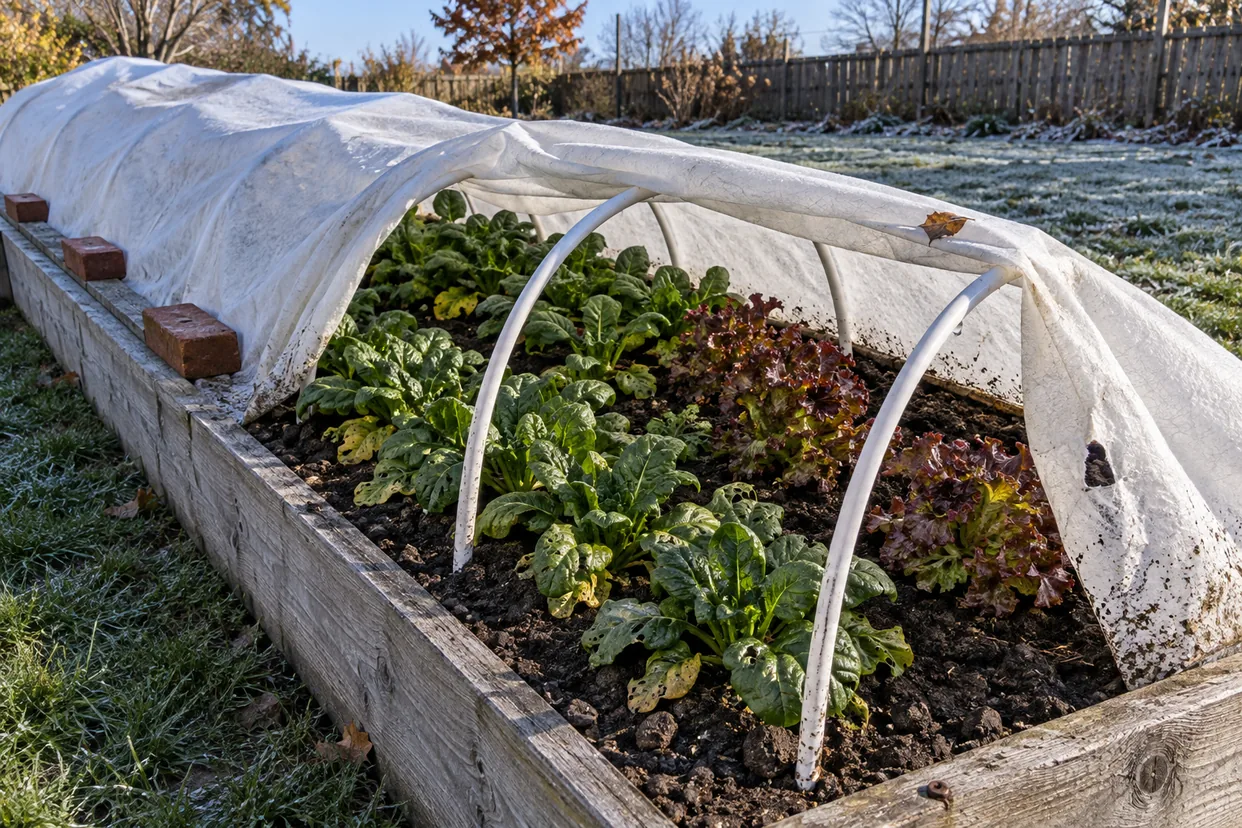
The first hard frost of October usually ends the garden in one night, and it does not have to. Growing under cover is the simple habit of putting a layer of fabric, plastic, or glass between your crops and the sky. That layer does not heat anything, but it holds what the soil already has. The difference is worth weeks in spring and months in fall.
I learned this the expensive way on the farm in Oregon, losing a bed of transplanted lettuce to a clear April night. The next spring a length of row cover, held down with rocks, carried the same bed through three frosts. Since then, every bed I plant early or late gets a cover of some kind.
Growing Under Cover at a Glance
| What it does | Adds 2 to 8°F of frost protection and calms wind, depending on the cover |
| Best seasons | Early spring and fall through early winter |
| Zones | Works everywhere; pays off most in Zones 3 to 7 |
| Three main tools | Floating row cover, low tunnel, cold frame |
| Crops that love it | Lettuce, spinach, kale, arugula, carrots, scallions, Asian greens |
| Crops that hate it | Anything that needs bees while it flowers, unless you uncover it |
| The one rule | Vent on sunny days, or you will cook what you were protecting |
Why Growing Under Cover Works at All
A row cover is not a blanket: it weighs less than a shirt, and on its own it holds almost no heat. What it does is stop two things: the wind, which strips warmth from leaves, and the escape of heat from the soil into a clear night sky. Under a cover, the soil stays a few degrees warmer than the open bed beside it.
That is why growing under cover works best on still, clear nights, which are exactly the nights that bring frost. On a cloudy, windy night the cover helps less, but on those nights frost is less likely anyway. If you have already found your first frost date, a cover is what lets you treat that date as a suggestion.
The Three Tools for Growing Under Cover
Every tool for growing under cover is a version of one of three things. Start with the lightest one that solves your problem.
Floating Row Cover
Floating row cover is a white spun-bonded fabric that you lay straight over the plants. Water, air, and most of the light go through it. University of Maryland Extension puts the numbers on the weights. A lightweight cover of 0.45 ounce per square yard gives about 2°F of frost protection. It lets through 90 to 95 percent of the light. A heavyweight cover of 1.5 to 2.2 ounces gives up to 8°F. Only 30 to 50 percent of the light reaches the leaves, though. The full table is in their row cover guide, and that trade-off is the whole decision. In spring, use the light fabric and leave it on for weeks. In late fall, when a hard freeze is coming, throw the heavy fabric over the bed for the night and take it off in the morning. I keep both rolled in the shed and use the heavy one perhaps six nights a year.
The fabric also keeps out flea beetles, cabbage moths, and rabbits. That is the reason I wrote a whole piece on floating row covers for brassicas. Weigh the edges down with soil, boards, or bricks so nothing crawls under.
Low Tunnel
A low tunnel is the same fabric, or a sheet of clear plastic, held up on hoops so it never touches the leaves. Penn State Extension describes the standard build in its guide to season extenders. Hoops of 10-gauge galvanized wire go in 3 to 4 feet apart, covered with 4 to 6 mil poly. Half-inch PVC pipe or old fence wire works just as well over a 4-foot bed.
The tunnel gives you two things the flat cover does not. The plastic version holds noticeably more heat, enough to keep spinach and kale picking through December in Zone 6. And the hoops keep wet fabric off the plants, which matters after a sleety night when a flat cover freezes onto the lettuce.
The price of that heat is the venting. A closed plastic tunnel on a sunny 45°F day can reach 90°F inside by noon. Open the ends, or fold back one side, any morning the forecast is sunny and above freezing.
Cold Frame
A cold frame is a bottomless box, usually wood, with a clear lid that slopes toward the south. It is the heaviest of the three and the one that changes the garden most. The soil inside stays workable when the open bed is frozen. Seed sown in it germinates two or three weeks ahead of the same seed outdoors.
I covered the building of one in cold frame gardening, so here is only the short version. Face it south, slope the lid at 30 to 45 degrees, and keep a stick handy to prop it open. On any sunny day above 40°F the lid comes up a few inches, and above 60°F it comes off entirely.
Which Crops Earn Their Place Beneath a Cover
Not every vegetable wants to be covered, and growing under cover suits some crops far better than others. The ones that do are the cool-season crops that survive a light frost on their own and just need help with the hard ones.
- Leafy greens. Lettuce (Lactuca sativa), spinach, arugula, mache, and the Asian greens. Spinach is the champion, because under a low tunnel it will sit through Zone 5 winters and start growing again in February. That is the whole idea behind overwintering spinach.
- Kale and collards. They get sweeter after frost and hold under a tunnel until the ground freezes solid.
- Roots. Carrots, beets, and turnips do not grow much once soil drops below 40°F. A cover keeps the soil diggable, though, so you can harvest into winter.
- Scallions and leeks. Both stand through most of the cold season with a fabric cover.
- Early transplants. Broccoli, cabbage, and lettuce set out three weeks before the last frost, covered with light fabric.
The crops that hate cover are the ones that need pollinators. Squash, cucumbers, and melons can go under fabric while they are small to keep beetles off. The cover must come off the day the first flowers open. Tomatoes and peppers benefit from a tunnel in a cold spring, then need it gone by June.
Growing Under Cover in Spring: Three Weeks Early
Spring is where growing under cover feels like cheating. The soil in a covered bed warms faster and dries sooner, and both matter more than the air temperature. Seeds decide when to germinate by the temperature of the soil around them, not by the calendar. A cover shifts that number in your favor. If you want the exact figures, my piece on soil temperature for planting has them.
- Cover the empty bed first. Two weeks before you want to sow, lay clear plastic or a low tunnel over the bare soil. This alone can raise the top two inches by 5 to 10°F.
- Sow the cold-tolerant crops. Spinach, peas, lettuce, and radishes go in as soon as the soil under the cover reads 45°F.
- Switch plastic for fabric once the seedlings are up. Plastic in April sun is too hot for a seedling; the fabric is gentler and needs less babysitting.
- Harden off before you uncover. Plants raised under a tunnel are soft. Open the ends a little more each day for a week before you take the cover away for good. It is the same routine as for seedlings from the windowsill. Hardening off applies under a tunnel as much as indoors.
Growing Under Cover in Fall and Winter
Fall is the opposite job, because instead of pushing growth you are protecting growth that already happened. A bed of mature kale in October will not get much bigger. Under a tunnel, though, it will stay pickable until January in Zone 6 and until Thanksgiving in Zone 4.
The timing is the part people miss, because plants must reach nearly full size before daylight drops under ten hours a day. In most of the country that happens in early November. After that, growth all but stops, cover or no cover. So the sowing dates for a covered fall bed are the same as for an open one. That means roughly 8 to 10 weeks before your first frost. The fall vegetable gardening guide lists them crop by crop.
A few more habits for the cold months:
- Mulch under the cover. A few inches of straw over the soil around the plants adds a layer of insulation the fabric cannot. On very cold nights I throw an old blanket over the tunnel on top of that, and take it off at dawn.
- Water before a freeze, not after. Moist soil holds more heat than dry soil. A thorough watering the afternoon before a forecast hard freeze buys another degree or two.
- Brush off snow. Snow on a fabric tunnel is fine and even insulating. Snow on a plastic tunnel can collapse the hoops, so knock it off with a broom.
- Do not harvest frozen leaves. Wait until the sun has thawed the tunnel. Leaves picked while frozen turn to mush; the same leaves picked at noon are perfect.
What Goes Wrong When Growing Under Cover
Every cover creates a small, sheltered world, and that world has its own problems.
Cooking. This is the number one killer of covered crops, and it happens in March, not July. A closed plastic tunnel on a bright day heats fast. If you cannot be home to vent, use fabric instead of plastic, or leave the ends of the tunnel permanently open.
Aphids and slugs. The cover keeps out the ladybugs and the birds as well as the pests. Check under the fabric every week. If aphids build up, pull the cover for a few days and let the predators in.
Fungal disease. Still, humid air under plastic favors gray mold and downy mildew, especially on spinach and lettuce. Venting is the cure, and so is spacing plants a little wider than you would in an open bed.
Wind damage. A tunnel that is not anchored becomes a sail. On the farm we lost a 30-foot tunnel to a February storm because the plastic was only weighed down with soil. Use sandbags, or tie the cover to the hoops with twine every few feet.
Forgetting the pollinators. Covered squash and cucumbers set no fruit. If you see flowers, the cover comes off or you go out with a paintbrush every morning.
A word on pests and sprays. A cover is the best pest control you own, since it stops the pest from ever reaching the plant. If you still need to treat something under the fabric, read the product label and follow it. Doses, timing, and days-to-harvest are on the label, and they change from state to state.
A Simple Plan for Your First Season
If you have never tried growing under cover, do not buy the whole catalog; start with these three items and one bed.
- One roll of lightweight row cover, 0.5 ounce, wide enough to drape over your bed with a foot to spare on each side.
- Six hoops, cut from half-inch PVC or 9-gauge wire, long enough to stand 18 to 24 inches over the bed.
- A dozen sod staples or bricks to hold the edges.
In September, sow spinach and a hardy lettuce in that bed. Cover it in October when the first frost is forecast, and keep picking. In March, move the same hoops and fabric to a second bed and sow peas and radishes under them. By your second year you will know whether the cold frame is worth building. You will also have eaten salad in December to help you decide.
Frequently Asked Questions
Can I leave row cover on all winter?
Yes, if it is fabric and the plants are cold-hardy. Check underneath every couple of weeks for slugs and to harvest. Plastic needs venting on sunny days, so it should not be left sealed for weeks at a time.
How much warmer is it under a low tunnel?
On a clear night, a fabric tunnel keeps the air 2 to 6°F warmer than outside. The exact number depends on the weight of the fabric. A plastic tunnel adds a few more degrees, and a cold frame does more still. None of them will save tomatoes from a 20°F night.
Does growing under cover work in hot climates?
In Zones 8 and up the covers are less about frost and more about pests and sun. A light fabric keeps insects off in spring, a shade cloth of 30 to 50 percent keeps lettuce from bolting in the heat, and the same hoops carry both.
What is the cheapest cover that actually works?
An old bedsheet on hoops, taken off each morning, will get a bed through a couple of light frosts. It is not a season, but it is a start.
The tools are simple and the materials are cheap. The payoff is a garden that runs from March to December instead of May to October. Put one bed under cover this fall and you will not go back.
Check out the author’s book here: The Year-Round Vegetable Garden for Beginners.

Leave a Reply