
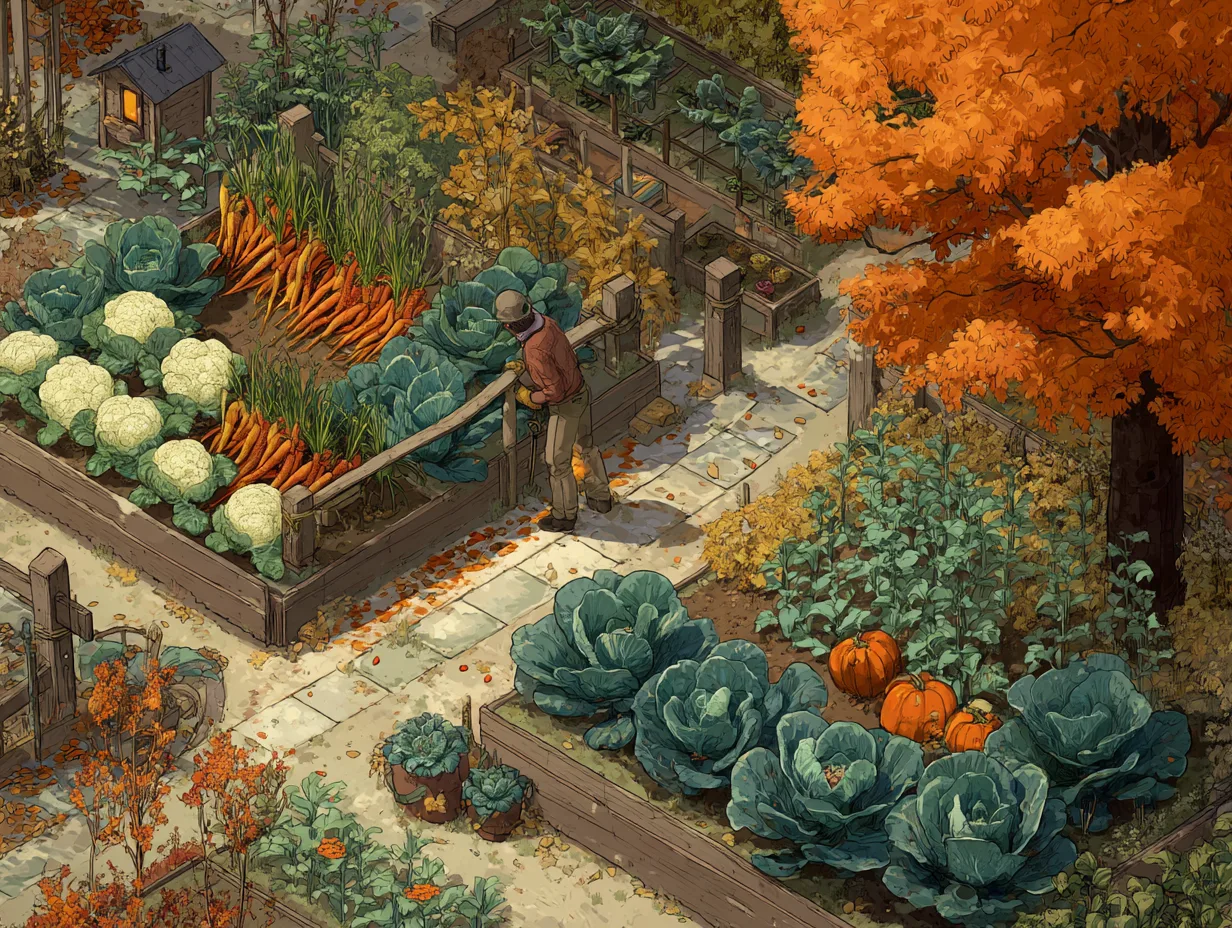
Autumn is a second spring—a window when crispy mornings and dwindling daylight coax exceptional flavor and color from cold-tolerant crops. A thoughtful Fall Vegetable Gardening Guide helps you pivot from summer exhaustion to fresh harvests of kale, carrots, and bok choy. This in-depth article maps out crop choices, sowing schedules, micro-climate hacks, and season-extension tricks, It weaves in insights from The Year-Round Vegetable Garden for Beginners plus research-backed tips from land-grant universities. In short, use it to transform fading tomato beds into vibrant fall salad bars, root cellars, and pantry staples—no greenhouse required.
1 Why Follow a Fall Vegetable Gardening Guide?
- Enhanced Flavor: Cool nights trigger sugar accumulation in brassicas and roots.
- Fewer Pests: Heat-loving insects decline, reducing pressure on greens.
- Efficient Space Use: Replant spent summer beds for a bonus harvest.
- Winter Pantry: Late plantings of garlic, onions, and overwintering spinach set you up for spring.
Why do cold crops taste better? According to University of Maryland Extension, frosts raise the sugar content and improve the flavor of many cool-season crops. Moreover, the same starch-to-sugar conversion makes the plant more cold-hardy.
However, not every crop handles the same cold. UMD lists broccoli, cabbage, lettuce, pea, turnip, kale, spinach, arugula, endive and radicchio as hardy crops that withstand a hard frost. By contrast, beet, carrot, Swiss chard, mustard greens, radish and cauliflower are half-hardy, so they tolerate only light frosts. Therefore, sow the half-hardy group first and let the hardy group carry the garden into winter.
2 Frost Dates: Where Every Fall Vegetable Gardening Guide Starts
First, know your first expected frost; First Frost Date: How to Find Yours and Protect Your Crops shows where to look it up. Then count back the days to maturity (DTM) plus a two-week buffer to set your last sowing date.
UMD calls that buffer the Short-Day Factor. In fall, shorter days and cooler temperatures slow growth, so crops take longer than the seed packet says. For example, if you want beets on October 15 and the packet says 55 days, you count back to August 20. Then you subtract 14 more days and sow on August 7. Notably, UMD adds that the buffer matters most for crops that form heads or pods, and less for roots and leafy greens.
Here is an example for Zone 6 (first frost ≈ 10 October):
| Crop | DTM | Buffer | Last Planting |
|---|---|---|---|
| Spinach | 40 | 14 | 17 Aug |
| Broccoli (transplant) | 60 | 14 | 28 Jul |
| Carrots | 70 | 0* | 1 Aug |
*Carrots are a root crop and sweeten under light frost, so the buffer is optional.
For customized calendars, see Seed Starting Calendar: How to Plan Your Vegetable Gardening Year.
3 Top Crops in This Fall Vegetable Gardening Guide
3.1 Leafy Greens
- Spinach: ‘Giant Winter’ resists 20 °F under row cover.
- Mâche (Corn Salad): Sows itself once established—see Mesclun Mix Growing: Cultivating Salad Greens for Every Palate.
- Kale: ‘Red Russian’ and ‘Winterbor’ gain sweetness after frost.
Spinach, in particular, can ride out the winter under cover and resume growth in early spring, as Overwintering Spinach: Growing Greens in Cold Months explains.
3.2 Brassica Heads
- Broccoli: ‘Arcadia’ tolerates 25 °F.
- Cauliflower: ‘Snow Crown’ for quick 52-day heads; it fits well in Mounded Row Gardening: A No-Lumber Approach to Raised Planting.
- Napa Cabbage: ‘Bilko’ bolts less in warm autumns.
Keep in mind that heading brassicas are exactly the crops where the Short-Day Factor matters most. So set them out as transplants rather than seed, and give them the full two-week buffer. For spacing and feeding, see Growing Brassicas: Cultivating Broccoli and Its Relatives in Your Backyard.
3.3 Root Crops
- Carrots: ‘Napoli’ for overwintering under straw.
- Beets: ‘Detroit Dark Red’ thrives in cooling soil.
- Daikon Radish: Its long root loosens compacted summer beds—learn more in Loam Soil Preparation: Understanding and Improving Your Garden’s Composition.
3.4 Alliums & Bulbs
- Garlic: Plant hardneck ‘Music’ 3 weeks before ground freeze; Planting Garlic Bulbs: Cultivating Flavorful Cloves at Home covers depth and spacing.
- Multiplier Onions (Shallots): Set cloves now for June harvest.
4 Soil Rehab After Summer
- First, Remove Spent Plants: Chop disease-free residue into 2″ pieces; compost or surface-mulch.
- Broad-Fork: Loosen without inversion—supports no-dig ethos (see No-Dig Gardening Method: Building Soil Health Without Tilling).
- Compost Top-Dress: UMD suggests spreading ½ to 1 inch of compost on the bed before planting, which replenishes what heavy summer feeders removed.
- Re-Mulch Paths: Fresh straw suppresses late-season weeds.
5 Seed Starting and Transplanting Strategies
5.1 Indoor or Shaded Nursery
Late-July sun fries brassica seedlings. So start trays under 40 % shade cloth or indoors under LEDs. Then harden them off for about a week, as Hardening Off Plants: How Much Stress Is Enough describes.
5.2 Direct Sowing in Heat
- Carrots & Beets: Cover rows with burlap or a board until germination. After all, UMD stresses that fall seedbeds must stay evenly moist, because seeds should not dry out as they germinate.
- Spinach & Lettuce: According to UMD, their seeds germinate poorly when the soil is above 70 °F. Therefore, wait for cooler weather or start them in a shaded spot.
6 Season Extension in a Fall Vegetable Gardening Guide
| Row Cover Weight | Frost Protection | Best For |
| Light (0.45 oz/sq yd) | about 2 °F | Insect blocking |
| Medium (0.5–1.0 oz/sq yd) | 4–6 °F | Spring and fall crops |
| Heavy (1.5–2.2 oz/sq yd) | up to 8 °F | Overwintering crops |
These figures come from University of Maryland Extension. However, heavier fabric lets through less light: the heavy grade passes only 30 to 50 percent. Consequently, save it for the coldest weeks, and use the medium grade for most fall crops. For a deeper shelter, a low tunnel of plastic over hoops traps more heat, but it needs venting on sunny days. For DIY diagrams, see Growing Under Cover: How to Add Months to Your Vegetable Season.
7 Watering and Nutrient Management
- Reduced Evaporation: Shorter, cooler days mean beds dry out much more slowly than in July. So check with a soil-moisture sensor or the finger test before you water.
- Liquid Fish & Kelp: A light feed every two weeks keeps fast-growing greens green.
- pH Check: Test before you lime, since lime only helps when the pH is actually low; see Soil pH Level: Testing and Balancing for Maximum Yield.
Next, Organic Plant Food: Feeding Your Veggies for Maximum Growth has the details.
8 Pest & Disease Shift in Fall
| Threat | Peak | Mitigation |
| Cabbage Worm | Aug–Sep | Row cover, BT spray |
| Slugs | Wet Septembers | Beer traps, copper tape |
| Powdery Mildew (squash) | Cooling nights | Remove infected leaves; neem oil |
Likewise, Organic Pest Management: Eco-Friendly Solutions for the Vegetable Garden covers more tactics.
9 Harvest Windows & Storage Tips
- Greens: Cut outer leaves; protect core for regrowth.
- Roots: Mulch carrots/beets; dig as needed through snow.
- Cabbage: Twist head ¼ turn to sever feeder roots—prevents split if rains resume.
- Leeks & Collards: Leave them in the ground; Penn State Extension notes that some varieties survive dips to 0 °F.
Meanwhile, crops you pull for storage need different conditions: potatoes, carrots and cabbage do not all want the same room. For the details, see Root Cellar Storage: Why One Room Cannot Hold Everything.
10 Cover Cropping for Winter Soil Armor
Options
- Crimson Clover: Fixes N; it may winter-kill in colder zones.
- Winter Rye: Scavenges nutrients; crimp in spring.
- Tillage Radish: Bio-drills, reduces compaction.
For sowing timelines, see Green Manure Cover Crops: How Much Nitrogen You Actually Get Back. Meanwhile, SARE’s cover crop resources list nutrient release rates.
11 A Sample 4×8 Bed from the Fall Vegetable Gardening Guide
| Early Aug | Mid Sep | Oct Nov |
| Pull zucchini | Plant broccoli transplants | Harvest & mulch |
| Top-dress compost | Under-seed crimson clover | Cover tunnel |
12 Mistakes This Fall Vegetable Gardening Guide Helps You Avoid
- Planting Too Late: Always back-count DTM and add the Short-Day Factor. If you are behind, choose baby-leaf cultivars.
- Skipping Shade for Seedlings: Use 30–40 % cloth over brassicas.
- Neglecting Nutrients: Summer crops exhaust beds, so always compost before replanting.
- Poor Ventilation in Tunnels: Prop sides open on warm days to prevent overheating and fungal outbreaks.
- Too Heavy a Cover: Heavy fabric blocks up to 70 percent of the light, so fall greens grow slowly under it. Instead, switch to it only when hard frosts arrive, as Floating Row Covers: Protecting Brassicas from Pests and Frost explains.
13 Putting the Fall Vegetable Gardening Guide to Work
In the end, a strategic fall garden rewards you with sweet greens, hearty roots, and soil primed for spring. Follow this Fall Vegetable Gardening Guide to back-schedule sowings, rehabilitate soil, deploy season-extenders, and leverage the cooling climate. Keep notes, observe micro-climates, and adapt; gardening is local and iterative. For deeper dives—low-cost hoop-house builds, thermal mass tricks, or overwinter crop trials—turn to the book and the research links provided.
Happy late-season planting—may your frosty mornings be crisp, your cabbages huge, and your soil richer come spring.
Check out the author’s book here: The Year-Round Vegetable Garden for Beginners
Leave a Reply