
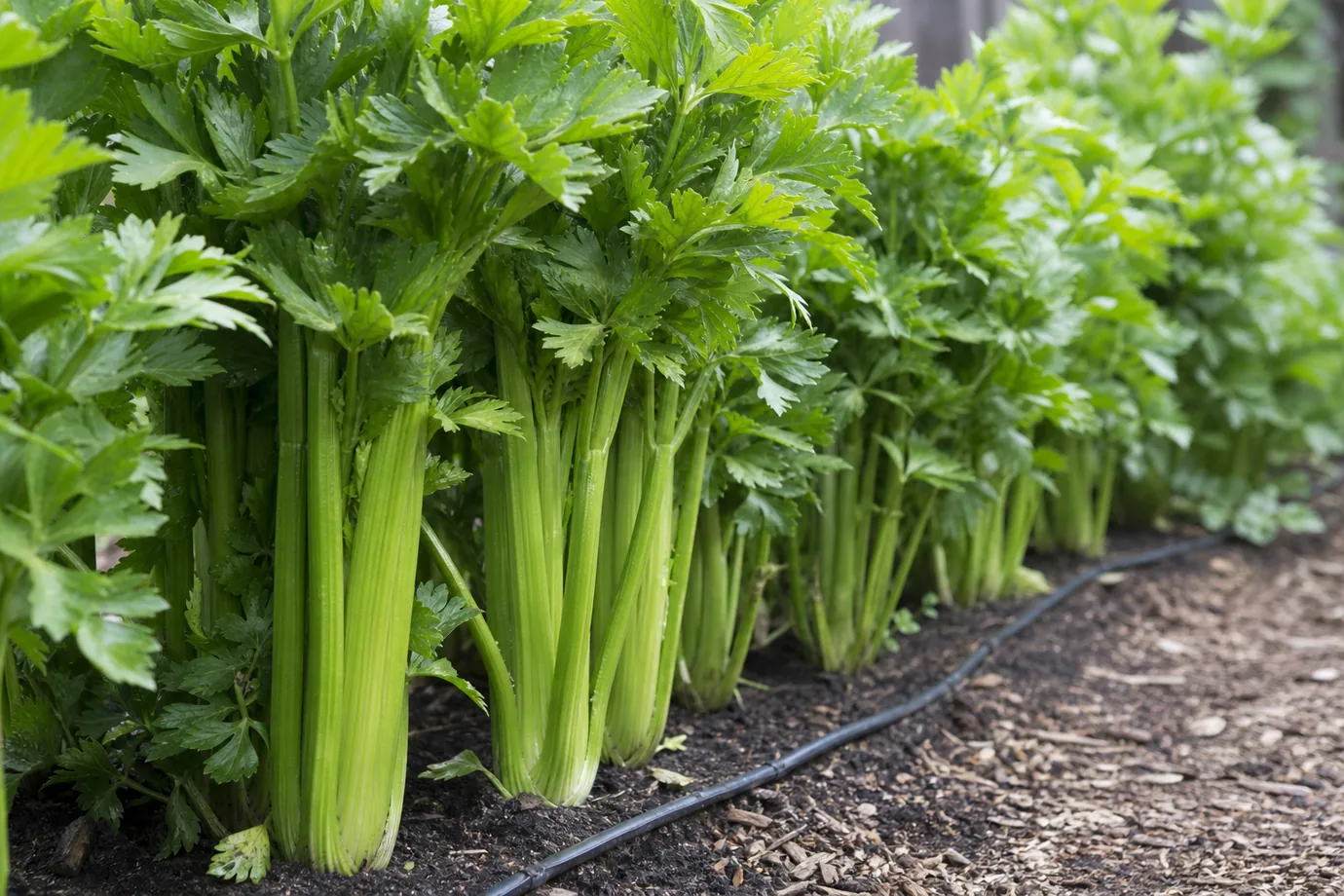
Celery has a reputation as one of the fussiest crops in the vegetable garden, and it is partly deserved. It grows slowly, it wants cool but not cold weather, and it sulks the moment the soil dries out. Yet a row of your own celery, with dark stalks and a flavour that shop celery never matches, is well worth the effort. Growing Celery is mostly a matter of timing and water.
This guide follows the crop from a February seed tray to the autumn harvest. The advice comes from Utah State University Extension, the Texas A&M AgriLife celery guide by Dr. Joe Masabni, and Colorado State University Extension.
What Growing Celery Really Asks For
Celery is a relative of carrots and parsley. Unlike them, however, it has a small, shallow root system, and that single fact explains most of its needs. USU describes it as a poor nutrient forager that does not compete well with weeds. The roots cannot reach far for food or water, so you have to bring both to them.
Before you start, check that you can give it:
- Mild temperatures. USU gives an ideal range of 55 to 65°F, and Texas A&M says celery does best when the monthly mean temperature is 60 to 70°F.
- A long season. Texas A&M counts 100 to 135 days from planting to harvest.
- Steady moisture. USU calls for at least 1 to 2 inches of water a week.
- Rich soil. USU prefers fertile, well-drained soil with plenty of organic matter.
Heat is the real enemy. Texas A&M notes that average highs above 75°F in the month before harvest limit growth and quality. In hot-summer regions, therefore, many gardeners grow celery as an autumn crop instead.
Choosing Varieties
Most garden celery belongs to the green Pascal type. USU singles out ‘Utah’ and ‘Pascal’, which stay green when ready to eat and are, in its words, of the finest quality. Texas A&M lists ‘Conquistador’, ‘Florida 683’, ‘Summer Pascal’ or ‘Giant Pascal’, and ‘Utah 52-70’.
If you mainly want flavour for soups and stock, leaf celery is an easier alternative. It forms thin stems and plenty of leaves, and it forgives irregular watering far better than stalk celery.
Starting Celery From Seed
Celery is almost always grown from transplants. Texas A&M explains why: it is difficult to get an even stand from seed sown directly in the garden. As a result, the season starts indoors, and it starts early. USU sows its seed around February 1 in Utah.
To work out your own date, count back from your last spring frost; Seed Starting Calendar: How to Plan Your Vegetable Gardening Year shows how.
Getting the Seeds to Germinate
Celery seed is tiny and slow. USU notes that it germinates better if you soak it in water first and change the water every day. After soaking, sow it on the surface and barely press it in, since the seed needs light.
Use a fine, light medium. Seed Starting Mix: What to Buy, How to Make It and Why Garden Soil Fails explains what to fill the trays with. Keep the surface evenly damp, because a single drying out can end the job. Watering from below is the gentlest method; Bottom Watering Seedlings: The Best Way to Prevent Overwatering and Fungus Gnats walks through it.
When to Plant Celery Outdoors
Timing the move outdoors is the most delicate step in growing celery. Colorado State classes celery as a tender vegetable. It grows with daytime temperatures above 55°F and does not tolerate frost. Texas A&M sets the optimum time for transplanting as when air temperatures are above 50°F.
The reason for caution is bolting. Texas A&M notes that temperatures below 40 to 55°F induce it. USU says that plants exposed to cool temperatures for several weeks will flower. Once a celery plant sends up a flower stalk, its stems turn tough and stringy. What is Bolting: How to Prevent Your Leafy Greens from Flowering Early explains the process in more detail.
So do not rush. USU recommends transplants with 3 to 4 mature leaves and a well-established root system. Harden them off gradually over a week or so; Hardening Off Plants: How Much Stress Is Enough covers how far to push them. If a cold night threatens after planting, a light cover helps; Floating Row Covers: Protecting Brassicas from Pests and Frost shows how to lay one.
Soil and Spacing for Growing Celery
Texas A&M recommends a pH of 6.0 to 7.5 and soil with good water-holding capacity. If you have not tested yours recently, Soil pH Testing: How to Take a Sample That Means Something explains how to do it properly.
USU suggests working in compost, but it sets a limit of no more than 1 inch of well-composted organic matter per 100 square feet. Then plant as follows:
- Set out the rows. USU spaces rows 2 feet apart.
- Space the plants. USU places plants 12 inches apart in the row.
- Plant at the same depth. Set each transplant at the depth it grew in the pot, and water it in well.
Closer spacing gives thinner, paler stalks, since the plants shade each other. Wider spacing gives heavier plants. For home use, USU suggests 5 to 10 plants per person.
Feeding Celery
Because the roots are so small, celery needs a good supply of nutrients close at hand. USU recommends a complete fertilizer with a high ratio of potassium, such as 4-4-8, before planting.
During the season, USU advises side-dressing with nitrogen at ¼ cup of 21-0-0 per 10 feet of row, at 4 and 8 weeks after transplanting. Texas A&M likewise splits the nitrogen, applying half before planting and the rest as side-dressings from 3 weeks after transplanting. It adds a warning, though: keep each side-dressing small, to prevent excessive growth.
Watering: The Heart of Growing Celery
If you remember only one thing about growing celery, make it this: never let the soil dry out. USU says good watering is essential and calls for at least 1 to 2 inches a week. It also advises soaking the soil thoroughly each time, because the root system is small and shallow.
Texas A&M stresses that uniform water distribution is a must, with peak demand in the last month before harvest. Stress at that stage leads to stringy, hollow or bitter stalks.
Drip irrigation suits celery well, since it delivers water evenly and keeps the leaves dry; Drip Tape Installation: DIY Micro-Irrigation for Efficient Veggie Gardens shows a simple setup.
Mulch and Weeds
Weeds are a real threat, because young celery grows slowly and cannot compete. USU recommends frequent, shallow cultivation, which avoids damaging the shallow roots. It also suggests black plastic mulch, which warms the soil, conserves water and controls weeds, or a mulch of compost. Organic Garden Mulch: How Deep to Lay It and When to Wait explains how to use organic mulches.
Blanching Celery Stalks
Blanching means shading the stalks for the last few weeks, so they turn paler and milder. Traditionally, gardeners wrapped the plants in cardboard or newspaper, or banked soil around them. However, modern green varieties such as ‘Utah’ and ‘Pascal’ are meant to be eaten green. Blanching is therefore optional, and many gardeners skip it, because green stalks keep more flavour and more vitamins.
Pests, Diseases and Disorders
Celery has a handful of problems worth knowing.
Aphids
USU notes that aphids make the leaves crinkled and curled. It suggests insecticidal soap, a strong jet of water or an appropriate insecticide. Aphid Control Methods: When to Spray and When to Wait helps you decide when action is needed.
Other Pests and Diseases
Texas A&M lists leafminers, loopers, armyworms and cutworms among the insect pests. USU adds powdery mildew, which starts as white patches on the older leaves.
Blackheart
Blackheart turns the young leaves at the centre of the plant black. USU explains that it is a localised shortage of calcium, which cells need to develop. Usually the soil holds enough calcium, but uneven watering stops the plant from moving it to the growing tip. For persistent cases, Texas A&M mentions a calcium spray directed at the plants. It is the same problem that causes blossom-end rot in tomatoes; Identifying and Preventing Blossom-End Rot in Your Vegetable Crop explains the link between water and calcium.
Harvesting and Storing Celery
You do not have to wait for the whole plant. USU suggests harvesting individual stalks from the outside once they are a foot or more long. The centre keeps growing, so you can pick for weeks. Whole plants, USU adds, are ready when they are 3 inches or more across.
Celery tolerates a light chill in autumn, and USU gives its minimum temperature as 36°F. Still, harvest the whole crop before a hard freeze. First Frost Date: How to Find Yours and Protect Your Crops helps you plan the last picking.
USU says celery keeps in the refrigerator for up to 2 weeks. For longer storage, chop and freeze it for cooking; Blanching Vegetables: Times, Steps and Why It Matters Before Freezing gives the method.
Make Growing Celery Part of Your Season
Start early, plant out when the nights are mild, feed little and often, and above all keep the water coming. Do those four things well, and growing celery stops being a gamble. Instead, it becomes one of the most satisfying harvests of the year.
Check out the author’s book here: The Year-Round Vegetable Garden for Beginners.


Leave a Reply