
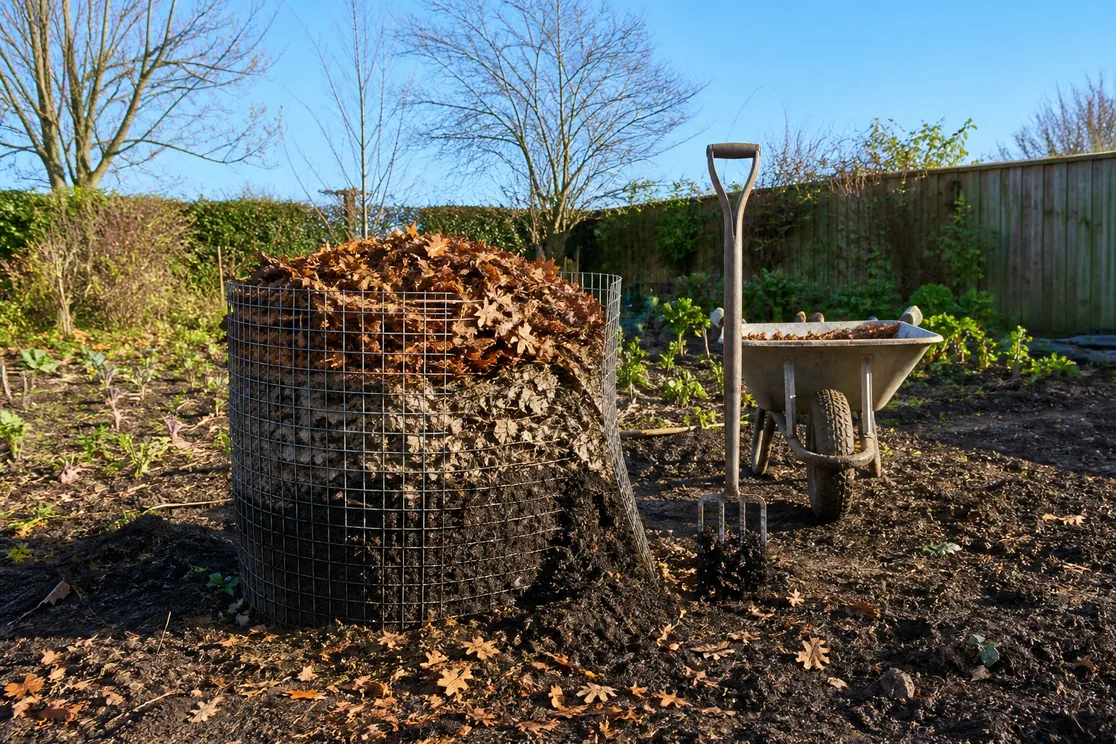
Every October the same free resource lands on the ground and most of it goes out with the trash. Leaf mold compost is what happens when you leave those leaves alone in a heap for a year: they turn into a dark, crumbly, sweet-smelling material that does more for soil structure than anything you can buy.
It costs nothing. It needs no turning, no green-to-brown ratio, no thermometer, and no skill. The only two things it asks for are water and patience, and one of those is free as well.
Leaf Mold Compost at a Glance
| What it is | Leaves broken down by fungi, not bacteria |
| Time | 6 to 12 months shredded, 1 to 2 years whole |
| Effort | Build the pile, wet it, walk away |
| Nutrients | Very low — this is a conditioner, not a feed |
| Water holding | Several times its own weight |
| You need | Leaves, wire fencing or bin bags, a hose |
| Best time to start | Late October and November |
| Where | Semi-shade, so the pile does not dry out |
What Leaf Mold Compost Is, and Why It Is Not Compost
A compost heap is a bacterial process. It runs hot, it wants nitrogen, and it needs turning and balancing.
Leaves are the opposite material. They are high in carbon, high in lignin, and low in nitrogen, so bacteria make slow work of them. Fungi take over instead, and fungi work cold and slow.
That is the entire difference. Penn State Extension’s guide, Leaves Are Treasure, Not Trash, describes the finished material as dark brown, crumbly, and earthy-smelling, which is exactly what a year of neglect produces.
So leaf mold compost is not a failed compost heap. It is a different product from a different process, and you would not want to hurry it into being the other one. The bacterial route is covered in composting 101, and the two run side by side very happily.
Why Free Leaves Beat a Bag of Anything
The nutrient content is close to nothing. What you are buying with your patience is structure.
- Water holding. Leaf mold soaks up several times its weight and releases it slowly. A bed amended with it survives a dry fortnight that would flatten a bare one.
- Air. Crumb structure means channels, and channels mean roots and worms.
- Fungal life. A garden soil dominated by bacteria behaves differently from one with a healthy fungal network. Leaves feed the second kind.
- Cost. Nothing, forever, every autumn.
Set against a bag of bought conditioner it wins on every count except speed. And the case for building soil rather than feeding plants is the whole argument of regenerative gardening.
Which Leaves Rot Fast and Which Take Years
Thin leaves with little wax break down in a season. Thick, leathery, tannin-heavy ones can sit for three years.
| Fast, under a year | Slow, two years or more |
|---|---|
| Maple, birch, ash | Oak, beech, sweet chestnut |
| Cherry, poplar, elm | Holly, magnolia, sycamore |
| Hornbeam, willow, linden | Horse chestnut, evergreen leaves |
Mixing the two is fine and normal. If you have a lot of oak, shred it and give the pile an extra year, or keep it in its own bin so it does not hold up the rest.
Pine needles are a separate case. They break down very slowly, they are mildly acidic, and they make a better surface mulch than a bin ingredient, as noted in organic garden mulch.
Making Leaf Mold Compost in a Wire Bin
The bin is a formality. Its only job is stopping the leaves from blowing back across the lawn.
- Cut a length of wire fencing about ten feet long and three to four feet tall.
- Roll it into a cylinder and tie the ends together with wire or cable ties.
- Stand it in semi-shade, on bare soil so worms and fungi can walk in from below.
- Fill it with leaves, treading them down hard in layers as you go.
- Soak the pile with a hose until water runs from the bottom.
- Leave it alone. Check the moisture two or three times a year and add water in dry spells.
Making leaf mold compost really is that short a list. A single bin of that size swallows the leaves from several large trees, and the contents drop by two thirds within a couple of months.
Turning is optional. It speeds things up a little and it is a good excuse to check the middle is damp.
The Bag Method for Small Gardens
No room for a bin? Use black plastic sacks, which is how I started before there was space for anything else.
Fill each bag with damp leaves, stab a dozen holes in the sides with a fork, tie the top loosely, and stack the bags behind the shed. Fungi need air as well as water, so the holes are not optional.
Bags work faster than an open pile in a dry climate because they hold moisture. Check one in six months and the rest at a year.
Shredding Halves the Wait
One pass with a lawn mower over a spread of dry leaves is the single most effective thing you can do. Penn State puts the shredded timeline at six to twelve months against a couple of years for whole leaves.
Shredding works because fungi attack surfaces, and cutting a leaf into eight pieces multiplies the surface many times over. A mower with a bag collects and shreds in one pass.
A string trimmer in a dustbin does the same job on a smaller scale. Either way, shred dry and wet afterward — wet leaves clog everything.
Moisture Is the Whole Game
Nine failed piles out of ten are simply dry. Fungi cannot colonize a dry leaf, and a heap of dry oak will still be a heap of dry oak three years later.
The pile should feel like a wrung-out sponge, all the way through and not just on top. Rain alone rarely does it, because a mound of leaves sheds water like a thatched roof.
- Soak it when you build it, layer by layer rather than all at the end.
- Check the middle in midsummer by pushing your arm in. Dry and rustling means a hose.
- Cover with a tarp in a hot dry region, or leave it open where rain is reliable.
- Never seal it completely, in a bin or a bag, or it goes anaerobic and sour.
When Leaf Mold Compost Is Ready
There are two stages, and both are useful.
At six to twelve months the leaves are broken and dark but still recognizable. This is the coarse stage, and it makes an excellent surface mulch around brassicas, fruit, and perennials.
At eighteen months to two years it is fine, dark, and crumbly, with no leaf shapes left. It smells of woodland floor. That is the stage worth saving for potting and seed mixes.
Sieve the fine stuff through a garden riddle and throw the lumps back into the new pile. Maryland Extension notes that plants can be grown in 100% compost or leaf mold as a growing medium, which tells you how good the finished material is.
Five Ways to Use Leaf Mold Compost
- Mulch, two inches thick around anything perennial, in autumn or spring.
- Soil conditioner, forked into a bed or spread on top and left for the worms — the no-dig way.
- Potting mix, one part leaf mold to one part garden soil and one part sharp sand.
- Seed starting, sieved fine and mixed half and half with sand, since low nutrients suit seedlings.
- Raised bed filler, as the organic fraction of the mix described in raised bed soil mix.
It pairs well with the richer amendments rather than replacing them. Worm castings bring the biology and a little feed, as set out in using worm castings, while the leaves bring the structure.
Leaves Straight Onto the Beds, No Bin Needed
Not every leaf has to go through a pile first. An empty vegetable bed in November is bare soil losing structure to the rain, and a blanket of leaves fixes that for free.
Shred them, spread them three or four inches deep over the cleared bed, and leave them. Worms pull the pieces down through the winter, and by April the bed is dark, open, and ready to plant into.
Two cautions apply. Whole unshredded leaves mat into a waterproof felt that sheds rain and smothers the soil, so shredding is not optional here. And a thick leaf layer keeps the ground cold in spring, so pull it aside two weeks before you plan to sow.
This is sheet composting rather than leaf mold, and it is the same principle as the layered beds in lasagna gardening. Where you want the soil actively improved rather than simply protected, a sown cover crop does more, and the two can share a bed — leaves on the paths, green manure on the growing ground.
A Year in the Life of the Pile
The whole cycle needs about twenty minutes of work, spread over twelve months.
October and November. Rake, shred, fill the bin, tread it down, soak it. This is the only day that takes any real effort.
December to February. Nothing. Rain does the work, and the pile sinks by half.
March. Push an arm into the middle. If it is dry, run a hose into it for ten minutes.
June to August. The one job that matters. Check the moisture twice through the summer, because a hot dry spell stops fungal decay dead and the pile simply waits until autumn.
Next October. Fork off the top layer of half-rotted leaves and use it as mulch. The bottom third is usable leaf mold compost. Then build the new pile beside it.
Two bins running a year apart is the arrangement that works: one filling, one finishing. After the second autumn you always have a bin ready and never wait again.
Leaves to Keep Out of the Pile
Most leaves are fine. Four kinds are not.
Black walnut (Juglans nigra) leaves and hulls contain juglone, which stunts or kills tomatoes, peppers, eggplants, and potatoes. Two years of composting reduces it but does not reliably remove it, so keep walnut out of any pile destined for the vegetable garden.
Roadside leaves carry whatever the road carries — salt, oil, brake dust. Sweep your own garden and your neighbor’s, not the verge.
Heavily diseased leaves from a tree with a fungal problem are better burned or binned than spread around next spring.
Leaves off a lawn treated with a persistent broadleaf herbicide can carry residue that damages tomatoes and beans. If the lawn was sprayed this year, keep those clippings and leaves out.
Everything else is welcome, including leaves with ordinary spots and holes in them. Those blemishes are the work of insects and weather, and both disappear entirely in the pile.
What Goes Wrong With Leaf Mold Compost
| Problem | Cause | Fix |
|---|---|---|
| Nothing has happened in a year | The pile is dry inside | Soak it thoroughly and cover |
| Slimy, sour, black layers | Sealed bag, no air | Punch holes, break up the mass |
| Still whole leaves after two years | Oak or beech, unshredded | Shred next time, or give it a third year |
| The pile blew away | No bin, exposed site | Wire cage, and tread the leaves down |
| Ants and dryness together | Too much sun on the pile | Move it into semi-shade |
Leaf Mold Compost Questions Answered
Can I just pile leaves on the vegetable bed instead?
Yes, and it works, but whole leaves mat down and shed rain. Shred them first, or use the coarse half-rotted stage rather than fresh leaves.
Do I need to add nitrogen to speed it up?
No, and adding it changes the process. A handful of grass clippings per layer will warm the pile toward ordinary composting, which gives you compost rather than leaf mold.
Will it make my soil acidic?
Not meaningfully. Fresh leaves are mildly acidic, and finished leaf mold sits close to neutral.
Can I use it as fertilizer?
No. Nutrient levels are very low by design. Use it for structure and water holding, and feed separately with the materials in soil amendments.
How much do I need?
More than you think, and the pile shrinks to roughly a fifth of its starting volume. Fill two bins if you have the leaves.
One Autumn Job, Paid Back for Years
Rake the leaves, cage them, wet them, and forget them until next autumn. Leaf mold compost is the least demanding thing in the garden and one of the most useful, and the only mistake that really matters is letting the pile go dry. Start a new bin every year and you will never buy a conditioner again.
Check out the author’s book here: The Year-Round Vegetable Garden for Beginners.


Leave a Reply