
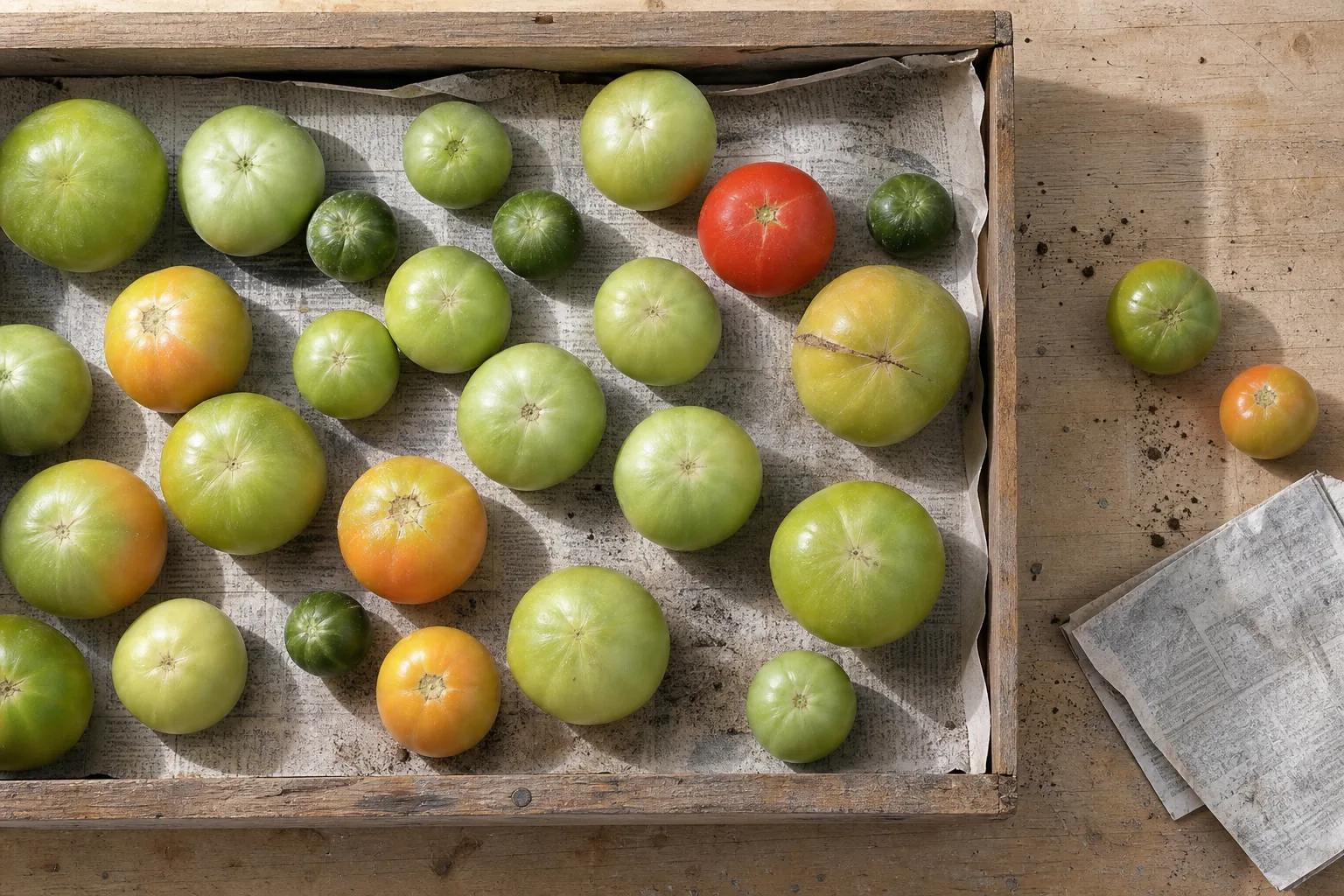
Every tomato season ends the same way. A frost is forecast, the vines are still loaded, and half the fruit is hard and green. Ripening green tomatoes indoors is the standard rescue. It works far better than most gardeners expect, but only on the right fruit and only in the right conditions.
The part nobody explains is that a green tomato is not one thing. Some are two days from turning and some will never turn at all. You can tell them apart in about three seconds. That test is the whole article, and everything else is storage.
Ripening Green Tomatoes at a Glance
| What ripens | Fruit at the mature green stage or later |
| What does not | Small, hard, matte fruit with no gel inside |
| Best temperature | 55 to 70°F |
| How long | 1 to 2 weeks at 70°F, up to a month at 55°F |
| Below 50°F | Flavor is ruined, texture goes mealy |
| Light needed | None at all |
| Layers | One deep, never stacked |
| Check every | 2 to 3 days, removing anything soft |
Which Green Tomatoes Will Ripen and Which Never Will
A tomato (Solanum lycopersicum) ripens off the vine because the fruit finishes itself. Once it has reached full size and formed its seed gel, it carries everything it needs. All it wants is warmth and ethylene, and it makes both itself.
Before that point the fruit is still growing and still drawing from the plant. Picking it ends the process for good. Those small hard ones will sit in the box for a month and then rot, still green.
So the sorting happens at the vine, not in the kitchen. Two piles: fruit that has a future, and fruit for the chutney pan.
The Mature Green Test
Three signs, and any two of them together are enough.
- Size. The fruit is as big as that variety gets. A beefsteak the size of a golf ball is not mature.
- Sheen. Mature green fruit is glossy and slightly pale, often with a whitish or cream star at the blossom end. Immature fruit is matte and dark green.
- Give. A very slight softness under thumb pressure, nothing like a ripe tomato but not stone hard either.
Cut one open if you are unsure. A mature green tomato has jelly around the seeds, and the seeds slide rather than cut. Cornell’s growers use the same indoor ripening method at the end of their season. The sorting is where it succeeds or fails.
Any fruit already showing a blush of color is at the breaker stage, and that one is a certainty. Breakers ripen fastest and taste closest to vine-ripened.
Picking Before the Frost Takes Them
Tomatoes are frost-tender in the strictest sense. A light frost blackens the foliage, and fruit exposed to freezing turns translucent and then mushy over the following days.
Pick when a hard frost is two or three nights away, not the morning after one. Work in dry weather and take the fruit with a short piece of stem, or none at all. Then handle it like eggs.
- Wipe each one dry and leave the skins clean.
- Reject anything cracked, punctured, or with a soft spot. One rotting fruit spoils the layer around it.
- Keep the breakers separate from the mature greens, because they will be ready weeks earlier.
Judging when a crop has finished is a skill of its own. The signals for a dozen others are in the guide to harvesting vegetables.
Ripening Green Tomatoes in a Box
Ripening green tomatoes in a box is what I use for anything over a dozen fruit, and it wastes the least.
- Line a shallow box with newspaper or a clean towel.
- Lay the fruit one layer deep, not touching, blossom end up.
- Cover loosely with a sheet of newspaper or a lid that does not seal.
- Put the box somewhere cool and dark — a spare room, a hallway cupboard, a basement stair.
- Check every two or three days and take out anything that has turned or gone soft.
Stacking is the mistake that costs a crop. Weight bruises the lower layer, bruises rot, and rot spreads through a closed box in days.
The Paper Bag and the Banana
For a handful of fruit, a paper bag is faster than a box. Put four or five tomatoes in with a ripe banana or an apple. Fold the top over and leave it on the counter.
Both of those fruits release ethylene, the gas that triggers ripening. The bag holds it around the tomatoes instead of letting it drift off. Expect a few days rather than a few weeks.
The bag has one drawback: it also holds moisture, and moisture grows mold. Open it daily, and never use plastic.
Hanging the Whole Vine
The old method still works, and it is the least effort of the three. Pull the whole plant and shake the soil off the roots. Hang it upside down in a garage, shed, or basement.
The fruit keeps ripening on the vine for weeks, drawing on what is left in the stems. It also takes up space and drops leaves everywhere. A garage floor suits it better than a spare room.
Hang it somewhere that stays between 55 and 70°F, and check the fruit as you would in a box. Whole-vine ripening is the same trick as curing a squash on the plant, described in storing winter squash.
Ripening Green Tomatoes Faster or Slower
Temperature is the dial that decides how fast ripening green tomatoes happens, and it is the only one you really control.
| Storage temperature | What happens |
|---|---|
| 70°F | Ripe in one to two weeks, all at once |
| 60-65°F | Two to three weeks, staggered |
| 55°F | Up to a month, a few at a time |
| Below 50°F | Mealy texture and flat flavor, permanently |
That last row is worth taking seriously. Chilling injury is not reversible, which is why an unripe tomato should never go into the refrigerator. Split the crop between a warm room and a cool one. That alone stretches the harvest from October into late November.
Why Light Has Nothing to Do With It
Windowsill ripening is the most common piece of bad advice in gardening. Ripening is not photosynthesis; it is a hormone-driven process that runs on ethylene and warmth alone.
A sunny sill does two unhelpful things. It heats one side of the fruit far above the ideal range, and it can scald the skin outright. Any warm, dark place beats it.
The color you want comes from lycopene, and lycopene production stalls above about 85°F. Sun and heat both work against you here. It is the same reason summer tomatoes go blotchy and yellow-shouldered in a heat wave.
Sorting Every Few Days
The whole method lives or dies on this habit, and it takes two minutes.
Lift the cover and run your eye over the layer. Pull three categories: anything fully red, anything softening, anything with a spot. Ripe fruit goes to the kitchen. Softening fruit gets used today. Spotted fruit goes out, not back.
Losses of ten to twenty percent are normal even when you do everything right. A note of what you picked and when tells you next year whether to pick earlier. It is one more use for a garden journal.
Ripening Green Tomatoes on the Vine
Ripening green tomatoes starts outdoors. There are two more weeks to be had before the frost, if you push the plant toward it.
- Stop watering in the last fortnight. Mild stress moves the plant from growing to ripening.
- Cut off all new flowers and small fruit. They will never finish, and they are drinking resources.
- Top the plant by cutting out the growing tips, so nothing new starts.
- Strip the lower leaves to move air and light around the trusses.
None of this works on a plant that is still racing upward, which is why the habit matters. The difference is set out in determinate vs indeterminate tomatoes. On a sprawling indeterminate the end-of-season cuts are heavier, as described in pruning indeterminate tomatoes.
Minnesota Extension’s tomato guide covers the season that leads up to this point. Most late-season disappointments start much earlier than October.
Ripening Green Tomatoes by Variety
Not every tomato behaves the same way once it leaves the plant, and knowing which is which saves a lot of disappointment.
Cherry and grape types ripen fastest of all, often within a few days. They also split easily, so handle them least and check them daily. Any that shows a crack goes straight to the kitchen.
Paste tomatoes — Roma, San Marzano and their kin — are the best keepers in the box. Thick walls and low water content mean they bruise less and rot later, and a mature green paste tomato will happily sit for a month at 55°F.
Beefsteaks are the least reliable. They are big, they are mostly water, and they carry the most weight on any bruise. Pick them first when frost threatens, keep them in a single layer with nothing touching, and eat them early in the sequence.
Cherry-sized fruit on a determinate plant often finishes on the vine anyway, since the whole plant sets and ripens in one narrow window. The habit difference is worth knowing before the last week of the season.
Small-fruited compact plants are the easiest of the lot to bring indoors whole, pot and all, which is one more argument for the kinds described in dwarf tomato varieties.
One general rule cuts across all of them. The thicker the wall and the drier the flesh, the better the fruit travels through a month in a box.
What to Do With the Ones That Stay Green
Immature fruit is not wasted, it is just a different vegetable. Fried green tomatoes, green tomato chutney, salsa verde, and pickles all use fruit that would never have ripened.
A note on the plant itself. The leaves and stems of a tomato contain tomatine and are not edible, for people or for pets. Green fruit contains far less, and has been cooked and eaten for generations, but it belongs in the pan rather than the salad bowl. Keep the pulled vines out of reach of dogs and away from grazing animals.
A green tomato also behaves differently in the pan. It is firmer, more acidic, and holds its shape through frying or long cooking in a way a ripe one never does, which is why the traditional recipes all treat it as its own ingredient rather than an unfinished tomato.
Compost the rest, unless the plants showed blight or leaf spot. Diseased tomato vines go in the trash. The ground goes to something else next year, under a proper crop rotation.
What Goes Wrong When Ripening Green Tomatoes
| Problem | Cause | Fix |
|---|---|---|
| Fruit rots without turning | Picked immature, or bruised | Use the mature green test, handle gently |
| Whole box goes moldy | Stacked layers, or a sealed container | One layer, loose cover, check often |
| Mealy, tasteless fruit | Stored below 50°F | Never refrigerate unripe tomatoes |
| Everything ripens at once | Stored too warm | Split the crop between two rooms |
| Shriveled skins | Air too dry, or too warm | Cool the room, cover more closely |
Ripening Green Tomatoes Questions Answered
How long does it take?
One to two weeks at 70°F, and up to a month at 55°F. Breakers, the ones already showing color, take a few days.
Do I need a banana in the box?
Not for a boxful. Ethylene from the tomatoes themselves is enough in an enclosed space. A banana is worth it in a paper bag with only a few fruit.
Will they taste as good as vine-ripened?
Breakers come very close. Mature green fruit ripened indoors is milder and slightly less sweet. It still beats a supermarket tomato in November.
Can I ripen them in the fridge?
No. Below 50°F the flavor compounds break down and the flesh goes mealy. Neither comes back when you warm the fruit up again.
Should I wash them before storing?
Wipe them with a dry cloth instead. Washing leaves a film of water in every dimple and around the stem scar, and that is exactly where mold starts. Any real soil comes off easily once the skin is dry, and a fruit that needs scrubbing is a fruit to eat this week.
What about the small hard ones?
They will not ripen. Cook them as green tomatoes, or compost them if the plants were healthy.
The Season Does Not End at the Frost
Ripening green tomatoes turns the last panic of the season into six more weeks of eating. Sort at the vine and keep only the fruit that has a future. Lay it one layer deep somewhere cool and dark, and look at it every couple of days. The rest goes in the chutney pan, which is no loss at all.
Check out the author’s book here: The Year-Round Vegetable Garden for Beginners.


Leave a Reply