
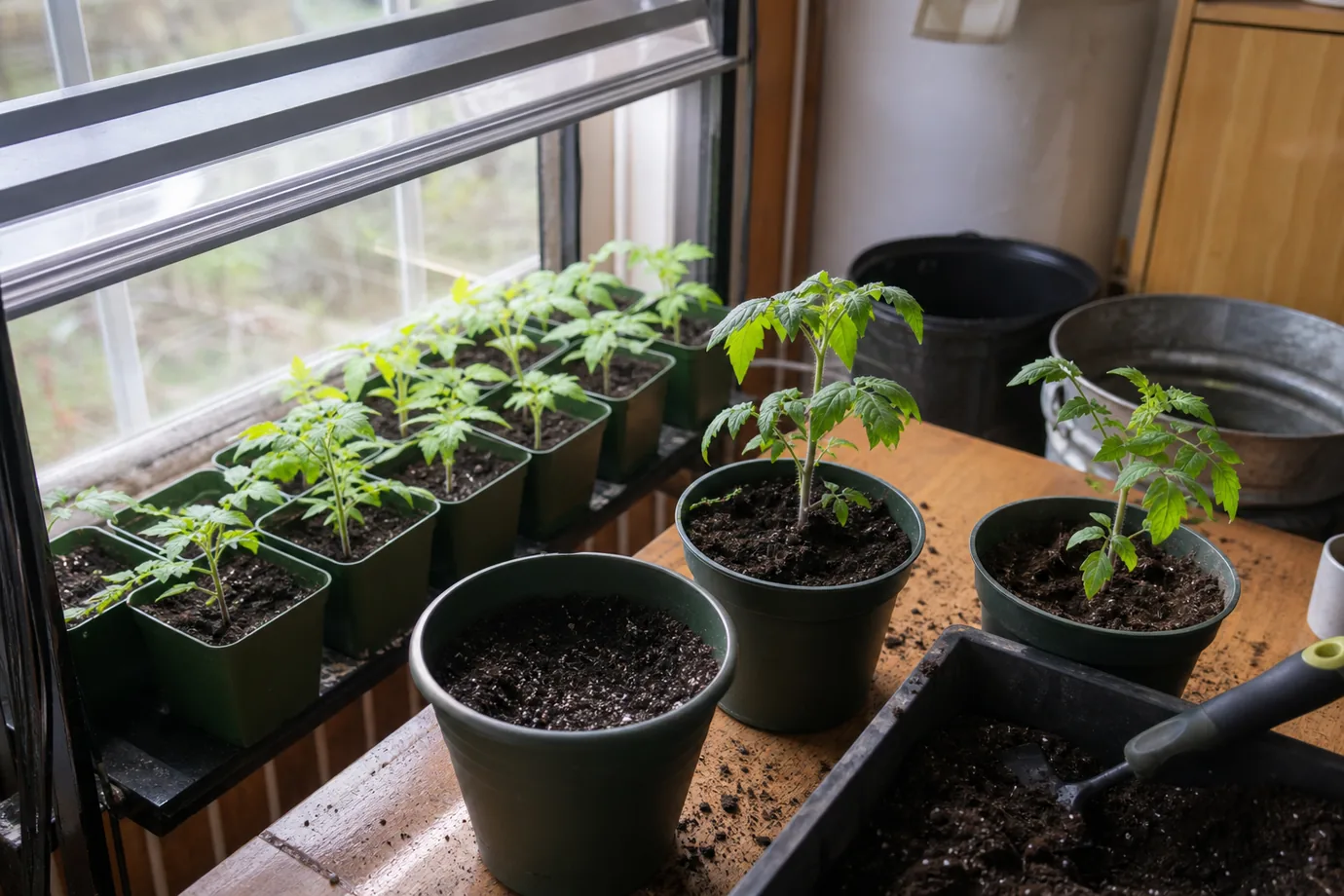
A garden centre sells perhaps a dozen tomato varieties. A seed catalogue sells hundreds: paste tomatoes for sauce, tiny currant types, striped heirlooms, compact plants for a balcony. Growing Tomatoes from Seed is the only way to get most of them, and it costs a fraction of the price of buying plants. It is also one of the easiest crops to raise indoors, provided you get the timing, the warmth and the light right.
This guide follows a tomato from the seed packet to the garden bed. The figures come from Oregon State University Extension and Utah State University Extension, whose advice on raising transplants is clear and practical.
Growing Tomatoes from Seed at a Glance
- When to sow: six to eight weeks before you plan to plant out.
- Germination: a warm mix, 60 to 70°F or a little above, and seedlings in about 6 to 10 days.
- Light: 14 to 16 hours a day, with the lamps close to the leaves.
- Growing on: 65 to 70°F, with nights a few degrees cooler.
- Potting up: into pots at least 2 to 3 inches wide once the first true leaves appear.
- Planting out: after the last frost, into soil that has reached at least 60°F.
Choosing Varieties Before You Sow
The choice you make at the seed rack shapes the whole season. Start with growth habit. Determinate tomatoes stop at a fixed height and ripen their crop over a few weeks, while indeterminate ones keep growing and fruiting until frost; Determinate vs Indeterminate Tomatoes: Choosing the Right Variety explains which suits your space. For pots and small beds, Dwarf Tomato Varieties: Heavy Yields for Small Spaces and Containers lists compact types that still crop well.
Next, decide between open-pollinated and hybrid seed. Heirlooms offer flavour and the chance to save your own seed, while many hybrids add disease resistance; Heirloom vs Hybrid: Choosing the Best Vegetable Varieties for Your Garden weighs the two. Finally, check the days to maturity on the packet. In a short summer, an early variety is the difference between a harvest and a bowl of green fruit; Reading Seed Packets: A Guide to Understanding Maturity Timelines shows how to read those numbers.
When to Start Tomato Seeds
Oregon State says it takes 5 to 8 weeks to produce good plants from seed, depending on the temperature, and Utah State allows 6 to 8 weeks. Work backwards from your planting-out date, not from the calendar. Tomatoes go outside only after the danger of frost has passed, so find your average last frost date first and count back six to eight weeks. Seed Starting Calendar: How to Plan Your Vegetable Gardening Year walks through the arithmetic.
The most common mistake is sowing too early. A tomato kept indoors for twelve weeks becomes tall, pot-bound and starved of light, and it often sulks for weeks after planting out. A younger, sturdier plant usually catches up and overtakes it.
Sowing: Mix, Depth and Warmth
Use a fresh, fine seed-starting mix rather than garden soil. It drains freely, holds air and carries few disease spores; Seed Starting Mix: What to Buy, How to Make It and Why Garden Soil Fails explains what to look for.
Sow in individual cells or in a shallow tray. If you use a tray, Oregon State advises against sowing more than 6 to 8 seeds per square inch, so that the seedlings are easy to separate later. Cover the seed lightly with mix, water gently and put a clear cover over the tray to hold in moisture.
Warmth drives germination. Oregon State puts the best soil temperature at 60 to 70°F, and Utah State germinates at 80°F until the root appears. A heat mat under the tray is the simplest way to get there. Once the first seedlings break the surface, remove the cover and take the tray off the heat.
If you are unsure whether an old packet is still good, test a few seeds on a damp paper towel before sowing the whole lot; Seed Germination Test: How to Check If Your Old Seeds Will Grow shows the method.
Light: The Step Most People Get Wrong
A south-facing windowsill is rarely enough in early spring. Seedlings lean towards the glass, stretch and turn pale. Utah State recommends 14 to 16 hours of light a day from lamps hung only 2 to 3 inches above the plants, raised as they grow. Modern LED shop lights do the job well and run cool, so they can sit close without scorching the leaves.
If your seedlings are already tall and thin, the cause is almost always too little light, too much warmth, or both. Leggy Seedlings: How to Fix Weak Plant Stems explains how to rescue them. A small fan blowing gently across the tray for part of the day also helps, because the movement makes the stems thicker.
Temperature and Watering for Tomato Seedlings
After germination, the plants want to be a little cooler. Utah State grows them on at 65 to 70°F, and notes that seedlings generally do best with nights 60 to 65°F and days about ten degrees warmer. A cool room with good light produces a sturdier plant than a warm room with poor light.
Water when the surface of the mix begins to dry, and let it dry slightly between waterings, but never let the seedlings wilt. Constantly wet mix invites fungus gnats and root problems. Watering from below keeps the stems and the surface dry; Bottom Watering Seedlings: The Best Way to Prevent Overwatering and Fungus Gnats walks through it.
The biggest risk at this stage is damping off, a fungal disease that makes seedlings collapse at the soil line. Clean pots, fresh mix, good air movement and moderate watering prevent most cases; Damping Off Disease: How to Prevent Seedling Rot and Fungal Death covers the rest.
Potting Up Tomato Seedlings
When the first true leaves appear, Oregon State advises moving the seedlings into containers at least 2 to 3 inches in diameter. Hold each seedling by a leaf, never by the stem, and lift it out with a pencil or a plant label under the roots.
Here tomatoes have an advantage over most crops. They form roots along any part of the stem that is buried, so you can set each seedling deeper in its new pot, right up to the seed leaves. The buried stem becomes extra root, and the plant ends up shorter and sturdier.
Utah State suggests potting up again when the leaves start to overlap with their neighbours, or when the roots form a thick mat at the bottom of the pot. Many gardeners move tomatoes twice: once into a small pot, then into a 4-inch or larger pot a few weeks before planting out.
Feeding Seedlings
Seed-starting mix contains little nutrition, so seedlings need feeding once they have true leaves. Utah State recommends a complete fertilizer diluted to half strength, applied weekly. It also warns that too much fertilizer produces soft, rapid growth, weak stems and plants that attract pests. Pale lower leaves mean a feed is due; lush, floppy growth means you are overdoing it.
Hardening Off Before Planting Out
Seedlings raised indoors have never felt wind, full sun or cold nights. Utah State recommends starting about two weeks before transplanting, first in shade and then with more sun each day, and keeping tomatoes out of temperatures below 45 to 50°F. Oregon State describes the same process: a gradual increase in exposure to cooler air, lower humidity and brighter light. Hardening Off Plants: How Much Stress Is Enough sets out a day-by-day routine.
Planting Out: Soil Temperature Comes First
The last frost date is only half the test. Tomatoes also need warm soil. Utah State plants when the soil is warmer than 60°F, and Oregon State notes that tomatoes prefer 65°F or warmer. In cold soil the plants simply stop growing, and they may never make up the lost time. A cheap soil thermometer settles the question; Soil Temperature for Planting: When to Safely Sow Warm-Season Crops explains how and when to read it.
According to Utah State, the transplants that grow away fastest are stocky and dark green, with 5 to 7 leaves and a height of 6 to 10 inches. Plant them deeper than they grew in the pot. For a leggy plant, Oregon State suggests setting it in the ground up to the first leaves, or laying it at about a 30-degree angle in a furrow so that only the top 5 or 6 inches show.
Utah State spaces transplants 2 feet apart, in rows 2 to 3 feet apart. Put in stakes or cages at planting time, before the roots spread, and mulch once the soil has warmed.
Common Problems When Growing Tomatoes from Seed
- No germination. The mix was too cold, too wet or too dry, or the seed was old. Warmth is the usual fix.
- Tall, thin seedlings. Not enough light, too much heat, or sown too early. Lower the lamps and cool the room.
- Seedlings collapsing at the base. Damping off. Improve air movement, water less and use fresh mix next time.
- Purple undersides on the leaves. Often a sign of cold roots or a lack of phosphorus. It usually fades once the plants are warmer and fed.
- Plants stalled after planting out. Cold soil or not enough hardening off. They generally recover once the weather warms.
Frequently Asked Questions
How long does Growing Tomatoes from Seed take before planting out?
Allow six to eight weeks from sowing, according to Utah State, and five to eight weeks according to Oregon State, depending on temperature.
Is Growing Tomatoes from Seed cheaper than buying plants?
Almost always. A single packet costs about the same as one nursery plant and holds dozens of seeds. The real cost is a grow light, which lasts for many seasons.
Can I sow tomato seeds directly in the garden?
In regions with long, hot summers, yes. Utah State spaces direct-seeded plants 18 inches apart. In most climates, however, the season is too short, and starting indoors gives the plants the head start they need.
Why plant tomato seedlings deeper than other crops?
Because tomatoes make roots along a buried stem. Deep planting gives a bigger root system and a sturdier plant, which is why it works so well for leggy seedlings.
Your First Tomatoes From Seed
Count back from your frost date, sow in a warm fresh mix, give the seedlings strong light and a cool room, and pot them up deep. Harden them off for two weeks and wait for warm soil. Follow those steps, and growing tomatoes from seed gives you better plants than the garden centre, in exactly the varieties you want. For the season that follows, Pruning Indeterminate Tomatoes: Maximizing Yields and Airflow is the natural next read.
Check out the author’s book here: The Year-Round Vegetable Garden for Beginners.
Leave a Reply