
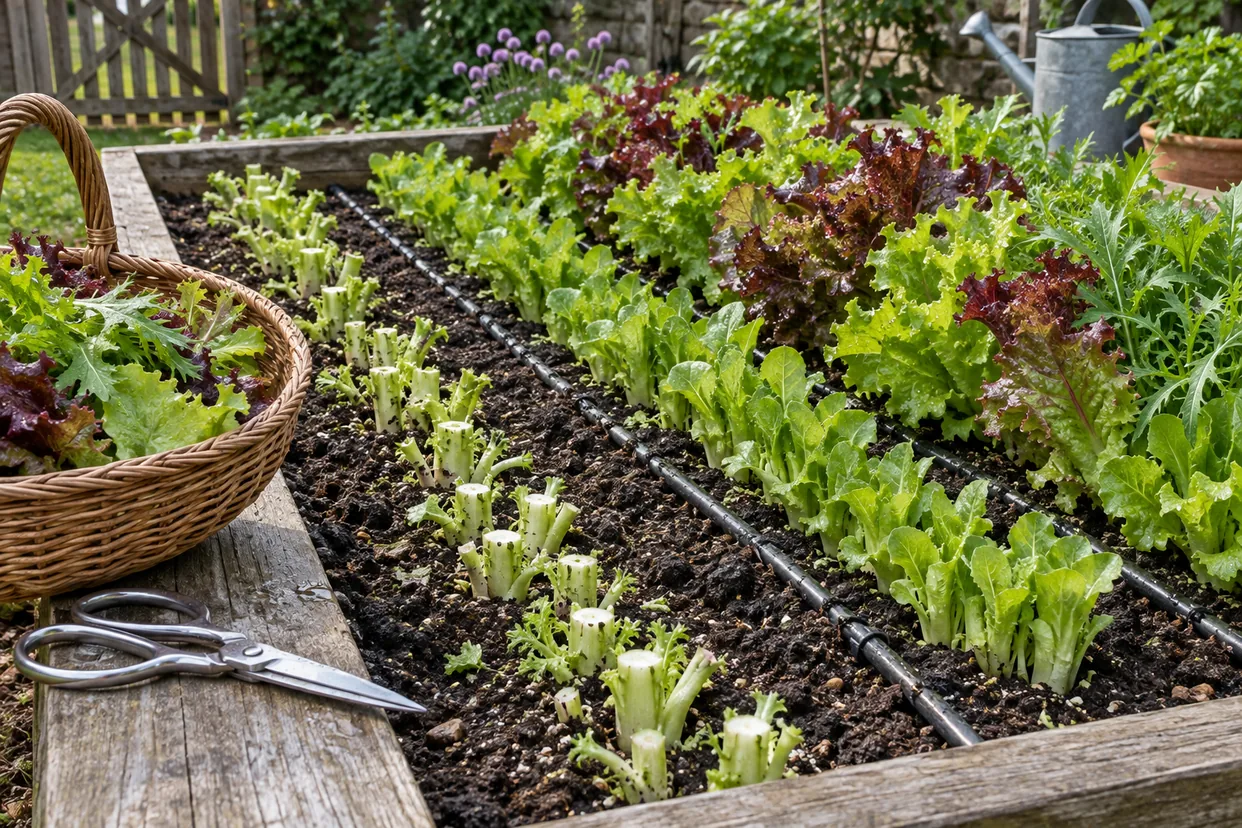
A single row of lettuce can feed you once, or it can feed you for two months. The difference lies almost entirely in how and where you cut it. If you pull the whole plant, the row is finished. If you cut the leaves and leave the base in the soil, the plant grows a new set, and you can return to it again and again. This is the idea behind cut and come again gardening. It turns a few square feet of greens into a steady supply, and it costs nothing but a little attention. This guide explains which crops respond to it, where and when to cut, and how to keep the plants productive for as long as possible.
What Cut and Come Again Gardening Means
The name of this method describes what you do quite literally. You cut part of the plant, and then you come back later for more. The key is that you never remove the growing point, which is the part of the plant that makes new leaves. As long as that point survives, along with enough leaves to feed the roots, the plant keeps producing.
There are two main ways to harvest a plant like this. The first is to cut a whole clump of young leaves a little above the soil, as you would with a patch of baby greens. The second is to pick single outer leaves one at a time, while the center of the plant keeps growing. Both methods work, but each suits different crops. In practice, most gardeners use both in the same bed, depending on what they grow.
The approach fits small spaces particularly well. A raised bed or even a large container can give you salad several times a week, because you harvest the same plants over and over instead of sowing new rows every time.
Crops That Suit Cut and Come Again Gardening
Not every vegetable regrows after cutting, so the choice of crop matters. Carrots, cabbages and heading lettuces give you one harvest and stop. The crops that work best are leafy plants that grow from a central crown, together with a few herbs and one brassica that surprises many beginners.
Leaf Lettuce and Salad Mixes
Loose-leaf lettuce is the classic crop for cut and come again gardening. The University of Maryland Extension, in its guide to growing lettuce, explains that you can cut leaf lettuce right above ground level with sharp scissors once it reaches 6 to 10 inches. If you water and feed the plants, they regrow quickly, and they are ready for a second cut in two to three weeks. The same page notes that you can start using leaves when the plants are only 5 to 6 inches tall, taking the older outer leaves first. For more detail on the crop itself, see our article on growing lettuce.
Salad mixes and baby greens work in exactly the same way. According to UMD’s page on salad greens, most of these plants are cut when they reach 4 to 8 inches, and baby lettuce is often ready in about 35 days. If you like a varied bowl, our guide to growing a mesclun mix covers the blends that suit repeated cutting.
Swiss Chard, Spinach and Asian Greens
Swiss chard is probably the most generous plant for this method. UMD advises snipping the leaves 2 inches above the crowns, which rejuvenates the plants, and it notes that chard can be harvested until frost. Young leaves under 4 inches long are tender enough for salads, while the larger ones are better cooked.
Spinach responds well to the outer-leaf method, although it bolts faster than chard once days grow long. Similarly, many Asian greens, such as mizuna, tatsoi and pak choi, regrow well after cutting while they are young.
Kale
Kale is a long-season option that can produce for several months. The University of Florida’s page on growing kale describes it as a “cut-and-come-again” vegetable. It advises harvesting the lower leaves individually and taking no more than one-third of the plant at a time. According to UF/IFAS, leaves can be picked about 70 to 80 days after sowing seed, or 55 days after setting out transplants.
Herbs
Many leafy herbs respond to regular cutting just as well as greens. For example, UF/IFAS recommends pinching the growing tips of basil, because regular harvesting makes the plant branch and grow bushier. It also advises pinching off flowers as soon as they form. Parsley, chives and cilantro can be cut the same way, although cilantro runs to seed quickly in heat. If you grow herbs near your vegetables, our guide to herb companion planting shows which pairings work.
Broccoli Side Shoots
Broccoli is not a leafy green, but it follows a similar principle. UMD’s page on broccoli explains that you should cut the central head before the flowers open, keeping 6 to 8 inches of stalk. After that, smaller side heads develop along the stem. They are smaller than the first head, but they keep coming for several weeks.
Planning a Bed for Cut and Come Again Gardening
A good plan starts before you sow, ideally with a layer of compost worked into the bed. For baby greens, broadcast the seed thinly across a wide band or sow short rows about 4 inches apart. Dense sowing gives you a carpet of leaves that is easy to cut in handfuls. By contrast, plants you will pick leaf by leaf, such as kale and chard, need more room. Give them 12 to 18 inches, so that air moves freely between them and each plant can reach its full size.
It also helps to divide the bed into sections by crop and sowing date. For example, a four-foot bed might hold a strip of mesclun, a strip of leaf lettuce, two chard plants and a kale plant at the back, where it will not shade the rest. Put the herbs at the edge, so you can reach them without stepping into the bed. With this layout, cut and come again gardening becomes a simple routine: each strip has its turn, and you always know which one is ready next.
How to Cut: Two Cut and Come Again Gardening Methods
Once you know which crops to grow, the technique is simple. Nevertheless, a few details make the difference between a plant that regrows and one that gives up.
The Clump Cut for Baby Greens
This method suits densely sown lettuce, mesclun and young chard. Wait until the leaves are 4 to 6 inches tall, then gather a handful and cut about an inch or two above the soil with clean scissors or a sharp knife. Always leave the crown and the smallest emerging leaves intact. If you cut too low, you remove the growing point, and the plant will not recover.
It is also wise to cut only part of the bed each time. For example, you might cut one third of a row every few days, so that each section has two to three weeks to regrow before its next harvest.
The Outer-Leaf Method for Larger Plants
This method suits kale, chard, spinach and larger lettuce plants. Take the oldest leaves from the outside of the plant, snapping or cutting them near the base of the stem. Leave the young leaves in the center to keep growing. As a rule of thumb, follow the UF/IFAS advice for kale and never remove more than one-third of the leaves at once.
The outer-leaf method gives you fewer leaves per harvest. However, the plant stays large and productive for much longer, often for several months.
Keeping Cut and Come Again Gardening Productive
Every cut takes energy from the plant, even when you leave the crown. For that reason, regrowth depends on how well you look after the bed between harvests.
- Water after cutting. UMD links fast regrowth to watering and feeding. A deep soak after each harvest helps the plant recover, and a layer of organic mulch keeps the soil moist.
- Feed lightly and often. Leafy crops need a steady supply of nitrogen. A gentle organic plant food every few weeks works better than one heavy dose.
- Start with rich soil. Working compost into the bed before sowing gives the plants a reserve they can draw on after each cut.
- Harvest in the morning. Leaves are crisp and full of water early in the day, so they store better in the fridge.
- Use clean, sharp tools. A clean cut heals faster than a torn stem and is less likely to let disease in.
Timing and Succession
Even the best cut and come again gardening has limits. After three or four cuts, most lettuce plants slow down, and their leaves turn smaller and tougher. Heat is the other limit, especially for lettuce and spinach. UMD warns that long days and high temperatures make lettuce bolt, and the leaves then turn bitter. Our article on what bolting is explains the signs and how to delay it.
The solution is to combine cutting with succession planting. UMD suggests planting lettuce in succession or choosing varieties that mature at different times. In practice, sow a new short row every two to three weeks. By the time the first row is tired, the next one is ready for its first cut.
The season also shapes your choice of crops for each bed. In spring and autumn, lettuce, spinach and Asian greens thrive. In summer, chard, kale and basil cope better with heat. If your garden gets strong afternoon sun, a spot with some shade can extend the life of your salad crops. Our list of shade-tolerant vegetables includes many of them.
Common Mistakes in Cut and Come Again Gardening
- Cutting too low. Removing the crown ends the plant’s life. Always leave at least an inch of stem above the soil.
- Taking too much at once. Stripping a kale or chard plant bare leaves it with no leaves to feed itself.
- Waiting too long. Old, large leaves are tough and bitter, and an overgrown plant is closer to bolting.
- Forgetting to feed. Plants that are cut repeatedly exhaust the soil, so regular feeding matters more than usual.
- Relying on one sowing. Even well-managed plants decline, so keep a young row coming along behind them.
Frequently Asked Questions
How many times can I cut lettuce?
Most leaf lettuce gives three or four good cuts. After that, regrowth slows, so sow a fresh row every few weeks.
Does cut and come again gardening work in containers?
Yes, it works very well in pots, troughs and window boxes. A container at least 6 inches deep holds enough soil for lettuce and salad mixes, as long as you water often.
Can I cut head lettuce the same way?
Not really. Heading lettuce is best harvested whole, so choose loose-leaf varieties for repeated cutting.
Should I cut or pick kale?
Pick kale leaf by leaf, starting from the bottom. That way, the center keeps growing and the plant produces for months.
A Small Bed, a Long Harvest
Cut and come again gardening is one of the easiest ways to get more from a small space. Choose leaf lettuce, chard, kale and a few herbs, then cut above the crown and never take too much at once. Water and feed after each harvest, and sow a new row every few weeks. With that rhythm, one modest bed can supply fresh greens from spring to the first frost. When a crop finally reaches the end of its run, our guide to harvesting vegetables covers the rest of the garden.
Check out the author’s book here: The Year-Round Vegetable Garden for Beginners.

Leave a Reply