
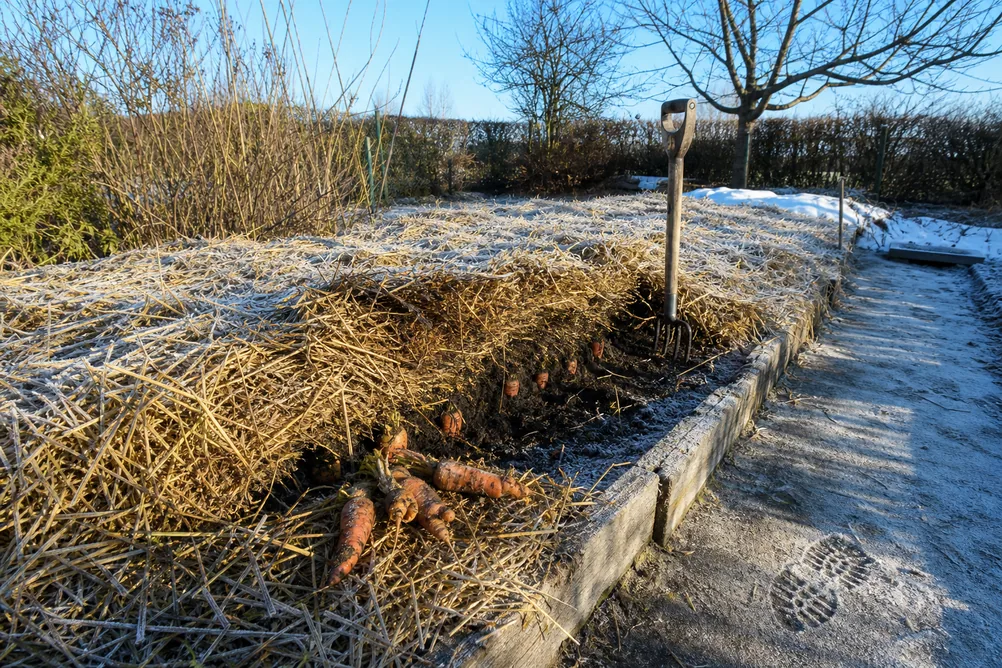
There is no better root cellar than the ground the crop grew in. Overwintering carrots means leaving them exactly where they are. You bury the row under a foot of straw and pull them one meal at a time, from November until March. They keep better than anything you could do indoors, and they get sweeter every week.
Overwintering carrots is genuinely simple. It has one real enemy, one timing decision that matters, and one deadline in spring that catches people out. Everything else is straw.
Overwintering Carrots at a Glance
| What it is | Leaving the crop in the ground under deep mulch |
| Works to | Zone 5 easily, colder with extra depth |
| Mulch depth | 12 to 18 inches of straw or shredded leaves |
| When to mulch | Once the soil has cooled, before it freezes hard |
| Flavor | Sweeter after every hard frost |
| The enemy | Voles and mice, not the cold |
| Harvest | On demand, all winter |
| Deadline | Everything out before spring regrowth |
Why the Cold Makes Them Sweet
A carrot (Daucus carota) is a biennial. It spends its first year storing sugar in a root so it can flower in its second. That store is what you eat.
When the soil cools, the plant converts stored starch into free sugars. Those sugars lower the freezing point inside its cells and stop them bursting. The root is protecting itself. The side effect is a carrot noticeably sweeter than the same variety pulled in August.
Illinois Extension notes the same on a late carrot crop. The sugars concentrate as the tops die back, and roots taken after frost beat summer ones on flavor. Parsnips, kale, and Brussels sprouts all run the same trick.
Timing the Sowing for a Winter Row
Overwintering carrots starts in midsummer, because the roots must reach full size before growth stops.
Growth effectively halts once daylight drops below ten hours, so anything not finished by then stays the size it was. Count back from your first frost:
- Days to maturity for the variety, usually 65 to 80.
- Two extra weeks for the autumn slowdown.
- Sow that many days before the first frost, which for most of the country means late June through July.
A row sown in September makes fingerlings, not carrots. The general arithmetic sits in the planting schedule. The soil preparation that decides whether roots grow straight is in growing carrots.
Which Varieties Survive the Winter
Not every carrot is built for this. You want a thick-shouldered storage type with dense flesh.
- Napoli, Bolero, Merida — bred for late sowing and winter standing.
- Danvers and Chantenay types — sturdy, blunt, reliable.
- Avoid the delicate ones: baby carrots, thin Nantes types for summer, and anything described as tender or quick.
Colored heirlooms are a mixed bag. Purple and yellow varieties often store well, but test a short row before committing the bed. The range is covered in heirloom carrot varieties.
Maryland Extension’s carrot guide is worth reading on soil and spacing. A winter row wants the same deep, stone-free ground as any other, only more so.
Mulching: How Deep and Exactly When
Overwintering carrots comes down to two decisions here, and the second matters more than gardeners expect.
How deep. Twelve inches of straw is the working minimum and eighteen in a cold region. Lay it so it presses onto the carrot shoulders rather than bridging over them. It compresses to about half that by January.
When. Wait until the soil has cooled and the first light frosts have passed. Then mulch, before the ground freezes hard. Mulch too early, into warm soil, and you build a heated hotel for mice.
Straw is the standard because it stays open and insulating when wet. Shredded leaves work and pack down more. Whole leaves mat into a wet mattress and are the worst of the three. The comparison is laid out in organic garden mulch.
Mark the ends of the row with tall stakes before you cover it. The foliage dies back and snow falls. A bed of straw looks identical from one end to the other in January.
Overwintering Carrots and the Vole Problem
The cold is not what takes the crop. Rodents are.
A deep mulch over a root bed is warm, hidden, and full of food. That is exactly what a vole wants in November. A colony works through a row from underneath. You are left with a bed of hollow shells and the tops still standing.
Four things help, in order of how much difference they make:
- Mulch late, once the ground is cold, so the bed is never a comfortable place to move in.
- Keep the surroundings short. Voles cross open ground reluctantly, so mow or clear the grass and weeds around the bed.
- Bury a hardware cloth barrier around a small bed, a foot down, if you have lost a crop before.
- Set traps under cover along the run, in the paths rather than in the bed.
Deer and rabbits also work a winter bed once other food runs short. The fencing that stops them is in animal proof vegetable garden.
Harvesting From Under the Snow
This is the part of overwintering carrots that feels like cheating.
Pull the straw back along a short section of row and lift what you need with a fork. Then pull the mulch straight back over the gap. Work on the mildest day you get and take a week’s worth at a time. Never leave a section uncovered overnight.
The soil under twelve inches of straw stays workable well below freezing air temperatures. In a hard spell the top inch may still crust, and a fork solves it.
Two habits keep the row healthy all winter:
- Take from one end and work along, rather than dotting holes through the bed.
- Lift any root that shows rot immediately, because soft carrots spread rot to their neighbors underground.
Overwintering Carrots Against Storing Them Indoors
Both methods work. They fail in different ways, and knowing which failure you can live with decides the one to choose.
In the ground, the root stays alive. It keeps its skin intact, it holds its moisture, and it goes on converting starch to sugar all winter. Nothing shrivels, because nothing has been cut off from the plant. The costs are that the bed stays occupied until spring, that rodents get a vote, and that you go outside in January in the rain to fetch dinner.
In sand in a cellar, the root is dead and slowly drying. It stops sweetening the day you lift it. Handled well it keeps three or four months, and handled badly it goes soft or grows white fur in six weeks. The advantages are real all the same: the bed is free for a cover crop, the crop is safe from voles, and the carrots are ten steps from the kitchen.
My own answer is to split the crop. Two thirds stay in the row under straw and one third goes into a box of damp sand, which insures against a bad winter without wasting the bed.
There is a third option that gets forgotten. Lift, then heap. Pull the whole row on a dry day in late autumn, pile the roots on the ground in a cone, cover the cone with a foot of straw and a layer of soil, and you have a clamp. It is the old field method, it needs no building, and it puts the crop somewhere the voles have to work for it. A clamp opened in February holds carrots in the same condition as the day they went in, and the only real skill is making sure the heap sheds rain instead of collecting it.
Whichever you pick, the deciding factor is drainage rather than temperature. Roots in wet ground rot at any temperature, and roots in dry cold ground keep almost indefinitely.
The Spring Deadline
Here is the mistake that costs the last third of the crop.
Carrots are biennial, and warmth in March tells them the second year has begun. The root feeds a flower stalk and the flesh turns woody and bitter. It happens fast, within two or three weeks of the soil warming.
So the bed empties before regrowth starts. Pull everything by late February or early March, depending on your region. Store what you cannot eat in damp sand in a cold place, following root cellar storage.
Any root you leave will make seed. Carrot seed saved from a garden row rarely comes true anyway, because the flowers cross freely with wild Queen Anne’s lace.
Where Overwintering Carrots Does Not Work
Three honest limits.
| Situation | Why it fails | What to do instead |
|---|---|---|
| Heavy wet clay | Roots rot rather than store | Lift and store in sand |
| Zone 3 and 4 without snow cover | Ground freezes through the mulch | Lift before hard freeze |
| Beds with a rodent history | The crop is eaten, not stored | Barrier, traps, or store indoors |
Snow, incidentally, is an asset rather than a problem. A foot of settled snow on top of a foot of straw is better insulation than either alone. The bad winters for a mulched row are not the cold ones but the mild wet ones, where the ground never freezes, the straw stays sodden, and rot works its way along the row unnoticed.
There is a fourth limit worth naming, and it is about the gardener rather than the garden. A row under straw needs visiting. If the bed is at the far end of a long plot, behind a gate, in a place you genuinely will not walk to in January, the crop will still be sitting there in March having gone woody. Put the winter row on the path you actually use.
Overwintering Carrots Beyond the Carrot Bed
The same method works on most of the root family, with small differences from crop to crop.
Parsnips are the champions and want no mulch at all in mild regions. Beets store adequately but soften faster. Turnips and rutabaga hold well. Leeks stand through the winter unaided and need only enough mulch to keep the soil diggable.
Potatoes are the exception, and they must come out. They rot at soil temperatures below about 40°F, and a forgotten row is a mess in spring.
The rest of the crops that carry a garden through the cold months are in the fall vegetable gardening guide. The same logic under glass is in cold frame gardening.
What Goes Wrong When Overwintering Carrots
| Problem | Cause | Fix |
|---|---|---|
| Hollowed roots, tops intact | Voles under the mulch | Mulch later, clear the surrounds, trap |
| Soft, rotten roots | Wet ground or mulch laid on warm soil | Lift and store in sand instead |
| Frozen solid, cannot dig | Mulch too thin | 12 inches minimum, 18 where it is cold |
| Woody, bitter roots in March | Left past the spring deadline | Empty the bed before regrowth |
| Split roots | Heavy rain after a dry spell, before winter | Water evenly in late summer |
Overwintering Carrots Questions Answered
Do I cut the tops off first?
No. Leave the foliage on the plants in the ground; it dies back naturally and marks the row. Tops only come off at the moment a root goes into indoor storage.
Will they freeze solid?
Under a foot of straw, rarely. The mulch holds the soil above the air temperature and stops the freeze-thaw cycling that damages roots.
Does the straw need to come off in spring?
Yes, and promptly. Once the bed is empty, rake the straw onto the paths or into the compost heap. Left in place it keeps the soil cold for weeks and delays the first spring sowing in exactly the bed that would otherwise have warmed first.
Can I do this in a raised bed?
Yes, and it needs more mulch, because a raised bed loses heat from its sides as well as its top. Bank straw against the outside of the boards too.
How long do they actually keep?
Until the plant starts growing again in spring. That is three to four months of harvest from a bed that would otherwise be empty.
Is the flavor really different?
Yes, and it is the reason to do it. A January carrot from under straw is sweeter than the same variety in September. Eaten raw, the difference is obvious.
The Bed That Feeds You in January
Overwintering carrots is the cheapest storage in gardening: no cellar, no sand, no crates, no checking for rot. Sow in midsummer and choose a storage variety. Mulch a foot deep once the soil is cold, keep the voles guessing, and empty the row before spring wakes it up. Then eat the sweetest carrots of the year in the middle of winter.
Check out the author’s book here: The Year-Round Vegetable Garden for Beginners.


Leave a Reply