
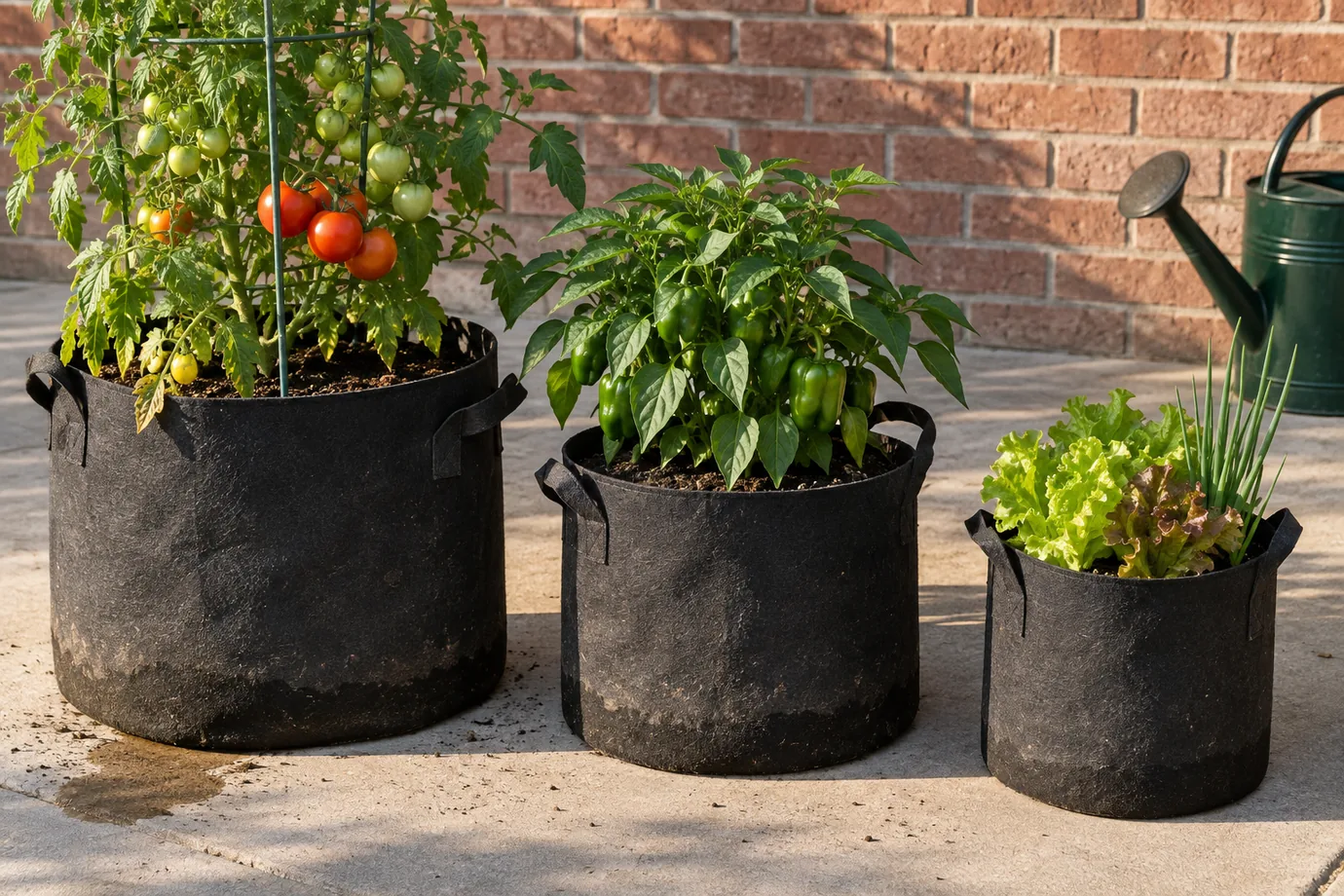
Not every gardener has a yard with good soil. Some have a balcony, a driveway or a patio that bakes in the afternoon sun. Others have ground so full of clay or rubble that digging a bed feels like quarrying. Meanwhile, rigid pots are heavy, and large ones cost a surprising amount. For all of these situations, Grow Bags for Vegetables offer a simple answer. They are soft fabric containers that you fill with potting mix, set down wherever the sun falls and plant like a small raised bed.
University of Maryland Extension describes fabric bags as relatively inexpensive, reusable, lightweight, portable and available in many sizes. In this guide, you will learn which size each crop needs, why fabric behaves differently from plastic, what to fill the bags with and how to keep them watered through summer.
Why Grow Bags for Vegetables Work
A plastic pot has solid walls. So when roots reach the edge, they turn and keep growing around the inside. Over a season, they can form a tight spiral that chokes the plant. Fabric changes that pattern.
According to UMD, bags improve plant growth through the air pruning of roots. When a root tip reaches open air at the edge of the bag, it stops growing in length. Then the plant branches into a denser, fibrous root system. In other words, instead of a few long roots circling the wall, you get many short feeder roots throughout the mix. Those fine roots are the ones that take up water and nutrients.
Heat is the second reason. UMD notes that dark colors create higher temperatures that could injure young, tender roots. Fabric bags are often black, too. However, moisture evaporating through the porous walls cools them, so they rarely get as hot as a black plastic pot on the same patio.
Choosing the Right Size of Grow Bags for Vegetables
Size matters more than anything else. A bag that is too small dries out within hours and caps the size of the plant. So match the volume to the crop before you buy.
University of Maryland gives useful minimums for container vegetables:
- Large crops, such as tomatoes, peppers, eggplant, cucumbers and winter squash, need at least 8 to 10 gallons of mix and a depth of 12 to 16 inches.
- Medium crops, such as dwarf tomatoes and peppers, summer squash, beans, beets and carrots, need 4 to 6 gallons and 8 to 12 inches of depth.
- Small crops, such as herbs, radishes, scallions, spinach and salad greens, need 1 to 3 gallons and 4 to 6 inches of depth.
These numbers are minimums. In practice, the bigger bag is the easier one to manage, because more mix holds more water. For example, a full-size tomato is much happier in 10 or 15 gallons than in 5. If you are short on room, choose compact varieties; our guide to Dwarf Tomato Varieties: Heavy Yields for Small Spaces and Containers lists types bred for exactly this.
What Grows Best in Grow Bags for Vegetables
Almost any vegetable will grow in a bag of the right size. Still, some crops are especially well suited.
Potatoes
Potatoes are the classic grow bag crop. In a UMD trial, three potato plants grown in a single 5-gallon fabric bag produced eight tubers. Better still, harvest is easy: you tip the bag over and pick the potatoes out of the loose mix. No digging, no forks through the tubers. For the full method, read How to Grow Potatoes in Containers for Beginners.
Tomatoes, Peppers and Eggplant
These heat lovers do well in bags on a sunny patio. Give each plant its own bag of at least 8 to 10 gallons, and add a stake or cage at planting time. For peppers, see Growing Peppers 101: A Guide to Sweet, Hot, and Exotic Varieties.
Garlic, Onions and Salad Greens
Wide, shallow bags suit crops that grow close together. UMD photographed over two dozen garlic plants growing in one large fabric bag after a fall planting. Similarly, lettuce, spinach and scallions fill a small bag quickly and can be cut again and again. For timing, see Planting Garlic Bulbs: Cultivating Flavorful Cloves at Home.
Crops to Think Twice About
Sprawling crops are harder. Winter squash and melons need big bags and room to run. Similarly, sweet corn needs a block of plants to pollinate well, so a single bag of corn rarely fills its ears.
What to Fill Grow Bags With
The mix inside the bag decides most of the result. Here, garden soil is the wrong choice. UMD explains that soil is too dense to allow good air and water movement around roots in a container. Oregon State University Extension agrees. It warns that garden soil or topsoil can be too heavy and may hold too much moisture.
Instead, use a quality potting mix. These mixes are light and drain freely, yet they hold enough water between waterings. Many gardeners blend in some finished compost for extra life and nutrients. For recipes and the reasoning behind them, read Best Soil for Container Vegetables: Air Space Before Nutrients.
Fill the bag almost to the top before planting. The mix settles after the first few waterings. So a bag filled only halfway ends up with a sunken, shaded surface.
Watering Grow Bags for Vegetables
This is the one real drawback. The same porous walls that cool the roots also let water escape. As a result, bags dry faster than plastic pots of the same size.
Oregon State notes that containers dry out quickly, especially on sunny patios, and that daily watering is often necessary in summer. It advises watering when the top of the mix feels dry, and continuing until water runs out of the bottom. However, don’t let the mix stay soggy either. Soggy mix drives out air, and roots suffocate. If you are unsure, Signs of Overwatering: Are You Loving Your Plants to Death? shows what to look for.
A few habits make watering easier:
- Group the bags. Placed side by side, they shade each other’s walls and lose less water.
- Use saucers or trays in hot weather. A shallow tray catches runoff that the mix can soak back up.
- Mulch the surface. An inch of straw or shredded leaves slows evaporation from the top.
- Go bigger. A 15-gallon bag forgives a missed day far better than a 5-gallon one.
Feeding Plants in Grow Bags for Vegetables
Frequent watering washes nutrients out of the mix. So plants in bags need regular feeding. Oregon State suggests a water-soluble all-purpose fertilizer every three to four days at half strength. Alternatively, a dry fertilizer every three weeks works too. Many growers also mix a slow-release fertilizer into the bag at planting, then top up with liquid feed once fruiting starts.
Watch the leaves for guidance. Pale, yellowing lower leaves on a tomato or pepper often mean the plant is hungry.
Setting Up Grow Bags for Vegetables Step by Step
Getting started takes an afternoon.
- Pick the spot. Most fruiting vegetables need at least six to eight hours of direct sun.
- Choose the size. Use the UMD minimums above, then size up if you can.
- Place before filling. A full 10-gallon bag of wet mix is heavy, so set it where it will stay.
- Fill with moist potting mix. Dampen the mix first, so it takes up water evenly.
- Plant and water in. Water until it drains from the base.
- Add support. Push stakes or cages in now, before roots spread through the bag.
Grow Bags on Balconies and Rooftops
Weight is where bags really shine. A plastic or ceramic pot adds its own weight to the mix, while a fabric bag adds almost nothing. That matters on a balcony or a flat roof, where every gallon counts. Still, wet potting mix is heavy, so check what your structure can safely carry before you line it with bags. For more on this, see Urban Rooftop Vegetable Gardening: Creative Ways to Maximize Small Spaces.
Wind is the other rooftop problem. It dries the fabric walls even faster than sun. So group the bags against a wall, and cover the surface with straw or leaves. Our guide to Organic Garden Mulch: How Deep to Lay It and When to Wait explains which materials hold moisture best.
Caring for Grow Bags at the End of the Season
Good fabric grow bags for vegetables last several seasons. When the harvest ends, empty the old mix into the compost pile or onto a garden bed. Then brush off the dried soil and let the bags dry fully in the sun. Finally, fold them flat and store them indoors. That small effort keeps them from rotting and stops disease from carrying over. Next spring, refill them with fresh mix and start again.
Start Small, Then Scale Up
Grow bags for vegetables turn any sunny, flat surface into growing space. They cost little, move easily and give roots a healthier shape than solid pots. The trade-off is water, so size up, group them and check them daily in summer. Try one bag of potatoes and one tomato this year. By autumn, you will know how many more your patio can hold.
Check out the author’s book here: The Year-Round Vegetable Garden for Beginners.

Leave a Reply