
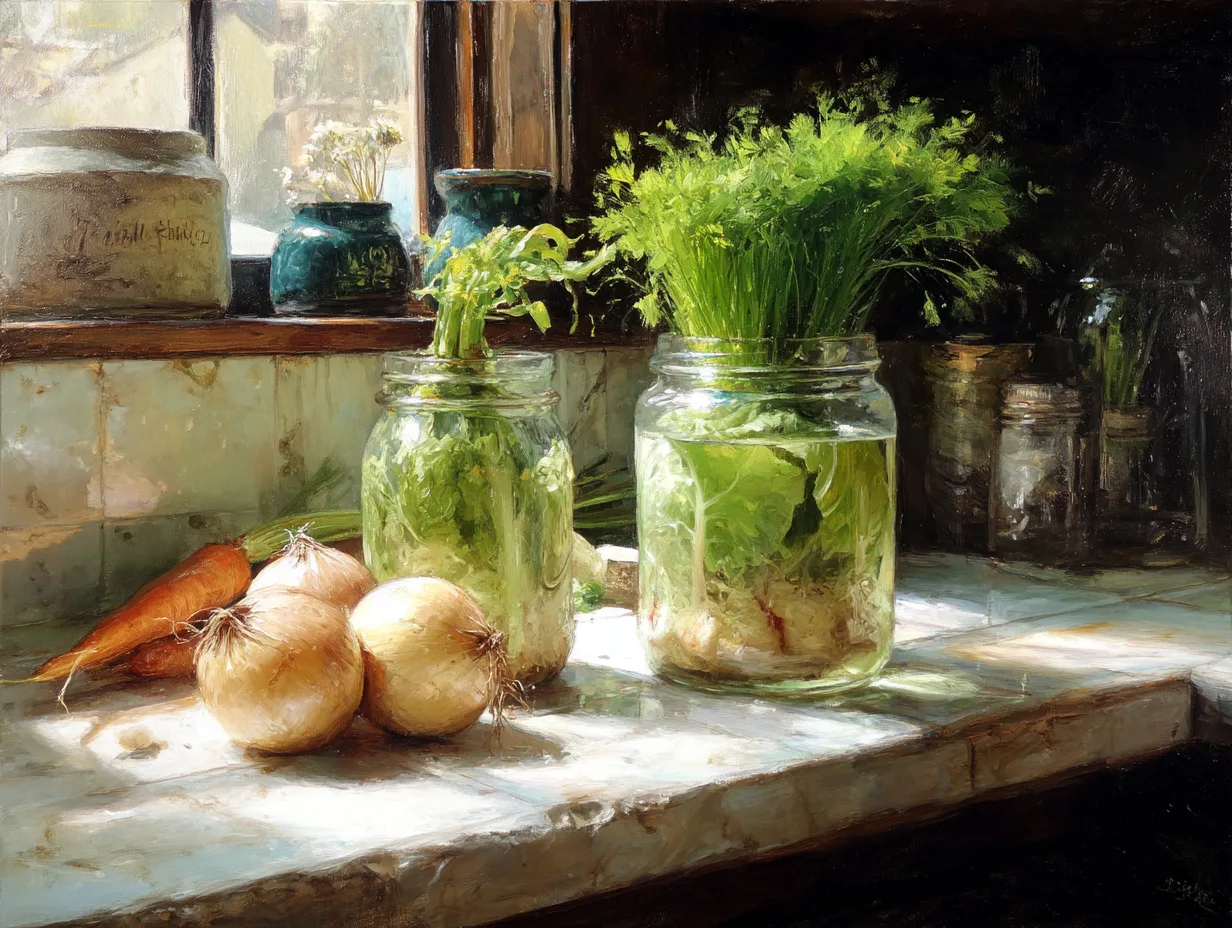
Almost every guide to Growing Vegetables from Scraps shows the same photograph of jars on a windowsill, and almost none of them say what happens in week six. The honest answer is that scraps produce three different outcomes, and only one of them ever reaches a plate. Some give you a real, repeatable harvest, some give you a houseplant that will never fruit, and a few are not worth the counter space at all. Sorting Growing Vegetables from Scraps into those three groups takes about five minutes. That small effort saves a whole season of quiet disappointment. This guide does the sorting, with the timings that the extension services actually publish.
Growing Vegetables from Scraps at a Glance
| Question | Short answer |
|---|---|
| Does it really produce food? | Yes for leaves, stems and a few roots, and almost never for fruit. |
| What is the fastest win? | Scallions and celery leaves, which put out roots in a few days on water alone. |
| How long for a pineapple? | Roots in six to eight weeks, and fruit in two to three years. |
| What about avocado? | Roots in up to a month, then several years to fruit, and the fruit comes out smaller. |
| Can I plant supermarket potatoes? | No, since many are treated to stop them sprouting and carry no disease certificate. |
| How often do I change the water? | Every day, with the base sitting in about one inch of it. |
The Three Outcomes, and Why They Get Confused
A scrap contains stored energy and, in the right cases, a growing point. Where both are present the plant can genuinely restart, and where only the energy is there it produces a flush of leaves and then stalls. That single distinction explains most of what follows, and it is worth holding onto as you read the three tiers below.
Photographs confuse the issue because they are all taken in week two. At that point the celery base is beautiful, the carrot top is green, and the pineapple crown looks certain. None of those pictures tells you whether anything edible arrives later.
The other source of confusion is the difference between a plant and a crop. Growing Vegetables from Scraps reliably gives you plants, and it only sometimes gives you a crop. Knowing which you are signing up for in advance changes how you feel about the result.
Growing Vegetables from Scraps, Tier One: The Ones That Feed You
Scallions are the clearest win available, and they need nothing but a glass of water. Leave an inch of white base with the roots attached, stand it upright, and cut the green tops as they regrow. Expect two or three good cuts before the base runs out of stored energy and the flavor thins.
Celery works on the same principle and is the one the extension services demonstrate most often. Leave about two inches of the stalk base, set it in an inch of water, and change that water every day. Roots and a center tuft of leaves appear within a few days, and after two to three weeks it can move into potting soil.
Be clear about what you are harvesting there, because it is leaves rather than stalks. Celery leaves are strong and useful in stock and salads, while the thick ribs you bought will never come back. The same method suits bok choy, cabbage, lettuce and the leafy tops of carrots, turnips, radishes and beets.
Ginger and turmeric belong in this tier too, since a plump rhizome with visible buds will genuinely grow into a new one. Growing ginger indoors covers the warmth and patience that it takes. A sprouted garlic clove will also make green garlic, though a full bulb needs a proper fall planting and a winter outdoors.
Tier Two: The Scraps That Give You a Plant
Pineapple is the classic of this group and the clearest illustration of the trap. Twist off the crown, plant it an inch deep in a gritty mix, and roots follow in six to eight weeks. Fruit follows in two to three years, and only if the plant gets serious warmth and light throughout.
Avocado is slower still and better known for the toothpicks than for the results. Roots and a shoot appear within about a month, but fruit takes several years and comes out much smaller than what you bought. Citrus pips germinate in two to four weeks and then behave the same way, with no fruit for years.
Carrot tops deserve an honest mention because they are so widely photographed. The top will sprout a fine head of ferny leaves, and it will never regrow a carrot, since the root you ate was the storage organ itself. Left long enough it bolts and flowers, which is useful only if you want the seed.
Tier Three: The Scraps Not Worth Starting
Supermarket potatoes head this list, and the reason is not snobbery about certified seed. Penn State Extension puts it plainly: do not plant potatoes purchased from a grocery store, because many are treated with chemicals to stop them sprouting. Those that do sprout carry no certificate that they are free of disease.
The same source advises against replanting potatoes you harvested yourself the previous year, since they may hold fungal spores you cannot see. Buy certified seed tubers instead and treat it as cheap insurance. Chitting potatoes covers how to start those properly, and grow potatoes in containers covers the rest.
Tomato and pepper seeds scraped from a supermarket fruit are the other common waste of effort. They germinate happily, yet almost all supermarket produce comes from hybrids, so the seedlings will not resemble the parent. Saving Vegetable Seeds: A Step-by-Step Guide for the Home Garden explains why open-pollinated varieties come true from seed while hybrids scatter in every direction.
Finally, ignore any article telling you to root a single lettuce leaf. Illinois Extension notes that the internet is split between the core method, which works, and the single-leaf method, which does not. A leaf has no growing point, so it will rot rather than root.
How Long Growing Vegetables from Scraps Actually Takes
Timings are where most of the enthusiasm for Growing Vegetables from Scraps quietly dies. Here they are gathered in one place for easy reference. Scallions and celery give visible roots in a few days, and a first cut inside two weeks. A celery base is ready for soil after two to three weeks in water.
Sweet potato halves suspended over water sprout slips in a few weeks, and those slips are the start of a real crop. Growing sweet potatoes covers the heat they need and the curing that makes them sweet. Ginger takes longer, often a month before anything shows above the surface.
Then the long end: six to eight weeks to root a pineapple crown, a month for an avocado stone, and two to four weeks for citrus pips to germinate. Add two to three years before a pineapple fruits, and several years for avocado or citrus. None of that is failure, provided you knew the numbers going in.
Growing Vegetables from Scraps: The Water Method
Use a shallow container and about an inch of water, which is enough to cover the roots without drowning the crown. Too much water rots the base, and that is the most common failure by a wide margin. Set the jar where it gets bright light but not a scorching afternoon sun.
Change the water every single day rather than topping it up. Standing water goes cloudy quickly as sugars leach out of the cut surface, and cloudy water means bacteria. A daily rinse of the base under the tap takes five seconds and roughly doubles how long a scrap lasts.
Watch for the point where growth stalls, because every scrap has a fixed budget. Once the stored energy is spent, water alone cannot carry the plant any further. That is the moment to move it into soil or to compost it.
Moving a Scrap into Soil
Pot the rooted base in ordinary potting mix, covering it completely except for the center leaf tips. Firm the mix gently, water it in, and keep it out of direct sun for the first few days while the roots adjust. Water roots are thinner than soil roots, so expect a short check in growth.
From there it is an ordinary seedling and wants ordinary care. Feed it once the first new leaves expand, since potting mix runs out of nutrients within a few weeks. Indoor Herb Garden: Growing Basil and Mint Year-Round covers the light levels that windowsill plants really need through winter.
If the plant is heading outdoors later, harden it off over a week or so. A scrap raised on a warm kitchen counter is softer than anything raised in a cold frame.
Where Growing Vegetables from Scraps Earns Its Keep
The strongest case for the practice is not the harvest at all, and it is worth saying so directly. Growing Vegetables from Scraps is the cheapest possible introduction to propagation, and it works brilliantly with children because results arrive in days. Nothing else in the garden gives feedback that fast, which matters enormously when the gardener is six years old.
It also reduces waste in a small and genuine way. Anything that stalls goes on the heap afterward, so nothing is lost either way. Composting and the indoor worm bin both turn the leftovers into something the garden can use.
For actual winter food from a countertop, though, there is a better answer. Indoor Microgreens Setup: Cultivating Tiny Greens on Your Countertop yields a real crop in ten days from a packet of seed. Vegetable gardening on a budget sets both approaches against each other on cost.
Frequently Asked Questions
Will celery from scraps grow full stalks again?
No, and that is the single most oversold claim in the whole subject. You get a tuft of strong-flavored leaves, which are genuinely useful in cooking. The thick ribs only form on a plant grown from seed over a full season.
Can I regrow onions from the root end?
A scallion base regrows well, while a large bulb onion does not, since the bulb was the storage organ. Planting onion sets is the route to real bulbs. Planting garlic bulbs covers the same point for garlic, which needs a cold winter in the ground to split into a bulb.
Why did my scrap go slimy and smell?
It sat in too much water, or the water was not changed daily. Cut back to an inch, rinse the base, and change the water every day from then on. A slimy base rarely recovers once the rot reaches the growing point.
Does lettuce really regrow from the core?
The core works and a single leaf does not, because only the core carries the growing point that new leaves come from. Stand the core in shallow water or plant it, and expect a modest flush of small leaves rather than a new head. Growing lettuce covers how to get a proper head from a packet of seed in about eight weeks.
Is any of this cheaper than buying seed?
Only marginally, since a packet of scallion seed costs less than a bunch of scallions. The real saving is in the produce you would otherwise have thrown away. A tray of microgreens gives more food per dollar than any scrap will.
Growing Vegetables from Scraps: The Short Version
Sort the scrap before you commit the windowsill to it. Growing Vegetables from Scraps rewards the gardener who knows which tier is in the jar. Leaves and stems regrow, so scallions, celery, lettuce cores, leafy tops and ginger all earn their jar. Fruit does not follow, so pineapple, avocado and citrus are houseplants with a long wait attached.
Keep an inch of water, change it daily, and pot the survivors once the roots show. Leave supermarket potatoes and hybrid fruit seeds alone entirely, since neither one repays the pot it would occupy. Judged as propagation practice rather than as a food supply, it is one of the most satisfying things you can do with a kitchen bin.
Check out the author’s book here: The Year-Round Vegetable Garden for Beginners.


Leave a Reply