
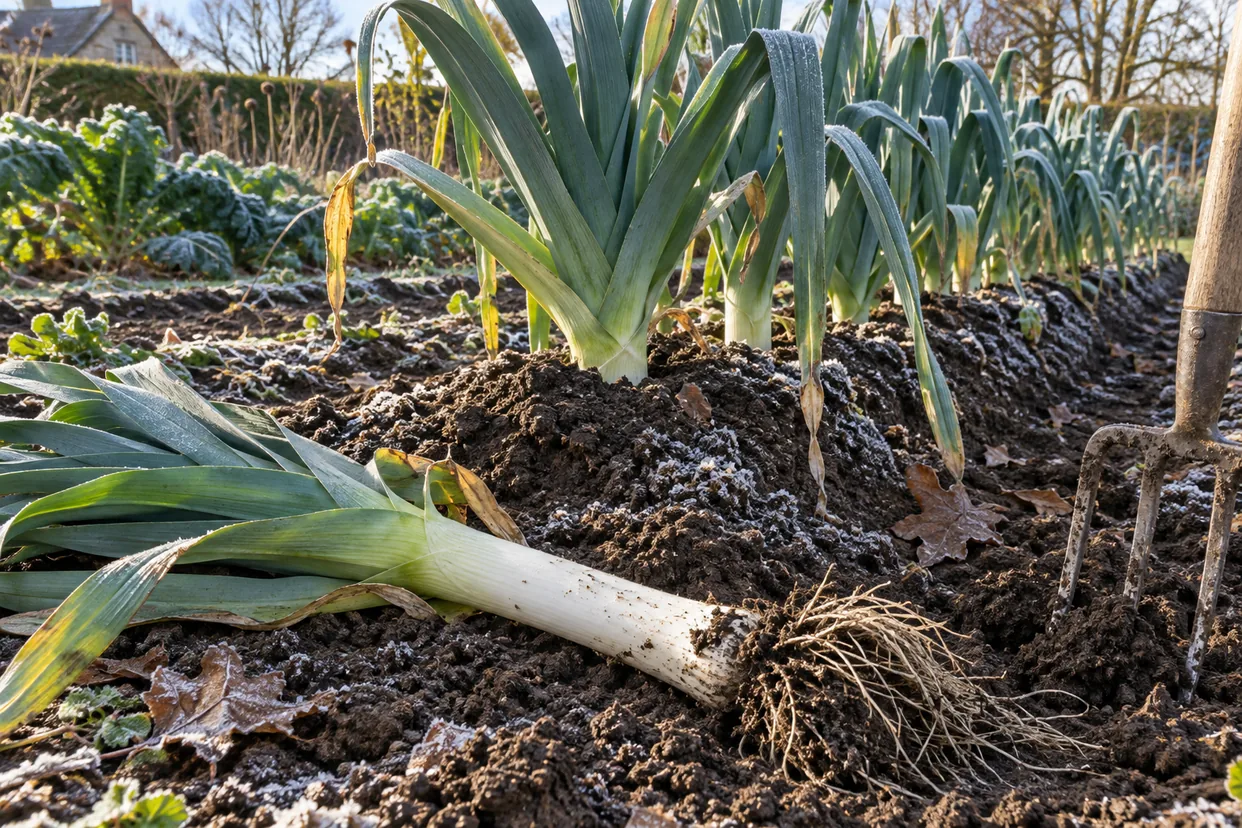
Leeks are the slowest crop in many gardens, and one of the most rewarding. They sit quietly through summer, thicken in autumn and then stand in the bed through frost, waiting to be dug whenever the kitchen needs them. They ask for almost nothing in return except an early start and a little soil pulled up around their stems. Growing Leeks is mostly a matter of planting deep and being patient.
This guide covers the whole season, from sowing to the last winter harvest. The advice comes from University of Maryland Extension, Utah State University Extension and the Clemson Home and Garden Information Center.
Why Growing Leeks Is Worth It
A leek is an onion that never makes a bulb. Instead, it grows a long, thick stem of tightly wrapped leaves, mild and sweet when cooked. UMD calls it a hardy cool-season biennial. In other words, it would flower in its second year, but gardeners harvest it in the first.
Two things set leeks apart from their relatives. First, they do not need curing or drying. Onions and garlic must be lifted and stored, while leeks can simply stay in the ground until you want them. Second, they are very hardy. UMD notes that they withstand heavy frosts, so they fill the gap in late autumn and winter when most beds are empty.
If you already grow the rest of the family, Planting Onion Sets: Unearthing the Layers of Growing Bulb Vegetables and Planting Garlic Bulbs: Cultivating Flavorful Cloves at Home cover the bulb-forming alliums.
Choosing Leek Varieties
Leek varieties differ mainly in speed and hardiness. UMD gives a range of 70 to 120 days to maturity, depending on the cultivar.
- Early or summer leeks. Fast varieties with longer, slimmer stems and paler leaves. They are ready in late summer and early autumn, but they are less hardy.
- Late or winter leeks. Slower varieties with shorter, thicker stems and dark blue-green leaves. These are the ones to leave in the ground through frost.
USU recommends ‘Large American Flag’, ‘Comanche’ and ‘King Richard’. ‘King Richard’ is a quick, long-stemmed early type, while ‘Large American Flag’ is an old, reliable standard. In the South, Clemson suggests ‘Arkansas’ for autumn and winter growing. A row of each type spreads the harvest from September into the new year.
When to Start Growing Leeks
Leeks need a long season, so most gardeners start them from seed indoors. USU advises that transplants need 6 to 8 weeks of growth before they go into the garden. Count back from your planting date, and sow in late winter; Seed Starting Calendar: How to Plan Your Vegetable Gardening Year helps you set the dates.
Sowing Leek Seed
Leek seed is small and black, like onion seed. Sow it thinly in a tray or deep cell pack filled with a light, fine medium; Seed Starting Mix: What to Buy, How to Make It and Why Garden Soil Fails explains what to use. The seedlings look like blades of grass for weeks. That is normal.
Many growers trim the tops back to about 4 inches once or twice while the seedlings grow indoors. The haircut keeps them upright and encourages a thicker base. Before planting out, give them a week outdoors to adjust; Hardening Off Plants: How Much Stress Is Enough sets out a schedule.
Direct Sowing
In areas with a long season, you can also sow outdoors. USU suggests sowing seeds ¼ to ½ inch deep in late March, then thinning the seedlings to 4 to 6 inches apart. Clemson recommends 10 to 15 seeds per foot of row, thinned to 4 inches apart. In the South, Clemson adds a second window: plant in late summer or early autumn for a winter harvest, since leeks grow best below 75°F.
Planting Leeks Deep
Planting is the step that makes growing leeks different from other crops. The goal is a long white stem, and the simplest way to get one is to bury most of the young plant from the start.
UMD describes the classic dibble method:
- Make the holes. Use a stick about 1 to 1¼ inches thick to make holes 5 to 6 inches deep.
- Drop in a transplant. Set one seedling in each hole, with only the top few inches of leaf showing. USU recommends transplants 10 to 12 inches tall.
- Do not fill the hole. Simply pour water into it. The water settles a little soil around the roots, and the hole fills in gradually as the leek thickens.
Spacing is generous but not huge. UMD suggests 5 inches between plants, either in narrow rows or evenly across a wide bed. USU gives 4 to 6 inches in rows 8 to 16 inches apart. Each transplant, UMD notes, produces one stem 6 to 8 inches long and 1 to 2 inches wide.
Leeks can go out early. UMD says they can be planted several weeks before the last frost date, once daytime temperatures reach at least 45°F.
Sun, Soil and Feeding
Leeks need full sun. UMD defines that as at least 6 hours a day, with 8 to 10 hours preferred.
Clemson’s rule for soil is simple: any garden that grows good onions will grow good leeks. Aim for a pH of 6.2 to 6.5. If you are not sure where yours stands, Soil pH Testing: How to Take a Sample That Means Something explains how to get a useful reading. Work in organic matter before planting, but keep it moderate; USU suggests no more than 1 inch of compost over the bed.
Leeks are in the ground for months, so they need steady feeding. USU recommends side-dressing with nitrogen in mid-May and again in late June, at ¼ pound of ammonium sulfate (21-0-0) per 100 square feet. In the South, where leeks grow through winter, Clemson spreads four light side-dressings of calcium nitrate across the season. Organic gardeners can use a nitrogen-rich feed on the same schedule; Organic Plant Food: Feeding Your Veggies for Maximum Growth compares the options.
Watering and Weeding
Leeks have shallow roots and narrow, upright leaves that shade the soil very little. As a result, they suffer from both drought and weeds.
UMD suggests about 1 inch of water a week, from rain or irrigation. USU goes further and recommends moistening the soil to a depth of 18 inches every 7 days. Stems that dry out turn tough and fibrous, so do not skip dry spells.
Weeds matter most early on. UMD notes that weed control is particularly important during the first two months, when the plants grow slowly. After that, a mulch of compost, grass clippings or shredded leaves holds moisture and smothers new weeds. For depths and timing, read Organic Garden Mulch: How Deep to Lay It and When to Wait.
Hilling Up for Long White Stems
The white part of a leek is the part you eat. It stays white because it grows in the dark. So, once the plants are established, keep adding soil around the stems as they grow.
Clemson suggests starting when the plants are about as thick as a pencil. Gradually draw soil up around the base to blanch the lower stem, aiming for 6 to 10 inches of white. USU recommends hilling two or three times during the season, adding 2 to 3 inches of soil each time.
A few tips make it easier:
- Hill in dry weather. Wet soil packs down hard.
- Stop below the leaf fork. Soil that falls between the leaves ends up as grit in the kitchen.
- Use collars if you prefer. A tube of cardboard or a length of pipe slipped over each leek blanches the stem without moving soil.
How to Harvest Leeks
Harvest is flexible, which is one of the best things about growing leeks. UMD says you can pull them as early as 60 days after planting, at about the size of a green onion. However, most varieties need 100 to 120 days to reach full size. Both UMD and USU say leeks are ready when the stem is about 1 inch across.
Do not pull a leek by its leaves. Instead, loosen the soil beside it with a fork, then lift it out with the roots. Trim the roots and the tough dark tops, then rinse well. Soil often hides between the layers, so slice the stem lengthwise and wash it under running water.
Growing Leeks Through Frost and Winter
Late varieties are among the hardiest crops in the garden. UMD notes that they can be overwintered and dug throughout winter. In mild regions, that means fresh leeks from November to March.
Where the ground freezes hard, add protection. Mound mulch or straw around the stems, so you can still get a fork in the soil on cold days. A cold frame gives even more shelter; Cold Frame Gardening: Build a Box That Feeds You Through Winter shows how to build one. To time the autumn crop, start from your local frost date; First Frost Date: How to Find Yours and Protect Your Crops explains how to find it.
Leeks keep for a while after harvest, too. UMD gives 7 to 10 days in the refrigerator, and USU recommends storing them at 32 to 40°F with high humidity. For longer keeping, USU suggests blanching the sliced stems for 2 to 3 minutes before freezing. Otherwise, the garden itself is the best store.
Pests and Diseases When Growing Leeks
Leeks share their problems with onions. Clemson lists thrips, root maggots and bulb rot among them.
Thrips
Onion thrips are tiny insects that rasp the leaf surface and leave silvery streaks. They thrive in hot, dry weather. Regular watering helps, and a strong spray of water knocks many off.
Allium Leafminer
UMD identifies the allium leafminer as a problem for leeks. This small fly lays eggs in the leaves in spring and autumn, and its larvae tunnel down into the stem. The best defence is a floating row cover laid over the plants during those flights; Floating Row Covers: Protecting Brassicas from Pests and Frost explains how to use it on any crop.
Rust and Rot
Orange rust pustules sometimes appear on leeks in damp autumns. Usually the stems stay edible, so harvest affected plants first. Rot is more likely in wet, heavy soil.
Above all, do not plant leeks where onions, garlic or leeks grew the year before. Vegetable Crop Rotation: An Essential Guide for Soil Health Families helps you plan where each family goes.
How Many Leeks to Grow
USU suggests 3 to 6 feet of row per person. UMD, meanwhile, estimates five pounds or more from a 10-foot row. For a family that cooks soups and stews through winter, a double row across one bed is usually plenty.
Make Growing Leeks Part of Your Year
Leeks are a long-term investment: sow in late winter, plant deep in spring, hill up in summer and dig from autumn until spring comes again. They take little space, need no curing and wait patiently in the cold. So next February, when the seed trays come out, start growing leeks alongside your onions, and plan a few soups for the coldest months.
Check out the author’s book here: The Year-Round Vegetable Garden for Beginners.

Leave a Reply