
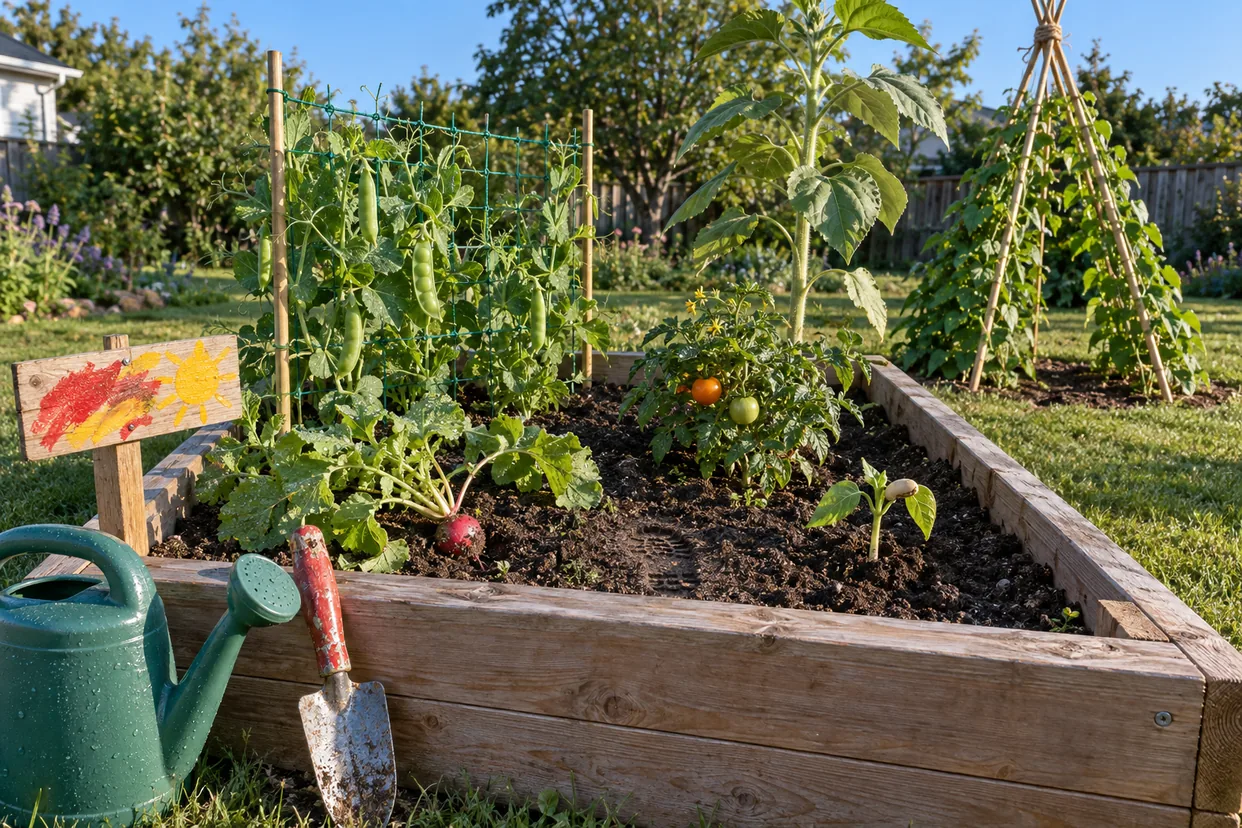
My daughter’s first crop was a row of radishes she sowed at age four. She pulled every one of them ten days too early, because she wanted to see what was under there. I let her, since the point was never the radishes. Twelve years later she still grows a bed of her own. Since then, I have watched three more children go through the same first summer. Gardening with kids works when the garden is built for them. It fails, quietly, when it is built for you and they are merely allowed to help.
That difference is the whole subject of this guide, because a child does not want to weed your tomatoes. However, a child will guard a three-by-three bed with their name on a stake as if it were a kingdom. The crops, the tools, and the size of the bed all have to match a short attention span. So does what you let them do at each age, because a child needs to see results quickly. The good news is that every one of those decisions is easy once you know it. After that, the plants themselves do most of the teaching.
Gardening with Kids at a Glance
| The short answer | |
|---|---|
| Bed size | 3 by 3 feet, one per child, with their name on it |
| First crops | Radishes, snap peas, bush beans, cherry tomatoes, sunflowers |
| Fastest reward | Radishes, 4 to 6 weeks from seed to table |
| Ages 2 to 4 | Watering, digging, harvesting, no seeds smaller than a pea |
| Ages 5 to 8 | Sowing, labeling, a journal, their own bed |
| Ages 9 and up | Planning, the seed order, a crop to sell or give away |
| Skip | Carrots the first year, sprays of any kind, anything that takes 100 days |
Why Gardening with Kids Is Worth the Mess
The case does not rest on nostalgia. Children who grow a vegetable eat it, and I have never seen this fail. One boy had refused peas for six years, and then he ate them raw off his own vine. Illinois Extension’s youth gardening pages make the same point about healthy eating. They also add exercise and time outdoors to the list. In practice, the garden is the one place where a seven-year-old can be in charge of something alive. Every decision they make shows a result within days.
There is a cost, though, and the cost is order. A bed run by a child has crooked rows and a sunflower in the middle of the lettuce. Somewhere in it there is a hole where the dinosaur was buried. If you cannot stand that, give them a bed at the far end and do not look at it. However, if you can stand it, gardening with kids will teach them about soil, weather, and patience. No lesson you could plan does it better, and it will also teach you what a plant can survive.
Give Them a Bed of Their Own
The single decision that matters most in gardening with kids is ownership. A shared garden where the child “helps” lasts about two weekends, because helping is a chore. Meanwhile, a bed with their name on it is a possession, and children guard possessions. Make it small: three feet by three feet is right for a child under eight. For an older child, four by four is plenty. A child can reach the middle of a three-foot bed from any side without stepping in it, and that is the rule that keeps the soil loose.
Build it as a raised bed, a foot high, because a low wall makes a border the child can sit on. Fill it with the same mix you would use anywhere. The recipe in raised bed soil mix is what I use. Oregon State Extension’s educator’s guide to vegetable gardening recommends raised beds for teaching gardens. The reasons are the same ones that apply at home: they save space, they are easier to weed, and small feet compact them less. Put the bed where the child passes it every day, which usually means next to the door. A bed at the sunny far corner is out of sight, and out of sight is out of mind by July.
Give the bed the sun it needs, though, since six hours is the minimum for the crops on the list below. Therefore, check the spot with a garden sun map before you build. A child’s bed in the shade grows nothing but disappointment, and they will blame themselves for it.
The Crops That Make Gardening with Kids Work
Every crop in a child’s bed has to pass one test: does something happen within two weeks? A child’s sense of time is not yours, and as a result a seed that sits invisible for three weeks has failed. The following crops pass the test, and they are the same ones extension services recommend for school gardens.
Radishes come first, because nothing else is as fast. The seeds are big enough for small fingers, they are up in four days, and the roots are ready in four to six weeks. Sow a short row every two weeks so there is always something to pull. Also, let them pull too early the first time, since that is how they learn what “ready” means. The full method is in fast growing root veggies, and it applies unchanged to gardening with kids.
Snap peas are the crop children eat standing up. The seeds are the size of a pea, obviously, so the youngest child can sow them. The vines climb a short net on their own, and if you plant them in early spring the child is grazing by the time school ends. Growing beans and peas covers the timing and the support.
Bush beans follow the peas in warm soil. A bean seed is the perfect first seed, because it is large and it sprouts in a week. Then the seedling comes up carrying the split seed on its back like a hat. Children find that hilarious, and it is a lesson in how a seed works.
Cherry tomatoes are the summer reward. One plant per bed is enough, and a dwarf variety stays short enough for a small child to pick. The list in dwarf tomato varieties has several under three feet. Yellow and orange types are sweeter, and they win over a child who thinks they hate tomatoes.
Sunflowers are not a vegetable, but no child’s bed should be without one. Plant a single giant variety in the north corner, so it does not shade the rest. Then measure the child against it every week. In August, the head comes down and the child counts the seeds, which is the best math lesson a garden offers.
Pumpkins are for a child with room to spare, because a vine covers forty square feet. If you have that room, sow a small pie pumpkin from a seed the child plants in May. That is the crop they will remember at thirty. Growing pumpkins explains how to keep the vine in bounds.
What to Skip the First Year
Some crops are fine for adults and cruel for children. Carrots head the list, because the seed is dust and it takes three weeks to come up. Then it must be thinned, which means pulling out plants the child has been watching. Save carrots for the second year, and the same goes for onions and garlic, which sit in the ground for months and do nothing visible. Peppers and eggplants are slow to start and slow to fruit. Anything with a “days to maturity” figure over 90 on the packet is a bad fit. The guide to reading seed packets shows where to find that number.
Skip the sprays too, all of them, including the organic ones. In gardening with kids, a bed gets pests, and the pests become the lesson. Aphids are for squashing, cabbage worms are for hunting, and a slug at dusk with a flashlight is an event. If a crop is lost, it is lost, and the child learns that too. Penn State Extension’s Better Kid Care guide to gardening puts safety first for good reason. Its rules are simple: know which plants are safe, keep small seeds away from children under three, and watch the tools.
Gardening with Kids at Each Age
Gardening with kids changes shape every couple of years. The mistake is to give a four-year-old the jobs of a nine-year-old. The list below is what has worked in my garden across a dozen children.
Two to four. This age wants water and dirt, so give them both. They need a small watering can they can lift when full. Add a corner of the bed where they can dig for no reason, and the job of harvesting anything ready. They can plant bean and pea seeds if you make the hole. However, give them no smaller seed, because it goes in the mouth. Expect fifteen minutes of attention, and stop before they do.
Five to eight. Now they can sow a row on their own, with a string to keep it straight. A stick makes the furrow, and they can label what they planted, which they should, because a label is a promise. This is the age for the first bed of their own and for the journal. A notebook holds a drawing of each plant, the date it came up, and the date they ate it. Watering becomes their daily job, and when the lettuce turns yellow, read signs of overwatering with them.
Nine and up. Give them the seed catalog and a budget. A child who chooses the varieties, draws the plan, and places the order treats the bed like a business. Some will want to sell the surplus at the end of the driveway, and I let them. Others will want to grow one thing, a pumpkin the size of a chair, and I let them do that too. At this age they can also run a compost bin. The indoor worm bin is a good winter project for the curious.
The rule I never break is that the child’s bed is the child’s. I do not weed it, and I do not thin it. I do not plant a tomato in the gap where their lettuce failed. When they ask for help, I show them once and step back. The beds run this way are messier, and they grow more year after year than the ones where a parent hovers.
Tools That Fit Small Hands
Toy tools are a waste, because they bend at the first stone. Worse, they teach a child that tools do not work. Buy a short-handled trowel and a hand fork of real steel, the same ones adults use. Add a watering can of one gallon or less, and for a child under eight that is the whole kit. From nine or so, add a short border spade with a D-handle, which is the tool they will keep. The rest of the list in essential gardening hand tools applies at any age, and so does the rule about cleaning them.
Two habits belong with the tools in gardening with kids. First, tools go back on the same hook every time, and the child hangs them there. A trowel left in the bed is a trowel lost until October. Second, hands get washed after gardening and before eating anything, including the peas. Paint the child’s tools a bright color, and they stop disappearing into the grass.
Build Them a Place to Hide
The thing children remember from gardening with kids is not the harvest but the hideout. A bean teepee is the classic: six poles lashed at the top, with pole beans sown around the base. By July it is a green tent with a door. Children read inside it, eat inside it, and pull beans from the walls. The construction is the same as the teepee in vegetable trellis designs, only wider. Leave a gap between two poles for the door, and make it face the house.
A sunflower house does the same job with less building. Sow giant sunflowers in a rough circle six feet across, leaving a gap on one side. By August the child has walls ten feet high, and then you sow a ring of morning glories or scarlet runner beans at the base, and they climb the stalks to make a roof. Both of these take up space that could grow vegetables, and both are worth it. The child who has a hideout in the garden comes to the garden.
Keeping Gardening with Kids Going Past July
Gardening with kids has a predictable curve: high excitement in April, a slump in July, and a second peak at harvest. The July slump is the danger, because the beans need picking and the child has discovered the pool. Three things carry the bed through the slump.
The first is a crop that keeps giving, and this is why the cherry tomato and the bush beans are on the list. A child who picks a bowl every evening keeps coming back. Also, sow a second row of radishes in mid-July, since a fresh crop restarts the clock. The second is a task that is theirs alone, usually watering, with a fixed time. Right after breakfast works, before the day gets away. The third is the kitchen, because a child who cooks what they grew eats what they grew. Let them make the salad or the pizza, however it turns out. The timing of the harvest matters here, and it is the part children get wrong most. Harvesting vegetables explains what “ready” looks like for each crop.
Finally, save seeds together in September, because a sunflower head or a dried bean pod holds next year’s garden. A child who puts their own seeds in an envelope has already decided to plant again.
Frequently Asked Questions
What is the best first vegetable for a child to grow?
Radishes, because they are up in four days and ready in a month. Snap peas are a close second, since the seed is easy to handle. The crop is also eaten straight from the vine, which no child refuses.
How big should a child’s garden bed be?
Three feet by three feet for a child under eight, and four by four after that. Anything larger becomes a chore, and the child also needs to reach the middle without stepping on the soil.
At what age can children start gardening?
At two, with watering and digging. Large seeds like beans and peas come in from about three. Keep small seeds away from children under three, because they end up in the mouth.
How do I keep kids interested in the garden through summer?
Grow crops that keep producing, such as cherry tomatoes and bush beans. Give them one daily job at a fixed time, and let them cook what they pick. A second sowing of radishes in July restarts the clock as well.
Check out the author’s book here: The Year-Round Vegetable Garden for Beginners.

Leave a Reply