
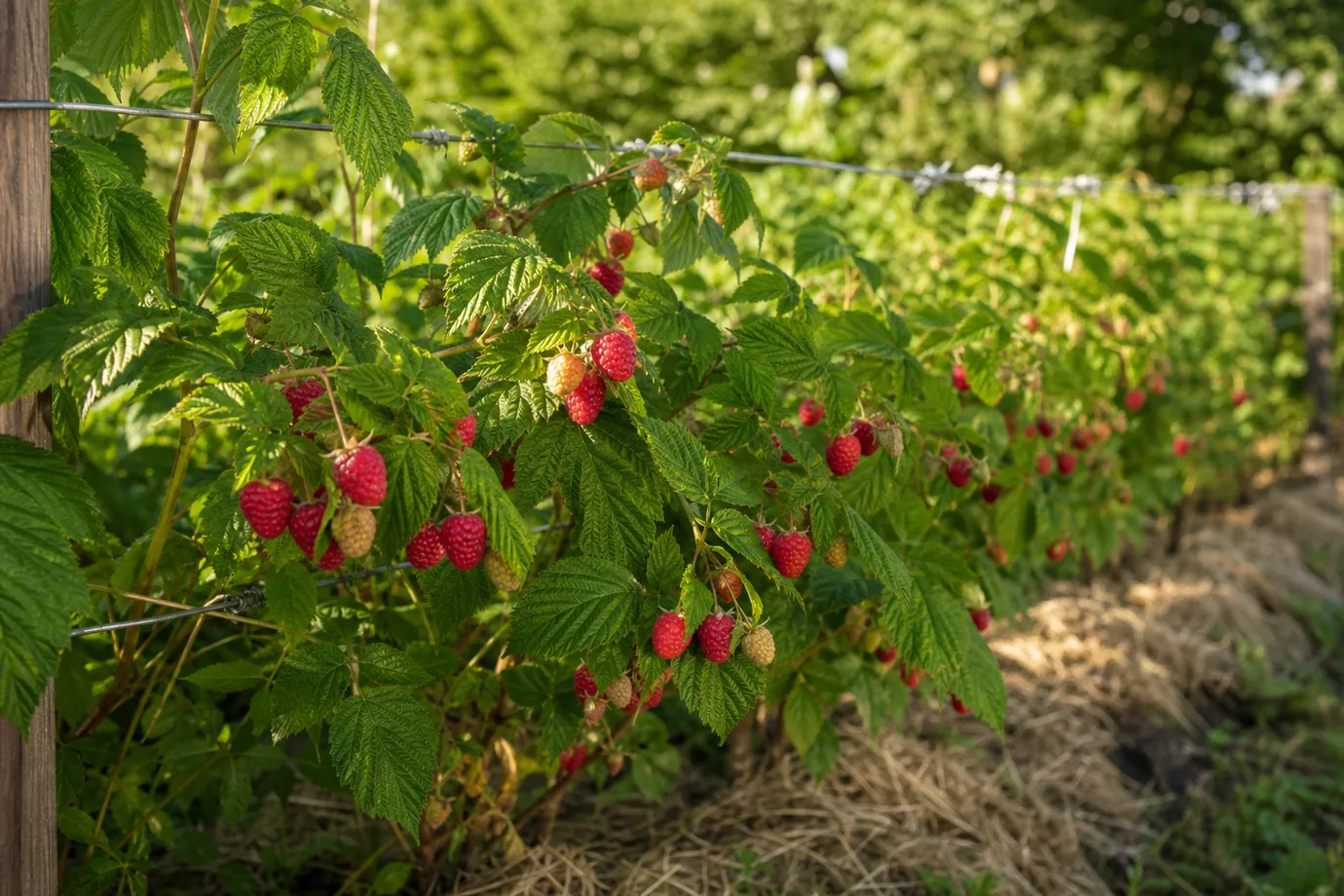
Raspberries are the fruit that makes the best case for growing your own. A ripe berry is so soft that it barely survives the trip from the cane to the kitchen, which is why the ones in the shop are picked early and taste of very little. Growing Raspberries at home is not difficult, but it rewards a few decisions made at the start: which type to plant, where to put the row, and how to keep the canes in order once they start spreading.
This guide follows those decisions in order. The figures come from University of Illinois Extension, whose guides to growing raspberries and pruning and training raspberries cover the essentials, and from Oregon State University Extension’s detailed Growing Raspberries in Your Home Garden.
Growing Raspberries at a Glance
- Sun: full sun.
- Soil: deep, well drained, rich in organic matter, pH 5.6 to 6.5.
- Planting: early spring, as soon as the soil can be worked.
- Spacing: about 2 to 3 feet between plants, 8 to 10 feet between rows.
- Water: 1 to 1.5 inches a week in the growing season.
- Lifespan: a red raspberry planting can last 10 to 15 years.
How a Raspberry Cane Works
Everything about pruning makes sense once you know one fact: raspberry roots and crowns are perennial, but each cane lives only two years. In its first year a cane is green and leafy, and it is called a primocane. Over winter it turns woody and becomes a floricane, which flowers, fruits and then dies. New primocanes come up from the roots every spring, so a healthy row always holds canes of two ages.
Summer-Bearing or Everbearing?
Summer-bearing raspberries, also called floricane-fruiting, crop once, on second-year canes, in early to mid summer. Oregon State reports yields of 18 to 27 pounds per 10 feet of row once the plants are mature, the highest of any type.
Everbearing raspberries, also called fall-bearing or primocane-fruiting, fruit at the tips of first-year canes from late summer into autumn, and can give a second, smaller crop lower on the same canes the following summer. Their great advantage is simplicity: you can mow the whole row down every winter and still get a crop, which also removes most of the pruning.
Black and purple raspberries are summer-bearing only, with their own growth habit and pruning rules, covered below. Yellow raspberries are red types without the red pigment, and they are grown the same way.
If you want one easy crop and have little time for pruning, choose everbearing. If you want the heaviest harvest and do not mind a yearly pruning session, choose summer-bearing. Planting a short row of each spreads the picking from early summer to the first frost.
Choosing the Site
Raspberries need full sun, and their roots, which Illinois Extension says can reach 4 feet deep, need soil that drains well. Wet soil is the most common reason a planting fails, because it invites root rot. Oregon State advises planting at least 2, and ideally 3, feet above the water table; on heavy or wet ground it recommends raised beds or mounded rows about 1 to 1.5 feet high. If you are unsure where the sun falls through the day, Garden Sun Map: Count the Hours, Not the Shadows shows how to check before you dig.
Site history matters too. Both Illinois and Oregon State advise against planting where tomatoes, potatoes, peppers, eggplant or strawberries have grown in the past five years, because those crops can leave verticillium wilt in the soil. Illinois Extension also recommends planting away from other brambles, including wild ones, to avoid viral diseases. Vegetable Crop Rotation: An Essential Guide for Soil Health Families explains how to keep track of what grew where.
Preparing the Soil
Oregon State puts the ideal pH at 5.6 to 6.5, and prefers soil with more than 3 percent organic matter. Test the soil the season before planting; Soil pH Testing: How to Take a Sample That Means Something explains how to take a sample the lab can use, and Soil pH Level: Testing and Balancing for Maximum Yield covers how to correct the result. Then work in compost or well-rotted organic matter along the whole row; Soil Amendments: Natural Methods for Rejuvenating Earth compares the options. Clear perennial weeds completely at this stage, because they are very hard to remove once the canes fill the row.
Planting Raspberries
Plant bare-root canes as early in spring as the soil can be worked. Oregon State sets them so that the highest point where the roots join the cane sits 1 to 2 inches below the soil, and then cuts the canes to about 6 inches. Illinois Extension plants red raspberries at their nursery depth and cuts them to 8 to 12 inches, while black and purple raspberries go about an inch deeper and are cut to ground level. Either way, the short stub is there to mark the plant; the real growth comes from new shoots from the roots.
Spacing depends on the type:
- Red and yellow raspberries: Illinois Extension sets plants 2 to 3 feet apart in the row, with 10 feet between rows. Oregon State uses 2 feet for everbearing and 2.5 feet for summer-bearing, with rows 8 to 10 feet apart. The plants fill in to form a hedgerow.
- Black raspberries: 3 to 4 feet apart in the row, with 10 to 12 feet between rows.
- Purple raspberries: 3 to 5 feet apart in the row, with 12 feet between rows.
The wide spacing between rows looks excessive at planting time, but it leaves room to walk, pick and prune once the canes are full size.
A Simple Trellis
Raspberries do not strictly need support, but a trellis keeps the canes upright, the fruit clean and the row easy to pick. Oregon State describes a two-wire system for summer-bearing red raspberries, with posts about 6 feet high and the top wires at 5.5 to 6 feet. For everbearing and black raspberries it uses a simple T-trellis, with a cross arm about 1.5 feet wide at knee height. Illinois Extension describes a larger T-trellis for fall-bearing red raspberries, with posts about 7 feet long, cross arms about 3 feet long and posts 25 to 30 feet apart. Purple raspberries do not need a trellis.
Watering and Mulching
Oregon State recommends 1 to 1.5 inches of water a week for established plants during the growing season, and Illinois Extension asks for 1 to 2 inches. Both favour drip irrigation, because it keeps the leaves and fruit dry and reduces fruit rot; Oregon State uses half-gallon emitters every 18 inches. Drip Tape Installation: DIY Micro-Irrigation for Efficient Veggie Gardens walks through the setup. At the same time, avoid overwatering in heavy soil, since standing water is what brings on root rot; Signs of Overwatering: Are You Loving Your Plants to Death? lists the warning signs.
A layer of organic mulch along the row keeps the soil moist and holds back weeds. Organic Garden Mulch: How Deep to Lay It and When to Wait covers the choice of material and depth.
Feeding Raspberries
Oregon State gives nitrogen rates by type. For established summer-bearing red raspberries, it applies 2 to 3 ounces of actual nitrogen per 10 feet of row each year, and 3 ounces for everbearing ones, split into two doses: the first in late March or early April, the second 1.5 to 2 months later. New plantings get a little less, split into three doses. These are figures for actual nitrogen, so check the percentage on the fertilizer bag and scale up accordingly. Pale older leaves can signal a shortage; Nutrient Deficiency in Plants: A Visual Guide to What Your Vegetables Are Telling You helps read the symptoms.
Pruning Raspberries, Type by Type
Pruning is what keeps a raspberry row productive, and it is simpler than it looks once you know the age of each cane.
Summer-Bearing Red Raspberries
After the harvest, cut the canes that fruited down to the ground. They are dying anyway, and removing them gives light and air to the new canes. In winter, Oregon State removes weak and damaged canes and tops the rest at about 6 to 6.5 feet. Illinois Extension then thins the remaining canes to 3 to 4 canes per square foot. Keep the hedgerow narrow: Oregon State aims for 6 to 12 inches wide for summer-bearing types, and removes any new canes that come up outside it.
Everbearing Raspberries
For one large autumn crop, the easiest method is to cut every cane to just above ground level in late winter; Oregon State does it in March, and Illinois Extension between December and February. New canes grow and fruit the same year. If you prefer two crops, leave the canes standing through winter, remove only the dead tips a couple of buds below the dead part, and keep the row 12 to 18 inches wide.
Black and Purple Raspberries
These grow in clumps rather than hedgerows, and they need summer pinching. Illinois Extension pinches the new canes of black raspberries in early summer at about 28 inches, removing about four inches of the tip, and Oregon State aims for a height of about 3 feet. This makes the canes branch, and the side branches carry the fruit. In winter, remove the dead canes that fruited and shorten the side branches to 1.5 to 2.5 feet.
Harvesting Raspberries
A ripe raspberry comes away from its white core with a gentle pull. If it resists, leave it another day. Oregon State recommends picking every three to four days in shallow containers, so that the weight of the fruit does not crush the berries underneath, and refrigerating them straight away. Pick in the morning when the berries are cool, and do not wash them until just before eating.
Birds will take ripe fruit quickly, and netting over the row is the most reliable protection; Animal Proof Vegetable Garden: Keeping Deer and Rabbits Out of Your Crops covers barriers for larger visitors too. Raspberry flowers are also a favourite of bees, and good pollination gives fuller, better-shaped berries; Pollinator Friendly Garden: Attracting Bees and Butterflies to Your Vegetables shows how to bring more of them in.
Common Problems
- Root rot: new canes wilt and die in midsummer, usually in wet, heavy soil. Improving drainage or moving the planting to a raised row is the answer.
- Verticillium wilt: fruiting canes collapse in late summer. Black raspberries are especially susceptible, and there is no cure, which is why the five-year rule on previous crops matters.
- Viruses: Oregon State notes that raspberry bushy dwarf virus causes crumbly fruit and that infected plants stay infected. Replace them with certified disease-free plants in a new spot.
- Fruit rot: grey mould spreads in wet weather at harvest time. Water at the base, pick often and remove rotting berries.
- Pests: Illinois Extension lists aphids, cane borers, Japanese beetles, sawflies and sap beetles. Aphid Control Methods: When to Spray and When to Wait and Beneficial Insects for Garden: Creating a Haven for Natural Predators cover gentle ways to keep them in check.
Frequently Asked Questions
How long does Growing Raspberries take before the first harvest?
Everbearing raspberries can give a small crop in autumn of the first year. Summer-bearing raspberries fruit on second-year canes, so the first real harvest comes the summer after planting.
Is Growing Raspberries possible in a small garden?
Yes. A short row of everbearing canes, cut to the ground each winter, fits along a fence and needs very little pruning.
Do raspberries spread?
Red and yellow raspberries send up new canes from their roots and will wander if left alone. Removing the canes that come up outside the row keeps them in place. Black and purple raspberries stay in clumps.
Are raspberries a good perennial crop?
Very good. Oregon State expects a red raspberry planting to last 10 to 15 years, and black raspberries five to ten. For other fruit to grow alongside them, see Growing Strawberries: Choosing a Type, Planting the Crown and Keeping a Bed for Years and Growing Blueberries: Acid Soil, Two Varieties and Patience for a Crop That Lasts Decades, and for the wider picture, Edible Perennials: Planting Once for Lifetime Harvests.
A Row That Keeps Giving
Choose the type that fits your time, plant in a sunny, well-drained row away from old tomato and potato beds, give the canes a simple wire to lean on, and cut out the old wood every year. That is most of what growing raspberries takes, and a single row planted this way can fill bowls every summer for a decade or more.
Check out the author’s book here: The Year-Round Vegetable Garden for Beginners.


Leave a Reply