
Most garden folklore about plant pairings collapses the moment somebody tests it properly. Trap cropping is the exception, because it has been measured in real fields and it works. Trap Crops are sacrificial plants grown to pull a specific pest off a specific crop, which is a much narrower promise than companion planting usually makes. That narrowness is exactly why the method survives contact with evidence.
This guide covers the mechanics rather than the romance of the idea. You will find the four conditions a decoy has to meet, the pest pairings with research behind them, and the planting numbers from a Utah State trial. Trap Crops only pay off when you manage them, so the hardest section here is the one about killing what you attracted.
Trap Crops at a Glance
| What it is | A sacrificial planting that pulls one named pest off one named crop |
| Best proven pair | Blue Hubbard squash against squash bugs and striped cucumber beetles |
| Timing | Sown two weeks before the crop you want protected |
| Placement | Row ends, garden corners, or a full perimeter around the bed |
| Rough ratio | Roughly one decoy plant for every two or three protected plants |
| The rule | Treat or destroy the pests on the decoy, or it becomes a nursery |
| Checking | Twice weekly, looking at leaf undersides for egg clusters |
| Not a cure | One layer inside a whole pest plan, never the plan itself |
What Makes Trap Crops Actually Work
A decoy works chemically, not decoratively. Blue Hubbard squash carries high concentrations of cucurbitacin, the compound that striped cucumber beetles hunt for, which Penn State explains in its notes on deterring striped cucumber beetles. The insect is not being fooled at all. It is choosing the strongest signal available, and you simply made sure the strongest signal was standing somewhere convenient.
The Four Conditions
- More attractive than the crop. The decoy must beat your vegetables on the pest’s own terms, not merely resemble them.
- Ahead in growth. A seedling decoy beside a mature crop attracts nothing, so it needs a head start.
- Positioned between. Pests arrive from somewhere, usually a field edge or last year’s bed, and the decoy belongs in that path.
- Actively managed. Concentrating pests only helps if you then remove them.
Miss any one of those and the planting fails quietly. That is why so many gardeners conclude the whole idea is a myth.
Where the Evidence Is Strongest
Illinois Extension is refreshingly blunt about this field in its piece on companion planting. Little research exists at garden scale, and much of what circulates rests on anecdote rather than trials. The same article singles out trap cropping as a real mechanism, with blue Hubbard squash named as the working example. Treat the cucurbit pairings as solid and everything else as worth testing yourself.
Trap Crops for Squash Bugs and Cucumber Beetles
This is the pairing with numbers attached, so it deserves the most space. Squash bugs overwinter as adults under debris and produce one generation per year. That single generation is the whole opportunity, because catching it early decides the season.
The Blue Hubbard Numbers
Utah State University ran the trial and published the details in its report on trap crops to control squash bugs. Ten Hubbard plants protected twenty-five pumpkins in five rows, with the decoys set at the ends of each row. The Hubbards went in during the last week of May, two weeks before the pumpkins. Plots with the decoy carried significantly fewer adults, nymphs and eggs on the pumpkins themselves.
The lifecycle explains the timing. Penn State notes in its guide to insect pests affecting squash plants that squash bug eggs hatch in one to two weeks. Nymphs then pass through five stages over four to six weeks before maturing. Your entire window sits inside that first month, which is why the decoy must be up and feeding early.
Managing the Trap Before It Backfires
Utah State is explicit that a trap crop only works if you treat the pest on it. In a home garden that means hand-picking adults and nymphs into soapy water twice a week. Egg clusters are bronze to red and sit on leaf undersides, and a strip of duct tape lifts them off cleanly. Laying a board flat on the soil overnight gives you a second count, since the bugs gather underneath it by morning.
Trap Crops for Aphids
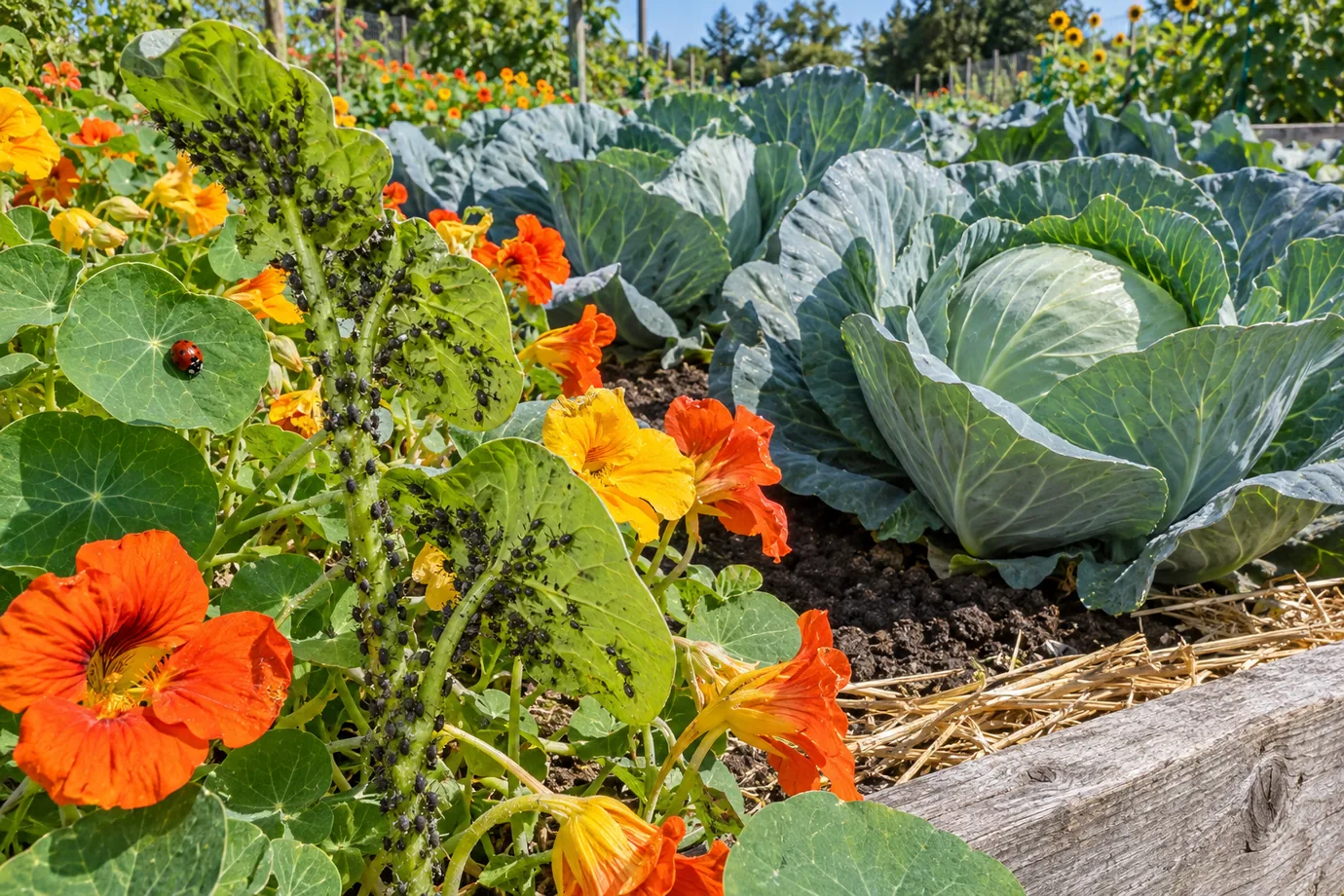
Nasturtium is the classic aphid decoy, and black bean aphids do prefer it to beans and brassicas. Plant it along the windward edge of the bed and let the colonies build up on the stems. Then cut the infested growth off and bag it, rather than shaking it into the compost. The technique sits alongside everything in Aphid Control Methods: When to Spray and When to Wait, and it feeds the predators described in Beneficial Insects for Garden: Creating a Haven for Natural Predators.
A modest aphid population on the decoy is not a failure. Ladybird and hoverfly larvae need prey before they will stay, so an aphid-free garden supports no predators at all. The nasturtium becomes a nursery for the good side as well. Both flowers and leaves are worth eating too, which Edible Flowers: Adding Color and Flavor to Your Plot covers in detail.
Trap Crops for Flea Beetles and Brassica Pests
Flea beetles hit eggplant, corn and the cabbage family hardest, and the University of Maryland describes the damage in its page on flea beetles in vegetables. Adults measure a tenth of an inch and chew a distinctive shot-hole pattern into foliage. Seedlings suffer most, since a hundred tiny holes on a small plant is a serious loss of leaf area.
Fast radish and spicy mustard make the usual decoys here, sown along the bed edge before the transplants go out. Harvest or pull the radishes before the beetles finish with them and move inward. The same pests are the reason for the barriers in Floating Row Covers: Protecting Brassicas from Pests and Frost, and your main crop schedule comes from Growing Brassicas: Cultivating Broccoli and Its Relatives in Your Backyard.
Placement: Perimeter, Rows and Clusters
Where the decoy stands matters as much as what it is. Three arrangements cover almost every garden, and each suits a different kind of pest movement.
Perimeter Planting
A continuous ring of decoys around the bed intercepts pests arriving from outside. Penn State reports that growers plant Blue Hubbard completely around the cucurbit crop they want protected. This is the strongest option for beetles that fly in from field margins. It also costs the most space, so it suits larger plots.
Row Ends and Corners
The Utah State trial used row ends rather than a full ring, with ten plants covering twenty-five. That is the practical compromise for a home garden that cannot spare a whole border. Corners work on the same logic and catch pests following scent trails inward. Sketch the positions before you sow, using the approach in Vegetable Garden Layout Ideas for Beginners.
Interplanting Within the Rows
Alternating decoys with vegetables suits highly mobile pests that hop from plant to plant. The drawback is obvious, because a pest colony now sits in the middle of your crop. Reserve this pattern for decoys you intend to pull early, and plan the spacing carefully. Tight beds make it harder still, as Intensive Gardening: Planning for High Yields in Small Plots explains.
Timing: Two Weeks Ahead of the Main Crop
Every successful trial starts the decoy early, and two weeks is the working figure. The Hubbards in Utah went in during the last week of May and the pumpkins followed in early June. Overwintered adults emerge in May and settle on whatever is largest and most fragrant. Give them the decoy at that moment and they never survey your rows.
Sow the decoy indoors if your season is short, then transplant it on schedule. Build the offset straight into your calendar rather than improvising in spring, and Planting Schedule: A Year-Round Guide for Every Season gives the framework. The tasks fit neatly into the Spring Garden Preparation Checklist: In the Order the Soil Allows as well.
Why Some Trap Crops Fail
Four failures account for nearly every disappointing result, and all of them are avoidable.
- The decoy was too small. Pests ignored it and went straight to the crop.
- Nobody treated it. The colony bred, outgrew the plant and spilled over.
- It stood in the wrong place. Pests reached the vegetables before reaching the decoy.
- The pest was not the one targeted. Nasturtium does nothing whatever about squash bugs.
Keep notes on which pest arrived when, because the pairing has to match your garden. A season of records beats any general recommendation, and Garden Journal Template: The Four Columns That Survive June makes that easy.
Trap Crops and the Rest of Your Pest Plan
Decoys are one layer, and a thin one on their own. They belong inside the framework set out in Organic Pest Management: Eco-Friendly Solutions for the Vegetable Garden, alongside scouting, barriers, predators and sanitation. Which vegetables sit next to which is a separate question, answered in Vegetable Companion Planting Chart: Boost Growth and Repel Pests.
Aromatic herbs work by masking scent rather than by attraction, so they complement decoys instead of duplicating them. That mechanism is the subject of Herb Companion Planting: Maximizing Vegetable Growth and Repelling Pests. Moving crops each year breaks the overwintering cycle that feeds next spring’s invasion, which is the whole argument of Vegetable Crop Rotation: An Essential Guide for Soil Health Families.
A Season with Trap Crops
- Late winter. Order Blue Hubbard, nasturtium, radish and mustard seed together with the main crop.
- Early spring. Sow radish and mustard along brassica beds two weeks before transplanting.
- Mid spring. Start Hubbard squash indoors, or direct sow it a fortnight ahead of your pumpkins.
Once the decoys are up the work becomes routine rather than seasonal, and it never stops entirely.
- Early summer. Check twice weekly, hand-pick adults and tape off the egg clusters.
- Midsummer. Pull heavily infested decoys and bag them, then sow replacements.
- Autumn. Clear every decoy and all debris, since squash bugs overwinter underneath it.
Fresh decoys every three weeks keep the lure attractive all summer, which is ordinary Succession Planting: A Guide to Continuous Harvests applied to a different purpose.
Frequently Asked Questions
Do Trap Crops attract more pests into my garden?
This is the commonest objection, and the trial data answers it. Utah State counted significantly fewer pests on protected pumpkins than on unprotected ones. Decoys concentrate the insects already heading your way rather than summoning distant ones. The risk only appears when you leave the colony to breed undisturbed.
How much space should Trap Crops take?
Less than most gardeners fear, judging by the published trials. Ten Hubbard plants covered twenty-five pumpkins in Utah, which is roughly one decoy per two or three protected plants. Radish and mustard need only a narrow edging strip. Even a tight plot can spare that much, as Vegetable Gardening on a Budget: Saving Money on Seeds and Soil points out.
Can I eat the trap crop?
Sometimes, although you should not plan on it. Radish and mustard stay perfectly edible if you harvest them before the damage becomes serious. Blue Hubbard squash is good eating, but a plant carrying squash bugs all season rarely produces much. Never eat a decoy you have sprayed, whatever the product was.
Do I have to spray the trap crop?
No, and in a home garden you usually should not. Hand-picking into soapy water twice a week handles the numbers on ten plants easily. Duct tape removes egg clusters faster than scraping them off by hand. Spraying is a commercial answer to a commercial scale.
Which Trap Crops work best for beginners?
Start with Blue Hubbard squash beside your zucchini, since that pairing has actual research behind it. Nasturtium against aphids comes second and costs almost nothing to try. Add radish along the brassica edge in spring. The zucchini side of that first experiment is covered in Growing Zucchini: Spacing, Pollination, and Picking Before They Turn Into Clubs.
The Decoy That Earns Its Bed
Trap cropping asks you to give up a little ground on purpose, which feels wrong until it works. The payoff is that pest pressure becomes visible and local instead of diffuse. You stop patrolling the whole garden and start checking ten known plants. That is a smaller job and a far more accurate one.
Begin with a single proven pairing this season and record what happens. Sow the decoy two weeks early, place it between the pest and the crop, and kill what lands on it. Everything else in the system, from soil to predators, works better once that pressure drops, which is the argument running through Permaculture Design: Principles for a Sustainable Ecosystem. One sacrificed plant can protect an entire bed.
Check out the author’s book here: The Year-Round Vegetable Garden for Beginners.


Leave a Reply